Q9XH75
Gene name |
TATB (HCF106, At5g52440, K24M7.19) |
Protein name |
Sec-independent protein translocase protein TATB, chloroplastic |
Names |
Protein HIGH CHLOROPHYLL FLUORESCENCE 106, Protein TWIN-ARGININE TRANSLOCATION B |
Species |
Arabidopsis thaliana (Mouse-ear cress) |
KEGG Pathway |
ath:AT5G52440 |
EC number |
|
Protein Class |
|
Descriptions
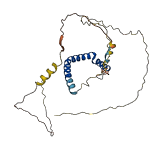
The autoinhibited protein was predicted that may have potential autoinhibitory elements via cis-regPred.
Autoinhibitory domains (AIDs)
Target domain |
|
Relief mechanism |
|
Assay |
cis-regPred |
Accessory elements
No accessory elements
Autoinhibited structure

Activated structure
1 structures for Q9XH75
| Entry ID | Method | Resolution | Chain | Position | Source |
|---|---|---|---|---|---|
| AF-Q9XH75-F1 | Predicted | AlphaFoldDB |
26 variants for Q9XH75
| Variant ID(s) | Position | Change | Description | Diseaes Association | Provenance |
|---|---|---|---|---|---|
| ENSVATH14628056 | 4 | A>G | No | 1000Genomes | |
| ENSVATH14628056 | 4 | A>V | No | 1000Genomes | |
| ENSVATH03414457 | 5 | L>F | No | 1000Genomes | |
| ENSVATH12718305 | 13 | S>P | No | 1000Genomes | |
| ENSVATH03414458 | 18 | T>A | No | 1000Genomes | |
| ENSVATH03414459 | 35 | S>L | No | 1000Genomes | |
| tmp_5_21287043_C_T | 50 | R>C | No | 1000Genomes | |
| ENSVATH07401734 | 53 | P>L | No | 1000Genomes | |
| tmp_5_21287070_C_G | 59 | H>D | No | 1000Genomes | |
| ENSVATH00729301 | 62 | I>F | No | 1000Genomes | |
| tmp_5_21287103_A_C | 70 | N>H | No | 1000Genomes | |
| tmp_5_21287221_G_T | 79 | S>I | No | 1000Genomes | |
| ENSVATH07401737 | 117 | L>I | No | 1000Genomes | |
| ENSVATH07401741 | 154 | P>L | No | 1000Genomes | |
| tmp_5_21287954_C_T | 174 | P>L | No | 1000Genomes | |
| tmp_5_21287959_G_A | 176 | V>I | No | 1000Genomes | |
| ENSVATH03414486 | 187 | D>N | No | 1000Genomes | |
| ENSVATH00729321 | 205 | F>I | No | 1000Genomes | |
| ENSVATH00729323 | 216 | A>V | No | 1000Genomes | |
| tmp_5_21288430_A_T | 226 | T>S | No | 1000Genomes | |
| ENSVATH03414501 | 229 | P>L | No | 1000Genomes | |
| ENSVATH07401743 | 232 | P>S | No | 1000Genomes | |
| tmp_5_21288569_A_C | 247 | T>P | No | 1000Genomes | |
| tmp_5_21288572_G_C | 248 | A>P | No | 1000Genomes | |
| ENSVATH12718355 | 253 | A>S | No | 1000Genomes | |
| ENSVATH00729324 | 254 | A>V | No | 1000Genomes |
No associated diseases with Q9XH75
No regional properties for Q9XH75
| Type | Name | Position | InterPro Accession |
|---|---|---|---|
| No domain, repeats, and functional sites for Q9XH75 | |||
8 GO annotations of cellular component
| Name | Definition |
|---|---|
| chloroplast | A chlorophyll-containing plastid with thylakoids organized into grana and frets, or stroma thylakoids, and embedded in a stroma. |
| chloroplast envelope | The double lipid bilayer enclosing the chloroplast and separating its contents from the rest of the cytoplasm; includes the intermembrane space. |
| chloroplast thylakoid | Sac-like membranous structures (cisternae) in a chloroplast combined into stacks (grana) and present singly in the stroma (stroma thylakoids or frets) as interconnections between grana. An example of this component is found in Arabidopsis thaliana. |
| chloroplast thylakoid membrane | The pigmented membrane of a chloroplast thylakoid. An example of this component is found in Arabidopsis thaliana. |
| integral component of membrane | The component of a membrane consisting of the gene products and protein complexes having at least some part of their peptide sequence embedded in the hydrophobic region of the membrane. |
| plastid | Any member of a family of organelles found in the cytoplasm of plants and some protists, which are membrane-bounded and contain DNA. Plant plastids develop from a common type, the proplastid. |
| TAT protein transport complex | A complex of three proteins integral to the cytoplasmic membrane of bacteria and membranes of organelles derived from bacteria (chloroplasts and mitochondria) involved in membrane transport of folded proteins. |
| thylakoid | A membranous cellular structure that bears the photosynthetic pigments in plants, algae, and cyanobacteria. In cyanobacteria thylakoids are of various shapes and are attached to, or continuous with, the plasma membrane. In eukaryotes they are flattened, membrane-bounded disk-like structures located in the chloroplasts; in the chloroplasts of higher plants the thylakoids form dense stacks called grana. Isolated thylakoid preparations can carry out photosynthetic electron transport and the associated phosphorylation. |
1 GO annotations of molecular function
| Name | Definition |
|---|---|
| proton motive force dependent protein transmembrane transporter activity | Catalysis of the transfer of proteins from one side of a membrane to the other. Transportation is dependent on pH gradient across the membrane. |
6 GO annotations of biological process
| Name | Definition |
|---|---|
| positive regulation of stomatal opening | Any process that activates or increases the frequency, rate or extent of stomatal opening. |
| protein import into chloroplast thylakoid membrane | The import of proteins into the chloroplast thylakoid membranes. Proteins that are destined for the thylakoid lumen require two uptake-targeting sequences: the first targets the protein to the stroma, and the second targets the protein from the stroma to the thylakoid lumen. Four separate thylakoid-import systems deal with the proteins once they are in the stroma. |
| protein transport by the Tat complex | The process in which folded proteins are transported across cytoplasmic membranes of bacteria and membranes of organelles derived from bacteria (chloroplasts and mitochondria) by the TAT complex. |
| regulation of reactive oxygen species biosynthetic process | Any process that modulates the frequency, rate or extent of reactive oxygen species biosynthetic process. |
| regulation of response to water deprivation | Any process that modulates the frequency, rate or extent of response to water deprivation. |
| response to cold | Any process that results in a change in state or activity of a cell or an organism (in terms of movement, secretion, enzyme production, gene expression, etc.) as a result of a cold stimulus, a temperature stimulus below the optimal temperature for that organism. |
No homologous proteins in AiPD
| UniProt AC | Gene Name | Protein Name | Species | Evidence Code |
|---|---|---|---|---|
| No homologous proteins | ||||
| 10 | 20 | 30 | 40 | 50 | 60 |
| MAMALQIIAS | SSSSPTITKS | HLFSYPPLQS | RYKASKPNLS | SWFSLLGSSR | FSPYIGLKHL |
| 70 | 80 | 90 | 100 | 110 | 120 |
| GISISPKSSN | PEKKRRCKSM | MIRASLFGVG | APEALVIGVV | ALLVFGPKGL | AEVARNLGKT |
| 130 | 140 | 150 | 160 | 170 | 180 |
| LRTFQPTIRE | LQDVSRDFKS | TLEREIGLDD | ISTPNVYNQN | RTNPVQPPPP | PPPPSVPSTE |
| 190 | 200 | 210 | 220 | 230 | 240 |
| APVTANDPND | SQSPKAYTSE | DYLKFTEEQL | KALSPAESQT | EDQTQTQEPP | QPTTVQTPTG |
| 250 | |||||
| ESQPNGTARE | TTAASPPRQD |