Q9X9J3
Gene name |
flgJ (VP0784) |
Protein name |
Peptidoglycan hydrolase FlgJ |
Names |
Muramidase FlgJ |
Species |
Vibrio parahaemolyticus serotype O3:K6 (strain RIMD 2210633) |
KEGG Pathway |
vpa:VP0784 |
EC number |
|
Protein Class |
|
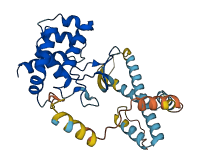
Descriptions
The autoinhibited protein was predicted that may have potential autoinhibitory elements via cis-regPred.
Autoinhibitory domains (AIDs)
Target domain |
|
Relief mechanism |
|
Assay |
cis-regPred |
Accessory elements
No accessory elements
Autoinhibited structure

Activated structure
1 structures for Q9X9J3
| Entry ID | Method | Resolution | Chain | Position | Source |
|---|---|---|---|---|---|
| AF-Q9X9J3-F1 | Predicted | AlphaFoldDB |
No variants for Q9X9J3
| Variant ID(s) | Position | Change | Description | Diseaes Association | Provenance |
|---|---|---|---|---|---|
| No variants for Q9X9J3 | |||||
No associated diseases with Q9X9J3
1 GO annotations of cellular component
| Name | Definition |
|---|---|
| periplasmic space | The region between the inner (cytoplasmic) and outer membrane (Gram-negative Bacteria) or cytoplasmic membrane and cell wall (Fungi and Gram-positive Bacteria). |
2 GO annotations of molecular function
| Name | Definition |
|---|---|
| amidase activity | Catalysis of the reaction: a monocarboxylic acid amide + H2O = a monocarboxylate + NH3. |
| hydrolase activity, acting on glycosyl bonds | Catalysis of the hydrolysis of any glycosyl bond. |
3 GO annotations of biological process
| Name | Definition |
|---|---|
| bacterial-type flagellum assembly | The assembly of a bacterial-type flagellum, a motor complex composed of an extracellular helical protein filament coupled to a rotary motor embedded in the cell envelope which functions in cell motility. |
| cell wall organization | A process that results in the assembly, arrangement of constituent parts, or disassembly of the cell wall, the rigid or semi-rigid envelope lying outside the cell membrane of plant, fungal and most prokaryotic cells, maintaining their shape and protecting them from osmotic lysis. |
| metabolic process | The chemical reactions and pathways, including anabolism and catabolism, by which living organisms transform chemical substances. Metabolic processes typically transform small molecules, but also include macromolecular processes such as DNA repair and replication, and protein synthesis and degradation. |
No homologous proteins in AiPD
| UniProt AC | Gene Name | Protein Name | Species | Evidence Code |
|---|---|---|---|---|
| No homologous proteins | ||||
| 10 | 20 | 30 | 40 | 50 | 60 |
| MMKNPNDIGF | IHDISSLDSL | RQKAVKEGKD | GEQEALHAAA | RQFESIFTSM | MLKSMREANE |
| 70 | 80 | 90 | 100 | 110 | 120 |
| GFESNIMNSQ | NEKFYRQMLD | EQMASELSAN | GSMGLADMIV | AQLTAGQGND | KSETAMRDAA |
| 130 | 140 | 150 | 160 | 170 | 180 |
| NSAVEYRRVD | PKKAREIEKR | LIESGELSRT | SHTPAKFDSP | ESFVNSMKPY | AEKAAKALGV |
| 190 | 200 | 210 | 220 | 230 | 240 |
| EPSLLLAQAA | LETGWGQKVV | QNARGSSNNL | FNIKADRSWQ | GDKVTTQTLE | FHDNTPVKET |
| 250 | 260 | 270 | 280 | 290 | 300 |
| AAFRSYSNYQ | DSFNDYVRFL | NDNPRYETAL | QQRGDSESFI | RGIHRAGYAT | DPTYADKVLQ |
| VKQKIESM |