Q9WYC5
Gene name |
pfp |
Protein name |
Pyrophosphate--fructose 6-phosphate 1-phosphotransferase |
Names |
6-phosphofructokinase, pyrophosphate dependent, PPi-dependent phosphofructokinase, PPi-PFK, Pyrophosphate-dependent 6-phosphofructose-1-kinase |
Species |
Thermotoga maritima (strain ATCC 43589 / DSM 3109 / JCM 10099 / NBRC 100826 / MSB8) |
KEGG Pathway |
tmw:THMA_0296 |
EC number |
2.7.1.90: Phosphotransferases with an alcohol group as acceptor |
Protein Class |
|
Descriptions
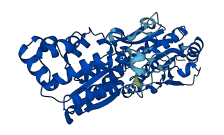
The autoinhibited protein was predicted that may have potential autoinhibitory elements via cis-regPred.
Autoinhibitory domains (AIDs)
Target domain |
|
Relief mechanism |
|
Assay |
cis-regPred |
Accessory elements
No accessory elements
Autoinhibited structure

Activated structure
1 structures for Q9WYC5
| Entry ID | Method | Resolution | Chain | Position | Source |
|---|---|---|---|---|---|
| AF-Q9WYC5-F1 | Predicted | AlphaFoldDB |
No variants for Q9WYC5
| Variant ID(s) | Position | Change | Description | Diseaes Association | Provenance |
|---|---|---|---|---|---|
| No variants for Q9WYC5 | |||||
No associated diseases with Q9WYC5
4 regional properties for Q9WYC5
| Type | Name | Position | InterPro Accession |
|---|---|---|---|
| conserved_site | Phosphoglucose isomerase, conserved site | 260 - 273 | IPR018189-1 |
| conserved_site | Phosphoglucose isomerase, conserved site | 486 - 503 | IPR018189-2 |
| domain | Phosphoglucose isomerase, SIS domain 1 | 116 - 279 | IPR035476 |
| domain | Phosphoglucose isomerase, SIS domain 2 | 326 - 507 | IPR035482 |
Functions
| Description | ||
|---|---|---|
| EC Number | 2.7.1.90 | Phosphotransferases with an alcohol group as acceptor |
| Subcellular Localization |
|
|
| PANTHER Family | ||
| PANTHER Subfamily | ||
| PANTHER Protein Class | ||
| PANTHER Pathway Category | No pathway information available | |
1 GO annotations of cellular component
| Name | Definition |
|---|---|
| cytoplasm | The contents of a cell excluding the plasma membrane and nucleus, but including other subcellular structures. |
4 GO annotations of molecular function
| Name | Definition |
|---|---|
| 6-phosphofructokinase activity | Catalysis of the reaction: ATP + D-fructose-6-phosphate = ADP + D-fructose 1,6-bisphosphate. |
| diphosphate-fructose-6-phosphate 1-phosphotransferase activity | Catalysis of the reaction: fructose-6-phosphate + diphosphate = phosphate + fructose-1,6-bisphosphate. |
| metal ion binding | Binding to a metal ion. |
| phosphofructokinase activity | Catalysis of the transfer of a phosphate group, usually from ATP, to a phosphofructose substrate molecule. |
2 GO annotations of biological process
| Name | Definition |
|---|---|
| fructose 6-phosphate metabolic process | The chemical reactions and pathways involving fructose 6-phosphate, also known as F6P. The D-enantiomer is an important intermediate in glycolysis, gluconeogenesis, and fructose metabolism. |
| response to glucose | Any process that results in a change in state or activity of a cell or an organism (in terms of movement, secretion, enzyme production, gene expression, etc.) as a result of a glucose stimulus. |
No homologous proteins in AiPD
| UniProt AC | Gene Name | Protein Name | Species | Evidence Code |
|---|---|---|---|---|
| No homologous proteins | ||||
| 10 | 20 | 30 | 40 | 50 | 60 |
| MAERLGILVG | GGPAPGINSV | ISSVTIEAIN | NGLEVIGIYD | GFKHLVEGKT | NMVKKLSIED |
| 70 | 80 | 90 | 100 | 110 | 120 |
| VSRIHIEGGS | ILRTSRVNPA | KSEETLEKTV | QTLKKLGIKY | LVTIGGDDTA | FSASKVCERS |
| 130 | 140 | 150 | 160 | 170 | 180 |
| KGEIKVVHVP | KTIDNDLPLP | ENMPTFGFET | ARHVATELVY | NLMQDSRTTN | RWYFVAMMGR |
| 190 | 200 | 210 | 220 | 230 | 240 |
| EAGHLALGVG | KAASATITII | PEEFKEGVTL | EEVCDVLDGA | ILKRKLMGRD | DGVAVIGEGI |
| 250 | 260 | 270 | 280 | 290 | 300 |
| AEKMDPEELA | NIPGVIVEKD | PHGHLRLAEI | PLATILKRAI | ERRYAERGER | IHIVDVTIGY |
| 310 | 320 | 330 | 340 | 350 | 360 |
| ELRSARPIPF | DIVYTRTLGY | GAVRFLLGDY | SDLPGGMVCV | VGGRIKILPF | DAFMDPKTGR |
| 370 | 380 | 390 | 400 | 410 | |
| TKVRVVDVRS | EDYRVARKYM | IRLEKKDLED | PETLEKLAKL | AKMEPEEFKK | KYWHTTELP |