Q9WVM1
Gene name |
Racgap1 |
Protein name |
Rac GTPase-activating protein 1 |
Names |
Male germ cell RacGap, MgcRacGAP |
Species |
Mus musculus (Mouse) |
KEGG Pathway |
mmu:26934 |
EC number |
|
Protein Class |
|
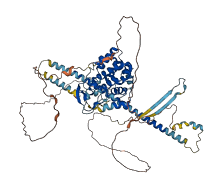
Descriptions
The autoinhibited protein was predicted that may have potential autoinhibitory elements via cis-regPred.
Autoinhibitory domains (AIDs)
Target domain |
|
Relief mechanism |
|
Assay |
cis-regPred |
Accessory elements
No accessory elements
Autoinhibited structure

Activated structure
1 structures for Q9WVM1
| Entry ID | Method | Resolution | Chain | Position | Source |
|---|---|---|---|---|---|
| AF-Q9WVM1-F1 | Predicted | AlphaFoldDB |
20 variants for Q9WVM1
| Variant ID(s) | Position | Change | Description | Diseaes Association | Provenance |
|---|---|---|---|---|---|
| rs3389368746 | 5 | M>V | No | EVA | |
| rs240266557 | 10 | T>A | No | EVA | |
| rs216179734 | 23 | N>S | No | EVA | |
| rs3406602952 | 29 | I>N | No | EVA | |
| rs3404923332 | 32 | I>N | No | EVA | |
| rs3389389772 | 259 | D>E | No | EVA | |
| rs3389339928 | 282 | T>I | No | EVA | |
| rs235651788 | 351 | M>V | No | EVA | |
| rs3389368790 | 373 | E>D | No | EVA | |
| rs3389400219 | 428 | R>H | No | EVA | |
| rs3389386204 | 492 | M>I | No | EVA | |
| rs3405978621 | 511 | P>A | No | EVA | |
| rs3406398647 | 543 | F>Y | No | EVA | |
| rs3410377129 | 570 | S>DG* | No | EVA | |
| rs3406398645 | 592 | S>L | No | EVA | |
| rs3406398599 | 593 | Q>E | No | EVA | |
| rs3389389834 | 597 | N>H | No | EVA | |
| rs3389359793 | 613 | T>S | No | EVA | |
| rs3389395886 | 620 | K>N | No | EVA | |
| rs3389307112 | 629 | K>Y | No | EVA |
No associated diseases with Q9WVM1
Functions
11 GO annotations of cellular component
| Name | Definition |
|---|---|
| acrosomal vesicle | A structure in the head of a spermatozoon that contains acid hydrolases, and is concerned with the breakdown of the outer membrane of the ovum during fertilization. It lies just beneath the plasma membrane and is derived from the lysosome. |
| centralspindlin complex | A heterotetrameric protein complex playing a key role in the formation of the central spindle in mitosis. Made up of two molecules each of a mitotic kinesin (ZEN-4 in Caenorhabditis elegans or MKLP1 in mammals) and of two molecules each of a GTPase activating protein (GAP) factor (CYK-4 in Caenorhabditis elegans or MgcRacGAP in mammals). |
| cleavage furrow | The cleavage furrow is a plasma membrane invagination at the cell division site. The cleavage furrow begins as a shallow groove and eventually deepens to divide the cytoplasm. |
| extrinsic component of cytoplasmic side of plasma membrane | The component of a plasma membrane consisting of gene products and protein complexes that are loosely bound to its cytoplasmic surface, but not integrated into the hydrophobic region. |
| Flemming body | A cell part that is the central region of the midbody characterized by a gap in alpha-tubulin staining. It is a dense structure of antiparallel microtubules from the central spindle in the middle of the intercellular bridge. |
| midbody | A thin cytoplasmic bridge formed between daughter cells at the end of cytokinesis. The midbody forms where the contractile ring constricts, and may persist for some time before finally breaking to complete cytokinesis. |
| mitotic spindle | A spindle that forms as part of mitosis. Mitotic and meiotic spindles contain distinctive complements of proteins associated with microtubules. |
| nucleoplasm | That part of the nuclear content other than the chromosomes or the nucleolus. |
| nucleus | A membrane-bounded organelle of eukaryotic cells in which chromosomes are housed and replicated. In most cells, the nucleus contains all of the cell's chromosomes except the organellar chromosomes, and is the site of RNA synthesis and processing. In some species, or in specialized cell types, RNA metabolism or DNA replication may be absent. |
| spindle | The array of microtubules and associated molecules that forms between opposite poles of a eukaryotic cell during mitosis or meiosis and serves to move the duplicated chromosomes apart. |
| spindle midzone | The area in the center of the spindle where the spindle microtubules from opposite poles overlap. |
8 GO annotations of molecular function
| Name | Definition |
|---|---|
| alpha-tubulin binding | Binding to the microtubule constituent protein alpha-tubulin. |
| beta-tubulin binding | Binding to the microtubule constituent protein beta-tubulin. |
| gamma-tubulin binding | Binding to the microtubule constituent protein gamma-tubulin. |
| GTPase activator activity | Binds to and increases the activity of a GTPase, an enzyme that catalyzes the hydrolysis of GTP. |
| metal ion binding | Binding to a metal ion. |
| microtubule binding | Binding to a microtubule, a filament composed of tubulin monomers. |
| phosphatidylinositol-3,4,5-trisphosphate binding | Binding to phosphatidylinositol-3,4,5-trisphosphate, a derivative of phosphatidylinositol in which the inositol ring is phosphorylated at the 3', 4' and 5' positions. |
| protein kinase binding | Binding to a protein kinase, any enzyme that catalyzes the transfer of a phosphate group, usually from ATP, to a protein substrate. |
10 GO annotations of biological process
| Name | Definition |
|---|---|
| actomyosin contractile ring assembly | The process of assembly of a ring composed of actin, myosin, and associated proteins that will function in cytokinesis. |
| mitotic cytokinesis | A cell cycle process that results in the division of the cytoplasm of a cell after mitosis, resulting in the separation of the original cell into two daughter cells. |
| mitotic spindle midzone assembly | The cell cycle process in which the aggregation, arrangement and bonding together of a set of components forms the spindle midzone. |
| neuroblast proliferation | The expansion of a neuroblast population by cell division. A neuroblast is any cell that will divide and give rise to a neuron. |
| positive regulation of cytokinesis | Any process that activates or increases the frequency, rate or extent of the division of the cytoplasm of a cell, and its separation into two daughter cells. |
| regulation of attachment of spindle microtubules to kinetochore | Any process that modulates the frequency, rate or extent of the attachment of spindle microtubules to the kinetochore. |
| regulation of embryonic development | Any process that modulates the frequency, rate or extent of embryonic development. |
| Rho protein signal transduction | The series of molecular signals within the cell that are mediated by a member of the Rho family of proteins switching to a GTP-bound active state. |
| spermatogenesis | The developmental process by which male germ line stem cells self renew or give rise to successive cell types resulting in the development of a spermatozoa. |
| sulfate transport | The directed movement of sulfate into, out of or within a cell, or between cells, by means of some agent such as a transporter or pore. |
1 homologous proteins in AiPD
| UniProt AC | Gene Name | Protein Name | Species | Evidence Code |
|---|---|---|---|---|
| Q9H0H5 | RACGAP1 | Rac GTPase-activating protein 1 | Homo sapiens (Human) | PR |
| 10 | 20 | 30 | 40 | 50 | 60 |
| MDTTMVNLWT | LFEQLVRRME | IINEGNESIE | FIQVVKDFED | FRKKYQRTNQ | ELEKFKDLLL |
| 70 | 80 | 90 | 100 | 110 | 120 |
| KAETGRSALD | VKLKHARNQV | DVEIKRRQRA | EAECAKLEQQ | IQLIRDILMC | DTSGSIQLSE |
| 130 | 140 | 150 | 160 | 170 | 180 |
| EQKSALAFLN | RGQASSGHAG | NNRLSTIDES | GSILSDISFD | KTDESLDWDS | SLVKNFKMKK |
| 190 | 200 | 210 | 220 | 230 | 240 |
| REKRRSNSRQ | FIDGPPGPVK | KTCSIGSTVD | QANESIVAKT | TVTVPSDGGP | IEAVSTIETL |
| 250 | 260 | 270 | 280 | 290 | 300 |
| PSWTRSRGKS | GPLQPVNSDS | ALNSRPLEPR | TDTDNLGTPQ | NTGGMRLHDF | VSKTVIKPES |
| 310 | 320 | 330 | 340 | 350 | 360 |
| CVPCGKRIKF | GKLSLKCRDC | RLVSHPECRD | RCPLPCIPPL | VGTPVKIGEG | MLADFVSQAS |
| 370 | 380 | 390 | 400 | 410 | 420 |
| PMIPAIVVSC | VNEIEQRGLT | EAGLYRISGC | DRTVKELKEK | FLKVKTVPLL | SKVDDIHVIC |
| 430 | 440 | 450 | 460 | 470 | 480 |
| SLLKDFLRNL | KEPLLTFWLS | KAFMEAAEIT | DEDNSTAAMY | QAVSELPQAN | RDTLAFLMIH |
| 490 | 500 | 510 | 520 | 530 | 540 |
| LQRVSQSPDT | KMDIANLAKV | FGPTIVAHTV | PNPDPVTMFQ | DIKRQLKVVE | RLLSLPLEYW |
| 550 | 560 | 570 | 580 | 590 | 600 |
| NQFMMVDQEN | IDSQRGNGNS | TPRTPDVKVS | LLGPVTTPEF | QLVKTPLSSS | LSQRLYNLSK |
| 610 | 620 | ||||
| STPRFGNKSK | SATNLGQQGK | FFPAPYLK |