Q9WTN3
Gene name |
Srebf1 |
Protein name |
Sterol regulatory element-binding protein 1 |
Names |
SREBP-1, Sterol regulatory element-binding transcription factor 1 |
Species |
Mus musculus (Mouse) |
KEGG Pathway |
mmu:20787 |
EC number |
|
Protein Class |
|
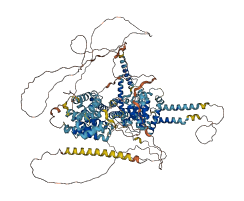
Descriptions
The autoinhibited protein was predicted that may have potential autoinhibitory elements via cis-regPred.
Autoinhibitory domains (AIDs)
Target domain |
|
Relief mechanism |
|
Assay |
cis-regPred |
Accessory elements
No accessory elements
Autoinhibited structure

Activated structure
1 structures for Q9WTN3
| Entry ID | Method | Resolution | Chain | Position | Source |
|---|---|---|---|---|---|
| AF-Q9WTN3-F1 | Predicted | AlphaFoldDB |
59 variants for Q9WTN3
| Variant ID(s) | Position | Change | Description | Diseaes Association | Provenance |
|---|---|---|---|---|---|
| rs3389151137 | 51 | Y>* | No | EVA | |
| rs3389163097 | 54 | G>R | No | EVA | |
| rs3389159724 | 63 | S>N | No | EVA | |
| rs3389161536 | 93 | A>T | No | EVA | |
| rs26973150 | 103 | A>T | No | EVA | |
| rs3389171872 | 132 | P>R | No | EVA | |
| rs3389137311 | 156 | P>R | No | EVA | |
| rs3389171896 | 160 | L>M | No | EVA | |
| rs49583502 | 171 | G>R | No | EVA | |
| rs3389151114 | 180 | P>R | No | EVA | |
| rs3389161005 | 189 | A>T | No | EVA | |
| rs3389171892 | 241 | D>H | No | EVA | |
| rs13463332 | 256 | V>M | No | EVA | |
| rs3389171908 | 346 | G>D | No | EVA | |
| rs261411837 | 385 | H>Q | No | EVA | |
| rs3389162572 | 406 | S>C | No | EVA | |
| rs3389132751 | 407 | M>D | No | EVA | |
| rs3389162623 | 434 | L>V | No | EVA | |
| rs3389137309 | 439 | R>S | No | EVA | |
| rs231071991 | 440 | A>G | No | EVA | |
| rs3389101594 | 447 | D>Y | No | EVA | |
| rs3389164836 | 448 | S>T | No | EVA | |
| rs3389169120 | 481 | C>* | No | EVA | |
| rs3389162566 | 483 | L>V | No | EVA | |
| rs3389132817 | 528 | N>Y | No | EVA | |
| rs3389175646 | 553 | L>H | No | EVA | |
| rs3389175687 | 585 | G>R | No | EVA | |
| rs3402295880 | 625 | L>P | No | EVA | |
| rs3402289188 | 652 | R>H | No | EVA | |
| rs3413091405 | 656 | R>Q | No | EVA | |
| rs26973163 | 658 | A>E | No | EVA | |
| rs3389101635 | 724 | H>N | No | EVA | |
| rs3389164807 | 729 | F>I | No | EVA | |
| rs3389151172 | 760 | F>V | No | EVA | |
| rs3389156585 | 773 | P>R | No | EVA | |
| rs3389156595 | 783 | P>S | No | EVA | |
| rs3389126571 | 808 | Q>* | No | EVA | |
| rs3389156522 | 833 | C>Y | No | EVA | |
| rs250579032 | 856 | P>T | No | EVA | |
| rs3389159782 | 873 | W>C | No | EVA | |
| rs3389171894 | 898 | T>I | No | EVA | |
| rs3389151156 | 920 | R>G | No | EVA | |
| rs3389156596 | 968 | R>H | No | EVA | |
| rs3389156593 | 971 | L>P | No | EVA | |
| rs3389156593 | 971 | L>Q | No | EVA | |
| rs3389137337 | 980 | S>P | No | EVA | |
| rs3412732702 | 1012 | A>T | No | EVA | |
| rs3389151148 | 1017 | P>S | No | EVA | |
| rs3389161053 | 1019 | M>V | No | EVA | |
| rs3389161265 | 1038 | A>S | No | EVA | |
| rs3389163075 | 1040 | T>R | No | EVA | |
| rs3402444213 | 1060 | T>P | No | EVA | |
| rs49852287 | 1061 | T>A | No | EVA | |
| rs3389169134 | 1062 | A>S | No | EVA | |
| rs3402289198 | 1063 | E>Q | No | EVA | |
| rs3412766618 | 1069 | T>P | No | EVA | |
| rs3389137350 | 1088 | F>I | No | EVA | |
| rs3389174306 | 1092 | P>S | No | EVA | |
| rs3389161065 | 1128 | G>* | No | EVA |
No associated diseases with Q9WTN3
1 regional properties for Q9WTN3
| Type | Name | Position | InterPro Accession |
|---|---|---|---|
| domain | Myc-type, basic helix-loop-helix (bHLH) domain | 317 - 373 | IPR011598 |
Functions
11 GO annotations of cellular component
| Name | Definition |
|---|---|
| cytoplasm | The contents of a cell excluding the plasma membrane and nucleus, but including other subcellular structures. |
| endoplasmic reticulum | The irregular network of unit membranes, visible only by electron microscopy, that occurs in the cytoplasm of many eukaryotic cells. The membranes form a complex meshwork of tubular channels, which are often expanded into slitlike cavities called cisternae. The ER takes two forms, rough (or granular), with ribosomes adhering to the outer surface, and smooth (with no ribosomes attached). |
| endoplasmic reticulum membrane | The lipid bilayer surrounding the endoplasmic reticulum. |
| ER to Golgi transport vesicle membrane | The lipid bilayer surrounding a vesicle transporting substances from the endoplasmic reticulum to the Golgi. |
| Golgi membrane | The lipid bilayer surrounding any of the compartments of the Golgi apparatus. |
| integral component of membrane | The component of a membrane consisting of the gene products and protein complexes having at least some part of their peptide sequence embedded in the hydrophobic region of the membrane. |
| intracellular membrane-bounded organelle | Organized structure of distinctive morphology and function, bounded by a single or double lipid bilayer membrane and occurring within the cell. Includes the nucleus, mitochondria, plastids, vacuoles, and vesicles. Excludes the plasma membrane. |
| membrane | A lipid bilayer along with all the proteins and protein complexes embedded in it an attached to it. |
| nucleoplasm | That part of the nuclear content other than the chromosomes or the nucleolus. |
| nucleus | A membrane-bounded organelle of eukaryotic cells in which chromosomes are housed and replicated. In most cells, the nucleus contains all of the cell's chromosomes except the organellar chromosomes, and is the site of RNA synthesis and processing. In some species, or in specialized cell types, RNA metabolism or DNA replication may be absent. |
| protein-containing complex | A stable assembly of two or more macromolecules, i.e. proteins, nucleic acids, carbohydrates or lipids, in which at least one component is a protein and the constituent parts function together. |
15 GO annotations of molecular function
| Name | Definition |
|---|---|
| chromatin binding | Binding to chromatin, the network of fibers of DNA, protein, and sometimes RNA, that make up the chromosomes of the eukaryotic nucleus during interphase. |
| DNA binding | Any molecular function by which a gene product interacts selectively and non-covalently with DNA (deoxyribonucleic acid). |
| DNA-binding transcription activator activity, RNA polymerase II-specific | A DNA-binding transcription factor activity that activates or increases transcription of specific gene sets transcribed by RNA polymerase II. |
| DNA-binding transcription factor activity | A transcription regulator activity that modulates transcription of gene sets via selective and non-covalent binding to a specific double-stranded genomic DNA sequence (sometimes referred to as a motif) within a cis-regulatory region. Regulatory regions include promoters (proximal and distal) and enhancers. Genes are transcriptional units, and include bacterial operons. |
| DNA-binding transcription factor activity, RNA polymerase II-specific | A DNA-binding transcription factor activity that modulates the transcription of specific gene sets transcribed by RNA polymerase II. |
| nuclear receptor activity | A DNA-binding transcription factor activity regulated by binding to a ligand that modulates the transcription of specific gene sets transcribed by RNA polymerase II. Nuclear receptor ligands are usually lipid-based (such as a steroid hormone) and the binding of the ligand to its receptor often occurs in the cytoplasm, which leads to its tranlocation to the nucleus. |
| protein dimerization activity | The formation of a protein dimer, a macromolecular structure consists of two noncovalently associated identical or nonidentical subunits. |
| protein kinase binding | Binding to a protein kinase, any enzyme that catalyzes the transfer of a phosphate group, usually from ATP, to a protein substrate. |
| protein-containing complex binding | Binding to a macromolecular complex. |
| RNA polymerase II cis-regulatory region sequence-specific DNA binding | Binding to a specific upstream regulatory DNA sequence (transcription factor recognition sequence or binding site) located in cis relative to the transcription start site (i.e., on the same strand of DNA) of a gene transcribed by RNA polymerase II. |
| RNA polymerase II transcription regulatory region sequence-specific DNA binding | Binding to a specific sequence of DNA that is part of a regulatory region that controls the transcription of a gene or cistron by RNA polymerase II. |
| sequence-specific DNA binding | Binding to DNA of a specific nucleotide composition, e.g. GC-rich DNA binding, or with a specific sequence motif or type of DNA e.g. promotor binding or rDNA binding. |
| sequence-specific double-stranded DNA binding | Binding to double-stranded DNA of a specific nucleotide composition, e.g. GC-rich DNA binding, or with a specific sequence motif or type of DNA, e.g. promotor binding or rDNA binding. |
| sterol response element binding | Binding to a sterol response element (SRE), a nonpalindromic sequence found in the promoters of genes involved in lipid metabolism. |
| transcription coregulator binding | Binding to a transcription coregulator, a protein involved in regulation of transcription via protein-protein interactions with transcription factors and other transcription regulatory proteins. Cofactors do not bind DNA directly, but rather mediate protein-protein interactions between regulatory transcription factors and the basal transcription machinery. |
43 GO annotations of biological process
| Name | Definition |
|---|---|
| aging | A developmental process that is a deterioration and loss of function over time. Aging includes loss of functions such as resistance to disease, homeostasis, and fertility, as well as wear and tear. Aging includes cellular senescence, but is more inclusive. May precede death and may succeed developmental maturation (GO:0021700). |
| cellular response to fatty acid | Any process that results in a change in state or activity of a cell (in terms of movement, secretion, enzyme production, gene expression, etc.) as a result of a fatty acid stimulus. |
| cellular response to starvation | Any process that results in a change in state or activity of a cell (in terms of movement, secretion, enzyme production, gene expression, etc.) as a result of deprivation of nourishment. |
| cholesterol biosynthetic process | The chemical reactions and pathways resulting in the formation of cholesterol, cholest-5-en-3 beta-ol, the principal sterol of vertebrates and the precursor of many steroids, including bile acids and steroid hormones. |
| cholesterol metabolic process | The chemical reactions and pathways involving cholesterol, cholest-5-en-3 beta-ol, the principal sterol of vertebrates and the precursor of many steroids, including bile acids and steroid hormones. It is a component of the plasma membrane lipid bilayer and of plasma lipoproteins and can be found in all animal tissues. |
| circadian rhythm | Any biological process in an organism that recurs with a regularity of approximately 24 hours. |
| fat cell differentiation | The process in which a relatively unspecialized cell acquires specialized features of an adipocyte, an animal connective tissue cell specialized for the synthesis and storage of fat. |
| insulin receptor signaling pathway | The series of molecular signals generated as a consequence of the insulin receptor binding to insulin. |
| insulin secretion | The regulated release of proinsulin from secretory granules accompanied by cleavage of proinsulin to form mature insulin. In vertebrates, insulin is secreted from B granules in the B cells of the vertebrate pancreas and from insulin-producing cells in insects. |
| lipid biosynthetic process | The chemical reactions and pathways resulting in the formation of lipids, compounds soluble in an organic solvent but not, or sparingly, in an aqueous solvent. |
| lipid localization | Any process in which a lipid is transported to, or maintained in, a specific location. |
| lung development | The process whose specific outcome is the progression of the lung over time, from its formation to the mature structure. In all air-breathing vertebrates the lungs are developed from the ventral wall of the oesophagus as a pouch which divides into two sacs. In amphibians and many reptiles the lungs retain very nearly this primitive sac-like character, but in the higher forms the connection with the esophagus becomes elongated into the windpipe and the inner walls of the sacs become more and more divided, until, in the mammals, the air spaces become minutely divided into tubes ending in small air cells, in the walls of which the blood circulates in a fine network of capillaries. In mammals the lungs are more or less divided into lobes, and each lung occupies a separate cavity in the thorax. |
| mRNA transcription by RNA polymerase II | The cellular synthesis of messenger RNA (mRNA) from a DNA template by RNA polymerase II, originating at an RNA polymerase II promoter. |
| negative regulation of insulin secretion | Any process that stops, prevents, or reduces the frequency, rate or extent of the regulated release of insulin. |
| negative regulation of transcription by RNA polymerase II | Any process that stops, prevents, or reduces the frequency, rate or extent of transcription mediated by RNA polymerase II. |
| positive regulation of cholesterol biosynthetic process | Any process that activates or increases the frequency, rate or extent of the chemical reactions and pathways resulting in the formation of cholesterol. |
| positive regulation of DNA-templated transcription | Any process that activates or increases the frequency, rate or extent of cellular DNA-templated transcription. |
| positive regulation of fatty acid biosynthetic process | Any process that activates or increases the frequency, rate or extent of the chemical reactions and pathways resulting in the formation of fatty acids. |
| positive regulation of histone deacetylation | Any process that activates or increases the frequency, rate or extent of the removal of acetyl groups from histones. |
| positive regulation of innate immune response | Any process that activates or increases the frequency, rate or extent of the innate immune response, the organism's first line of defense against infection. |
| positive regulation of lipid biosynthetic process | Any process that activates or increases the frequency, rate or extent of the chemical reactions and pathways resulting in the formation of lipids. |
| positive regulation of miRNA transcription | Any process that activates or increases the frequency, rate or extent of microRNA (miRNA) gene transcription. |
| positive regulation of transcription by RNA polymerase II | Any process that activates or increases the frequency, rate or extent of transcription from an RNA polymerase II promoter. |
| positive regulation of triglyceride biosynthetic process | Any process that increases the rate, frequency, or extent of triglyceride biosynthesis. Triglyceride biosynthesis is the collection of chemical reactions and pathways resulting in the formation of triglyceride, any triester of glycerol. |
| regulation of autophagy of mitochondrion | Any process that modulates the frequency, rate or extent of mitochondrion degradation by an autophagic process. |
| regulation of DNA-templated transcription | Any process that modulates the frequency, rate or extent of cellular DNA-templated transcription. |
| regulation of fatty acid metabolic process | Any process that modulates the frequency, rate or extent of the chemical reactions and pathways involving fatty acids. |
| regulation of heart rate by chemical signal | The regulation of the rate of heart contraction mediated by chemical signaling, hormonal, autocrine or paracrine. |
| regulation of insulin secretion | Any process that modulates the frequency, rate or extent of the regulated release of insulin. |
| regulation of lipid storage | Any process that modulates the rate, frequency or extent of lipid storage. Lipid storage is the accumulation and maintenance in cells or tissues of lipids, compounds soluble in organic solvents but insoluble or sparingly soluble in aqueous solvents. Lipid reserves can be accumulated during early developmental stages for mobilization and utilization at later stages of development. |
| regulation of protein stability | Any process that affects the structure and integrity of a protein, altering the likelihood of its degradation or aggregation. |
| regulation of protein targeting to mitochondrion | Any process that modulates the frequency, rate or extent of protein targeting to mitochondrion. |
| regulation of transcription by RNA polymerase II | Any process that modulates the frequency, rate or extent of transcription mediated by RNA polymerase II. |
| response to cAMP | Any process that results in a change in state or activity of a cell or an organism (in terms of movement, secretion, enzyme production, gene expression, etc.) as a result of a cAMP (cyclic AMP, adenosine 3',5'-cyclophosphate) stimulus. |
| response to ethanol | Any process that results in a change in state or activity of a cell or an organism (in terms of movement, secretion, enzyme production, gene expression, etc.) as a result of an ethanol stimulus. |
| response to food | Any process that results in a change in state or activity of a cell or an organism (in terms of movement, secretion, enzyme production, gene expression, etc.) as a result of a food stimulus; food is anything which, when taken into the body, serves to nourish or build up the tissues or to supply body heat. |
| response to glucagon | Any process that results in a change in state or activity of a cell or an organism (in terms of movement, secretion, enzyme production, gene expression, etc.) as a result of a glucagon stimulus. |
| response to glucose | Any process that results in a change in state or activity of a cell or an organism (in terms of movement, secretion, enzyme production, gene expression, etc.) as a result of a glucose stimulus. |
| response to progesterone | Any process that results in a change in state or activity of a cell or an organism (in terms of movement, secretion, enzyme production, gene expression, etc.) as a result of a progesterone stimulus. |
| response to retinoic acid | Any process that results in a change in state or activity of a cell or an organism (in terms of movement, secretion, enzyme production, gene expression, etc.) as a result of a retinoic acid stimulus. |
| response to xenobiotic stimulus | Any process that results in a change in state or activity of a cell or an organism (in terms of movement, secretion, enzyme production, gene expression, etc.) as a result of a stimulus from a xenobiotic, a compound foreign to the organim exposed to it. It may be synthesized by another organism (like ampicilin) or it can be a synthetic chemical. |
| SREBP signaling pathway | The series of molecular signals from the endoplasmic reticulum to the nucleus generated as a consequence of decreased levels of one or more sterols (and in some yeast, changes in oxygen levels) and which proceeds through activation of a sterol response element binding transcription factor (SREBP) to result in up-regulation of target gene transcription. |
| transcription by RNA polymerase II | The synthesis of RNA from a DNA template by RNA polymerase II (RNAP II), originating at an RNA polymerase II promoter. Includes transcription of messenger RNA (mRNA) and certain small nuclear RNAs (snRNAs). |
1 homologous proteins in AiPD
| UniProt AC | Gene Name | Protein Name | Species | Evidence Code |
|---|---|---|---|---|
| P04198 | MYCN | N-myc proto-oncogene protein | Homo sapiens (Human) | SS |
| 10 | 20 | 30 | 40 | 50 | 60 |
| MDELAFGEAA | LEQTLAEMCE | LDTAVLNDIE | DMLQLINNQD | SDFPGLFDAP | YAGGETGDTG |
| 70 | 80 | 90 | 100 | 110 | 120 |
| PSSPGANSPE | SFSSASLASS | LEAFLGGPKV | TPAPLSPPPS | APAALKMYPS | VSPFSPGPGI |
| 130 | 140 | 150 | 160 | 170 | 180 |
| KEEPVPLTIL | QPAAPQPSPG | TLLPPSFPAP | PVQLSPAPVL | GYSSLPSGFS | GTLPGNTQQP |
| 190 | 200 | 210 | 220 | 230 | 240 |
| PSSLPLAPAP | GVLPTPALHT | QVQSLASQQP | LPASAAPRTN | TVTSQVQQVP | VVLQPHFIKA |
| 250 | 260 | 270 | 280 | 290 | 300 |
| DSLLLTAVKT | DAGATVKTAG | ISTLAPGTAV | QAGPLQTLVS | GGTILATVPL | VVDTDKLPIH |
| 310 | 320 | 330 | 340 | 350 | 360 |
| RLAAGSKALG | SAQSRGEKRT | AHNAIEKRYR | SSINDKIVEL | KDLVVGTEAK | LNKSAVLRKA |
| 370 | 380 | 390 | 400 | 410 | 420 |
| IDYIRFLQHS | NQKLKQENLT | LRSAHKSKSL | KDLVSACGSG | GGTDVSMEGM | KPEVVETLTP |
| 430 | 440 | 450 | 460 | 470 | 480 |
| PPSDAGSPSQ | SSPLSFGSRA | SSSGGSDSEP | DSPAFEDSQV | KAQRLPSHSR | GMLDRSRLAL |
| 490 | 500 | 510 | 520 | 530 | 540 |
| CVLAFLCLTC | NPLASLFGWG | ILTPSDATGT | HRSSGRSMLE | AESRDGSNWT | QWLLPPLVWL |
| 550 | 560 | 570 | 580 | 590 | 600 |
| ANGLLVLACL | ALLFVYGEPV | TRPHSGPAVH | FWRHRKQADL | DLARGDFPQA | AQQLWLALQA |
| 610 | 620 | 630 | 640 | 650 | 660 |
| LGRPLPTSNL | DLACSLLWNL | IRHLLQRLWV | GRWLAGQAGG | LLRDRGLRKD | ARASARDAAV |
| 670 | 680 | 690 | 700 | 710 | 720 |
| VYHKLHQLHA | MGKYTGGHLA | ASNLALSALN | LAECAGDAIS | MATLAEIYVA | AALRVKTSLP |
| 730 | 740 | 750 | 760 | 770 | 780 |
| RALHFLTRFF | LSSARQACLA | QSGSVPLAMQ | WLCHPVGHRF | FVDGDWAVHG | APPESLYSVA |
| 790 | 800 | 810 | 820 | 830 | 840 |
| GNPVDPLAQV | TRLFREHLLE | RALNCIAQPS | PGAADGDREF | SDALGYLQLL | NSCSDAAGAP |
| 850 | 860 | 870 | 880 | 890 | 900 |
| ACSFSVSSSM | AATTGPDPVA | KWWASLTAVV | IHWLRRDEEA | AERLYPLVEH | IPQVLQDTER |
| 910 | 920 | 930 | 940 | 950 | 960 |
| PLPRAALYSF | KAARALLDHR | KVESSPASLA | ICEKASGYLR | DSLASTPTGS | SIDKAMQLLL |
| 970 | 980 | 990 | 1000 | 1010 | 1020 |
| CDLLLVARTS | LWQRQQSPAS | VQVAHGTSNG | PQASALELRG | FQHDLSSLRR | LAQSFRPAMR |
| 1030 | 1040 | 1050 | 1060 | 1070 | 1080 |
| RVFLHEATAR | LMAGASPART | HQLLDRSLRR | RAGSSGKGGT | TAELEPRPTW | REHTEALLLA |
| 1090 | 1100 | 1110 | 1120 | 1130 | |
| SCYLPPAFLS | APGQRMSMLA | EAARTVEKLG | DHRLLLDCQQ | MLLRLGGGTT | VTSS |