Q9W4I5
Gene name |
CG3062 |
Protein name |
Protein Flattop homolog |
Names |
Cilia- and flagella-associated protein 126 |
Species |
Drosophila melanogaster (Fruit fly) |
KEGG Pathway |
dme:Dmel_CG3062 |
EC number |
|
Protein Class |
|
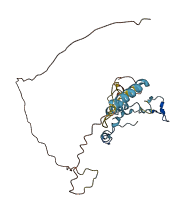
Descriptions
The autoinhibited protein was predicted that may have potential autoinhibitory elements via cis-regPred.
Autoinhibitory domains (AIDs)
Target domain |
|
Relief mechanism |
|
Assay |
cis-regPred |
Accessory elements
No accessory elements
Autoinhibited structure

Activated structure
1 structures for Q9W4I5
| Entry ID | Method | Resolution | Chain | Position | Source |
|---|---|---|---|---|---|
| AF-Q9W4I5-F1 | Predicted | AlphaFoldDB |
No variants for Q9W4I5
| Variant ID(s) | Position | Change | Description | Diseaes Association | Provenance |
|---|---|---|---|---|---|
| No variants for Q9W4I5 | |||||
No associated diseases with Q9W4I5
No regional properties for Q9W4I5
| Type | Name | Position | InterPro Accession |
|---|---|---|---|
| No domain, repeats, and functional sites for Q9W4I5 | |||
1 GO annotations of cellular component
| Name | Definition |
|---|---|
| ciliary basal body | A membrane-tethered, short cylindrical array of microtubules and associated proteins found at the base of a eukaryotic cilium (also called flagellum) that is similar in structure to a centriole and derives from it. The cilium basal body is the site of assembly and remodelling of the cilium and serves as a nucleation site for axoneme growth. As well as anchoring the cilium, it is thought to provide a selective gateway regulating the entry of ciliary proteins and vesicles by intraflagellar transport. |
No GO annotations of molecular function
| Name | Definition |
|---|---|
| No GO annotations for molecular function |
1 GO annotations of biological process
| Name | Definition |
|---|---|
| cilium organization | A process that is carried out at the cellular level which results in the assembly, arrangement of constituent parts, or disassembly of a cilium, a specialized eukaryotic organelle that consists of a filiform extrusion of the cell surface. Each cilium is bounded by an extrusion of the cytoplasmic membrane, and contains a regular longitudinal array of microtubules, anchored basally in a centriole. |
No homologous proteins in AiPD
| UniProt AC | Gene Name | Protein Name | Species | Evidence Code |
|---|---|---|---|---|
| No homologous proteins | ||||
| 10 | 20 | 30 | 40 | 50 | 60 |
| MALHFSAQQF | EGRFQSKRLN | NWEYPRFSPP | RPRGLQKNAK | VVAANNGHLL | PEVIKEGNSF |
| 70 | 80 | 90 | 100 | 110 | 120 |
| GQYRGTYELP | RRITRAFCAH | YDACLSGRYK | FVDFPRDLCN | CQRENRRALA | CDQRLTLGHK |
| 130 | 140 | 150 | 160 | 170 | 180 |
| DDPYWMRERC | QTKCEGLQKL | RALSERSARC | NRAKCDVVSE | KTVKMTPKAI | KTTGVATEKR |
| 190 | 200 | 210 | 220 | 230 | 240 |
| RRKRTITAFS | KGRTALHPNE | LTKPIPSSEK | PAATVATPKD | KPKDKPKDKE | AGKKDKTKDK |
| 250 | |||||
| GKEKERKAAK | GH |