Q9W484
Gene name |
Rtel1 |
Protein name |
Regulator of telomere elongation helicase 1 homolog |
Names |
|
Species |
Drosophila melanogaster (Fruit fly) |
KEGG Pathway |
dme:Dmel_CG4078 |
EC number |
3.6.4.12: Acting on ATP; involved in cellular and subcellular movement |
Protein Class |
|
Descriptions
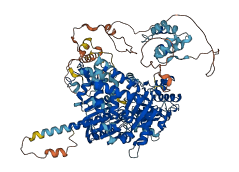
The autoinhibited protein was predicted that may have potential autoinhibitory elements via cis-regPred.
Autoinhibitory domains (AIDs)
Target domain |
|
Relief mechanism |
|
Assay |
cis-regPred |
Accessory elements
No accessory elements
Autoinhibited structure

Activated structure
1 structures for Q9W484
| Entry ID | Method | Resolution | Chain | Position | Source |
|---|---|---|---|---|---|
| AF-Q9W484-F1 | Predicted | AlphaFoldDB |
3 variants for Q9W484
| Variant ID(s) | Position | Change | Description | Diseaes Association | Provenance |
|---|---|---|---|---|---|
| 81 | G>D | strain: ZW104 [UniProt] | No | ||
| 95 | A>T | strain: ZW141 [UniProt] | No | ||
| 294 | Q>del | strain: ZW104 and ZW141 [UniProt] | No |
No associated diseases with Q9W484
4 regional properties for Q9W484
Functions
| Description | ||
|---|---|---|
| EC Number | 3.6.4.12 | Acting on ATP; involved in cellular and subcellular movement |
| Subcellular Localization |
|
|
| PANTHER Family | ||
| PANTHER Subfamily | ||
| PANTHER Protein Class | ||
| PANTHER Pathway Category | No pathway information available | |
2 GO annotations of cellular component
| Name | Definition |
|---|---|
| chromosome | A structure composed of a very long molecule of DNA and associated proteins (e.g. histones) that carries hereditary information. |
| nucleus | A membrane-bounded organelle of eukaryotic cells in which chromosomes are housed and replicated. In most cells, the nucleus contains all of the cell's chromosomes except the organellar chromosomes, and is the site of RNA synthesis and processing. In some species, or in specialized cell types, RNA metabolism or DNA replication may be absent. |
8 GO annotations of molecular function
| Name | Definition |
|---|---|
| 4 iron, 4 sulfur cluster binding | Binding to a 4 iron, 4 sulfur (4Fe-4S) cluster; this cluster consists of four iron atoms, with the inorganic sulfur atoms found between the irons and acting as bridging ligands. |
| ATP binding | Binding to ATP, adenosine 5'-triphosphate, a universally important coenzyme and enzyme regulator. |
| ATP hydrolysis activity | Catalysis of the reaction: ATP + H2O = ADP + H+ phosphate. ATP hydrolysis is used in some reactions as an energy source, for example to catalyze a reaction or drive transport against a concentration gradient. |
| chromatin binding | Binding to chromatin, the network of fibers of DNA, protein, and sometimes RNA, that make up the chromosomes of the eukaryotic nucleus during interphase. |
| DNA binding | Any molecular function by which a gene product interacts selectively and non-covalently with DNA (deoxyribonucleic acid). |
| DNA helicase activity | Unwinding of a DNA helix, driven by ATP hydrolysis. |
| DNA polymerase binding | Binding to a DNA polymerase. |
| metal ion binding | Binding to a metal ion. |
10 GO annotations of biological process
| Name | Definition |
|---|---|
| DNA duplex unwinding | The process in which interchain hydrogen bonds between two strands of DNA are broken or 'melted', generating a region of unpaired single strands. |
| DNA recombination | Any process in which a new genotype is formed by reassortment of genes resulting in gene combinations different from those that were present in the parents. In eukaryotes genetic recombination can occur by chromosome assortment, intrachromosomal recombination, or nonreciprocal interchromosomal recombination. Interchromosomal recombination occurs by crossing over. In bacteria it may occur by genetic transformation, conjugation, transduction, or F-duction. |
| DNA repair | The process of restoring DNA after damage. Genomes are subject to damage by chemical and physical agents in the environment (e.g. UV and ionizing radiations, chemical mutagens, fungal and bacterial toxins, etc.) and by free radicals or alkylating agents endogenously generated in metabolism. DNA is also damaged because of errors during its replication. A variety of different DNA repair pathways have been reported that include direct reversal, base excision repair, nucleotide excision repair, photoreactivation, bypass, double-strand break repair pathway, and mismatch repair pathway. |
| DNA replication | The cellular metabolic process in which a cell duplicates one or more molecules of DNA. DNA replication begins when specific sequences, known as origins of replication, are recognized and bound by initiation proteins, and ends when the original DNA molecule has been completely duplicated and the copies topologically separated. The unit of replication usually corresponds to the genome of the cell, an organelle, or a virus. The template for replication can either be an existing DNA molecule or RNA. |
| male germ-line stem cell population maintenance | The process by which an organism or tissue maintains a population of male germ-line stem cells. |
| negative regulation of DNA recombination | Any process that stops, prevents, or reduces the frequency, rate or extent of DNA recombination. |
| negative regulation of response to DNA damage stimulus | Any process that stops, prevents or reduces the frequency, rate or extent of response to DNA damage stimulus. |
| negative regulation of t-circle formation | Any process that stops, prevents or reduces the frequency, rate or extent of t-circle formation. |
| regulation of double-strand break repair via homologous recombination | Any process that modulates the frequency, rate or extent of the error-free repair of a double-strand break in DNA in which the broken DNA molecule is repaired using homologous sequences. |
| telomeric loop disassembly | The telomere maintenance process in which telomeric loops are disassembled to permit efficient telomere replication. |
1 homologous proteins in AiPD
| UniProt AC | Gene Name | Protein Name | Species | Evidence Code |
|---|---|---|---|---|
| Q9BX63 | BRIP1 | Fanconi anemia group J protein | Homo sapiens (Human) | PR |
| 10 | 20 | 30 | 40 | 50 | 60 |
| MPESLIAGIP | VHFPFEPYPV | QRAYMEKVIH | CLRDGTNGVL | ESPTGTGKTL | SLLCSSLAWI |
| 70 | 80 | 90 | 100 | 110 | 120 |
| RTRQSEHQKQ | MVKMEKADFS | GLGGGAPGGD | LSELAKTMGR | ANNWGVPKVI | YASRTHSQLT |
| 130 | 140 | 150 | 160 | 170 | 180 |
| QAMRELKRTA | YANMRSVVLG | SRDQLCIHPE | VMREQGNSNK | TNMCKLRVHS | KTCSFQMRVE |
| 190 | 200 | 210 | 220 | 230 | 240 |
| SRKDHPDLRG | PTIMDIEDLV | KVGQRLKICP | YFASRELVPQ | ADITFMPYNY | LLDPKARKAN |
| 250 | 260 | 270 | 280 | 290 | 300 |
| KIELGNTIVI | LDEAHNIEKI | CEESASVQIK | SSDVAMAIED | VTHIMQVFAS | GESQDMAGDE |
| 310 | 320 | 330 | 340 | 350 | 360 |
| PKDFTLDDLT | LLKEMLLELE | KAIDAIVVDN | AVDGTTFPAS | MMYELLGKAN | FTYGNVATIV |
| 370 | 380 | 390 | 400 | 410 | 420 |
| SLLDKLVQYL | LVASQQMSIR | KGGTFTLLSD | LLTIVFANKE | DVMSKVYASF | KVHVLVEESK |
| 430 | 440 | 450 | 460 | 470 | 480 |
| QGHGKQQGAK | QQGGWLGKGT | IAAATGLSKV | AKIINFWCFN | PGFGMEQLLN | TQVRSVILTS |
| 490 | 500 | 510 | 520 | 530 | 540 |
| GTLAPLKPLI | AELAIPVAQH | LENPHIVDQS | QVYVKIIGTG | PDRQQLISNY | ANRDNPKYIS |
| 550 | 560 | 570 | 580 | 590 | 600 |
| SLGQTILNVA | RIVPDGLLVF | FPSYPMLNKC | VDAWQASGLW | ADISCKKPIF | LEPRSKDQFT |
| 610 | 620 | 630 | 640 | 650 | 660 |
| STMEEFYQAI | RDSKGAVFMA | VCRGKVSEGL | DFADRNGRAV | IITGLPFPPL | KDPKVILKRR |
| 670 | 680 | 690 | 700 | 710 | 720 |
| YLEANRTREN | QLLSGQEWYN | LDATRAVNQA | IGRVIRHRND | YGAILLCDSR | FKDASQVQQL |
| 730 | 740 | 750 | 760 | 770 | 780 |
| SKWIRGHLGD | RPQCSPFGPI | VRELRQFFKN | AEANMKLPDE | RETDSPLETV | CKTEDEPLAA |
| 790 | 800 | 810 | 820 | 830 | 840 |
| IPKVKREPGS | NATFKSANES | AIKVEMANSI | KTWTPADYAS | AAGHKLGGAA | PNAMDFMSRL |
| 850 | 860 | 870 | 880 | 890 | 900 |
| DSNVSSIDFN | CCTDSKSGSS | GLVKIHKRER | SSPTAPESSS | QVTKKRYKLV | ENIKVEPSSS |
| 910 | 920 | 930 | 940 | 950 | 960 |
| QAKEAPEERA | AFLRELRSLV | TQDQFRRFGK | ALLEYKNGTY | ESFQALMAIL | LDVLSAPKVR |
| 970 | 980 | ||||
| YMLVGMRKYL | KNEHKDEFDR | RVGNL |