Q9VWA8
Gene name |
FRG1 (CG6480) |
Protein name |
Protein FRG1 homolog |
Names |
|
Species |
Drosophila melanogaster (Fruit fly) |
KEGG Pathway |
dme:Dmel_CG6480 |
EC number |
|
Protein Class |
|
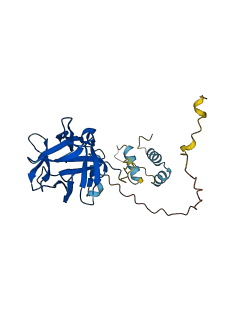
Descriptions
The autoinhibited protein was predicted that may have potential autoinhibitory elements via cis-regPred.
Autoinhibitory domains (AIDs)
Target domain |
|
Relief mechanism |
|
Assay |
cis-regPred |
Accessory elements
No accessory elements
Autoinhibited structure

Activated structure
1 structures for Q9VWA8
| Entry ID | Method | Resolution | Chain | Position | Source |
|---|---|---|---|---|---|
| AF-Q9VWA8-F1 | Predicted | AlphaFoldDB |
No variants for Q9VWA8
| Variant ID(s) | Position | Change | Description | Diseaes Association | Provenance |
|---|---|---|---|---|---|
| No variants for Q9VWA8 | |||||
No associated diseases with Q9VWA8
No regional properties for Q9VWA8
| Type | Name | Position | InterPro Accession |
|---|---|---|---|
| No domain, repeats, and functional sites for Q9VWA8 | |||
6 GO annotations of cellular component
| Name | Definition |
|---|---|
| Cajal body | A class of nuclear body, first seen after silver staining by Ramon y Cajal in 1903, enriched in small nuclear ribonucleoproteins, and certain general RNA polymerase II transcription factors; ultrastructurally, they appear as a tangle of coiled, electron-dense threads roughly 0.5 micrometers in diameter; involved in aspects of snRNP biogenesis; the protein coilin serves as a marker for Cajal bodies. Some argue that Cajal bodies are the sites for preassembly of transcriptosomes, unitary particles involved in transcription and processing of RNA. |
| catalytic step 2 spliceosome | A spliceosomal complex that contains three snRNPs, including U5, bound to a splicing intermediate in which the first catalytic cleavage of the 5' splice site has occurred. The precise subunit composition differs significantly from that of the catalytic step 1, or activated, spliceosome, and includes many proteins in addition to those found in the associated snRNPs. |
| cytoplasm | The contents of a cell excluding the plasma membrane and nucleus, but including other subcellular structures. |
| nucleolus | A small, dense body one or more of which are present in the nucleus of eukaryotic cells. It is rich in RNA and protein, is not bounded by a limiting membrane, and is not seen during mitosis. Its prime function is the transcription of the nucleolar DNA into 45S ribosomal-precursor RNA, the processing of this RNA into 5.8S, 18S, and 28S components of ribosomal RNA, and the association of these components with 5S RNA and proteins synthesized outside the nucleolus. This association results in the formation of ribonucleoprotein precursors; these pass into the cytoplasm and mature into the 40S and 60S subunits of the ribosome. |
| striated muscle dense body | A vinculin-containing myofibril attachment structure of striated muscle that connects sarcomeres to the extracellular matrix. In nematode body wall muscle, the dense body performs the dual role of Z-disk and costamere. |
| Z disc | Platelike region of a muscle sarcomere to which the plus ends of actin filaments are attached. |
1 GO annotations of molecular function
| Name | Definition |
|---|---|
| actin filament binding | Binding to an actin filament, also known as F-actin, a helical filamentous polymer of globular G-actin subunits. |
4 GO annotations of biological process
| Name | Definition |
|---|---|
| heterochromatin organization | Any process that results in the specification, formation or maintenance of the physical structure of eukaryotic heterochromatin, a compact and highly condensed form of chromatin. |
| muscle organ development | The process whose specific outcome is the progression of the muscle over time, from its formation to the mature structure. The muscle is an organ consisting of a tissue made up of various elongated cells that are specialized to contract and thus to produce movement and mechanical work. |
| negative regulation of histone H4-K20 methylation | Any process that stops, prevents, or reduces the frequency, rate or extent of the covalent addition of a methyl group to the lysine at position 20 of histone H4. |
| rRNA processing | Any process involved in the conversion of a primary ribosomal RNA (rRNA) transcript into one or more mature rRNA molecules. |
No homologous proteins in AiPD
| UniProt AC | Gene Name | Protein Name | Species | Evidence Code |
|---|---|---|---|---|
| No homologous proteins | ||||
| 10 | 20 | 30 | 40 | 50 | 60 |
| MSDYDHARIK | KLVLKGEKLK | KSKKRKKEKD | EAGSSKKAKV | VVDEDAVKHG | GWWAAKTAAD |
| 70 | 80 | 90 | 100 | 110 | 120 |
| ITGTVSIEFG | DRSYLKAMDN | GLFTLGAPHN | AGDGPDPEEI | FTAFPINDRK | VAFKSGYGKY |
| 130 | 140 | 150 | 160 | 170 | 180 |
| LKIEKDGMVT | GRSEAVGGME | QWEPVFEEQR | MALLSETGHF | MSIDPQDDAC | VALRKKVGQH |
| 190 | 200 | 210 | 220 | 230 | 240 |
| EICKVRSNAS | RDVVIDTEPK | EEKGDLGEVE | KNYVKKFQKF | QDKKMRINQN | DVKELEQAKA |
| 250 | 260 | ||||
| QGSLHETLLD | RRSKMKADRY | CK |