Q9VVD9
Gene name |
Papst2 (CG7853) |
Protein name |
Adenosine 3'-phospho 5'-phosphosulfate transporter 2 |
Names |
PAPS transporter 2, Solute carrier family 35 member B3 homolog, dPAPST2 |
Species |
Drosophila melanogaster (Fruit fly) |
KEGG Pathway |
dme:Dmel_CG7853 |
EC number |
|
Protein Class |
|
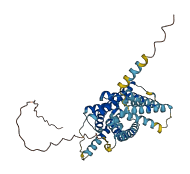
Descriptions
The autoinhibited protein was predicted that may have potential autoinhibitory elements via cis-regPred.
Autoinhibitory domains (AIDs)
Target domain |
|
Relief mechanism |
|
Assay |
cis-regPred |
Accessory elements
No accessory elements
Autoinhibited structure

Activated structure
1 structures for Q9VVD9
| Entry ID | Method | Resolution | Chain | Position | Source |
|---|---|---|---|---|---|
| AF-Q9VVD9-F1 | Predicted | AlphaFoldDB |
No variants for Q9VVD9
| Variant ID(s) | Position | Change | Description | Diseaes Association | Provenance |
|---|---|---|---|---|---|
| No variants for Q9VVD9 | |||||
No associated diseases with Q9VVD9
No regional properties for Q9VVD9
| Type | Name | Position | InterPro Accession |
|---|---|---|---|
| No domain, repeats, and functional sites for Q9VVD9 | |||
5 GO annotations of cellular component
| Name | Definition |
|---|---|
| endoplasmic reticulum | The irregular network of unit membranes, visible only by electron microscopy, that occurs in the cytoplasm of many eukaryotic cells. The membranes form a complex meshwork of tubular channels, which are often expanded into slitlike cavities called cisternae. The ER takes two forms, rough (or granular), with ribosomes adhering to the outer surface, and smooth (with no ribosomes attached). |
| Golgi apparatus | A membrane-bound cytoplasmic organelle of the endomembrane system that further processes the core oligosaccharides (e.g. N-glycans) added to proteins in the endoplasmic reticulum and packages them into membrane-bound vesicles. The Golgi apparatus operates at the intersection of the secretory, lysosomal, and endocytic pathways. |
| Golgi cis cisterna | The Golgi cisterna closest to the endoplasmic reticulum; the first processing compartment through which proteins pass after export from the ER. |
| integral component of endoplasmic reticulum membrane | The component of the endoplasmic reticulum membrane consisting of the gene products and protein complexes having at least some part of their peptide sequence embedded in the hydrophobic region of the membrane. |
| integral component of Golgi membrane | The component of the Golgi membrane consisting of the gene products and protein complexes having at least some part of their peptide sequence embedded in the hydrophobic region of the membrane. |
2 GO annotations of molecular function
| Name | Definition |
|---|---|
| 3'-phosphoadenosine 5'-phosphosulfate transmembrane transporter activity | Enables the transfer of 3'-phosphoadenosine 5'-phosphosulfate, a naturally occurring mixed anhydride synthesized from adenosine 5'-phosphosulfate, from one side of a membrane to the other. |
| transmembrane transporter activity | Enables the transfer of a substance, usually a specific substance or a group of related substances, from one side of a membrane to the other. |
2 GO annotations of biological process
| Name | Definition |
|---|---|
| 3'-phosphoadenosine 5'-phosphosulfate transport | The directed movement of 3'-phosphoadenosine 5'-phosphosulfate, a naturally occurring mixed anhydride synthesized from adenosine 5'-phosphosulfate, into, out of or within a cell, or between cells, by means of some agent such as a transporter or pore. |
| heparan sulfate proteoglycan biosynthetic process | The chemical reactions and pathways resulting in the formation of the heparan sulfate proteoglycan, a glycosaminoglycan with repeat unit consisting of alternating alpha-(1->4)-linked hexuronic acid and glucosamine residues; the former are a mixture of sulfated and nonsulfated D-glucuronic acid and L-iduronic acid; the L-iduronic acid is either sulfated or acetylated on its amino group as well as being sulfated on one of its hydroxyl groups; heparan sulfate chains are covalently linked to peptidyl-serine by a glycosidic attachment through the trisaccharide galactosyl-galactosyl-xylosyl to serine residues. |
1 homologous proteins in AiPD
| UniProt AC | Gene Name | Protein Name | Species | Evidence Code |
|---|---|---|---|---|
| Q9LDX3 | UTR4 | UDP-galactose/UDP-glucose transporter 4 | Arabidopsis thaliana (Mouse-ear cress) | PR |
| 10 | 20 | 30 | 40 | 50 | 60 |
| MYIDTSASSR | MTDNKGSVIT | INGGESAGNS | PPSQRKSSTS | ESPPELRILC | FDLTYYNRTT |
| 70 | 80 | 90 | 100 | 110 | 120 |
| QFLLSCAGVF | FLYILYGYLQ | ELIFTVEGFK | PYGWFLTLVQ | FGYYIGFGLV | ERRLEGYRIS |
| 130 | 140 | 150 | 160 | 170 | 180 |
| GGSFWNIEPE | PRCIPMRTYL | ILAALTLGTM | GLSNSSLGYL | NYPTQVIFKC | CKLIPVLVGS |
| 190 | 200 | 210 | 220 | 230 | 240 |
| ILIQGKRYGL | LDFAAATCMC | IGLAWFTLAD | SQMTPNFNLL | GVAMISGALL | CDAAIGNVQE |
| 250 | 260 | 270 | 280 | 290 | 300 |
| KAMREFKAPS | SEVVFYSYGL | GFVYLFVIML | VTGNFFSGFA | FCLEHPVETF | GYGFLFSLSG |
| 310 | 320 | 330 | 340 | 350 | 360 |
| YLGIQFVLAL | VRSSGAPIAA | TVTTARKAVT | IAFSFVLFSK | PFTLQYLWSG | LIVVLGIYLN |
| 370 | 380 | 390 | |||
| VYSKRNKLTL | ADVRQRIKQF | GAKVARSPSR | KFLIEV |