Q9VUB4
Gene name |
Nprl3 |
Protein name |
GATOR complex protein NPRL3 |
Names |
Nitrogen permease regulator 3-like protein |
Species |
Drosophila melanogaster (Fruit fly) |
KEGG Pathway |
dme:Dmel_CG8783 |
EC number |
|
Protein Class |
|
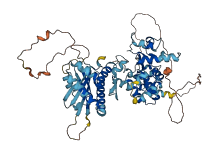
Descriptions
The autoinhibited protein was predicted that may have potential autoinhibitory elements via cis-regPred.
Autoinhibitory domains (AIDs)
Target domain |
|
Relief mechanism |
|
Assay |
cis-regPred |
Accessory elements
No accessory elements
Autoinhibited structure

Activated structure
1 structures for Q9VUB4
| Entry ID | Method | Resolution | Chain | Position | Source |
|---|---|---|---|---|---|
| AF-Q9VUB4-F1 | Predicted | AlphaFoldDB |
No variants for Q9VUB4
| Variant ID(s) | Position | Change | Description | Diseaes Association | Provenance |
|---|---|---|---|---|---|
| No variants for Q9VUB4 | |||||
No associated diseases with Q9VUB4
No regional properties for Q9VUB4
| Type | Name | Position | InterPro Accession |
|---|---|---|---|
| No domain, repeats, and functional sites for Q9VUB4 | |||
7 GO annotations of cellular component
| Name | Definition |
|---|---|
| autolysosome | A type of secondary lysosome in which a primary lysosome has fused with the outer membrane of an autophagosome. It is involved in the second step of autophagy in which it degrades contents with acidic lysosomal hydrolases. |
| cytoplasm | The contents of a cell excluding the plasma membrane and nucleus, but including other subcellular structures. |
| GATOR1 complex | A GTPase-activating protein (GAP) complex that regulates TORC1 signaling by interacting with the Rag GTPase. In human, the GATOR1 complex consists of DEPDC5, NPRL2, and NPRL3. In S. cerevisiae, this complex is referred to as SEACIT and contains the Iml1p, Npr2p, and Npr3p proteins. |
| GATOR2 complex | A multiprotein subcomplex of the GATOR complex that regulates TORC1 signaling by interacting with the Rag GTPase. In human, this complex consists of WDR24, WDR59, MIOS, SEH1L, and SEC13. In S. cerevisiae, this complex is referred to as SEACAT and contains the Sea2p, Sea3p, Sea4p, Seh1p, Sec13p proteins. |
| lysosome | A small lytic vacuole that has cell cycle-independent morphology found in most animal cells and that contains a variety of hydrolases, most of which have their maximal activities in the pH range 5-6. The contained enzymes display latency if properly isolated. About 40 different lysosomal hydrolases are known and lysosomes have a great variety of morphologies and functions. |
| nucleus | A membrane-bounded organelle of eukaryotic cells in which chromosomes are housed and replicated. In most cells, the nucleus contains all of the cell's chromosomes except the organellar chromosomes, and is the site of RNA synthesis and processing. In some species, or in specialized cell types, RNA metabolism or DNA replication may be absent. |
| Seh1-associated complex | A GTPase-activating protein (GAP) complex that regulates TORC1 signaling by interacting with the Rag GTPase. In S. cerevisiae the complex contains Seh1p, Sec13p, Npr2p, Npr3p, Iml1p, Mtc5p, Rtc1p, and Sea4p. |
No GO annotations of molecular function
| Name | Definition |
|---|---|
| No GO annotations for molecular function |
13 GO annotations of biological process
| Name | Definition |
|---|---|
| cell division | The process resulting in division and partitioning of components of a cell to form more cells; may or may not be accompanied by the physical separation of a cell into distinct, individually membrane-bounded daughter cells. |
| cellular response to amino acid starvation | Any process that results in a change in state or activity of a cell (in terms of movement, secretion, enzyme production, gene expression, etc.) as a result of deprivation of amino acids. |
| germarium-derived egg chamber formation | Construction of a stage-1 egg chamber in the anterior part of the germarium, from the progeny of germ-line and somatic stem cells. An example of this is found in Drosophila melanogaster. |
| meiotic cell cycle | Progression through the phases of the meiotic cell cycle, in which canonically a cell replicates to produce four offspring with half the chromosomal content of the progenitor cell via two nuclear divisions. |
| negative regulation of cell size | Any process that reduces cell size. |
| negative regulation of macroautophagy by TORC1 signaling | A TORC1 signaling that results in negative regulation of macroautophagy. |
| negative regulation of TOR signaling | Any process that stops, prevents, or reduces the frequency, rate or extent of TOR signaling. |
| negative regulation of TORC1 signaling | Any process that stops, prevents or reduces the frequency, rate or extent of TORC1 signaling. |
| oogenesis | The complete process of formation and maturation of an ovum or female gamete from a primordial female germ cell. Examples of this process are found in Mus musculus and Drosophila melanogaster. |
| positive regulation of autophagy | Any process that activates, maintains or increases the rate of autophagy. Autophagy is the process in which cells digest parts of their own cytoplasm. |
| positive regulation of macroautophagy | Any process, such as recognition of nutrient depletion, that activates or increases the rate of macroautophagy to bring cytosolic macromolecules to the vacuole/lysosome for degradation. |
| positive regulation of triglyceride catabolic process | Any process that increases the frequency, rate, or extent of the chemical reactions and pathways resulting in the breakdown of triglyceride. |
| TORC1 signaling | A series of intracellular molecular signals mediated by TORC1; TOR (target of rapamycin) in complex with at least Raptor (regulatory-associated protein of TOR), or orthologs of, and other signaling components. |
No homologous proteins in AiPD
| UniProt AC | Gene Name | Protein Name | Species | Evidence Code |
|---|---|---|---|---|
| No homologous proteins | ||||
| 10 | 20 | 30 | 40 | 50 | 60 |
| METNVNPLAV | ILVYFDSKGD | RLLYRYPYQT | LGQTEVANDE | QRKSRKRNPY | AVANTDDLLQ |
| 70 | 80 | 90 | 100 | 110 | 120 |
| TPTHLGAAKS | QGQLQGFADE | VLSALFAVKP | QLCNQKFELK | LNDVRFVSHP | TLIPQKEQRS |
| 130 | 140 | 150 | 160 | 170 | 180 |
| GPMAKQQMLI | NIVFALHAQA | SYSIVKCYHE | LSKRLGLALK | FEEQRSGYLT | EQTAQMARTH |
| 190 | 200 | 210 | 220 | 230 | 240 |
| DEQQQQPLER | TLELIAERCS | LAQALRSIFH | DLCTTGLLST | SLNHNLTLCF | CLPAKAHQLH |
| 250 | 260 | 270 | 280 | 290 | 300 |
| KKGSMVDPET | IDRCLRALKP | YHGMLLLVDF | AELLDCVPPT | GARMLWQLVD | VYDPLISLQS |
| 310 | 320 | 330 | 340 | 350 | 360 |
| MSSNADLSIE | HVYKLVSHLV | YWAKATIIYP | LCETNVYVIA | PDAPLHTKSH | LVEKFSARFA |
| 370 | 380 | 390 | 400 | 410 | 420 |
| GMSLFEVISD | FSLPTSIGHL | TTPLQQPARQ | GILAQMVIWM | LQHHLLMQLH | TYVQFMPSED |
| 430 | 440 | 450 | 460 | 470 | 480 |
| EFGDSASCSN | HLRDAISDEE | GDQEPDADEL | HGSMLSMSSH | PLPVPAVLVG | GHRREASEDH |
| 490 | 500 | 510 | 520 | 530 | 540 |
| SSLASDNIAV | QPSSSHKSNF | SITASMSTDN | CDSLDSMEDE | QKLKELLQVF | SDADRAAIRR |
| 550 | 560 | 570 | 580 | 590 | 600 |
| IPASANVDDL | SLLVKLYQMG | YFKSEHHLEE | IMYFENLRRS | QLLQLLDKFR | DVLIIYETED |
| PAIASMYNTK |