Q9VEC1
Gene name |
MED17 (Trap80, CG7957) |
Protein name |
Mediator of RNA polymerase II transcription subunit 17 |
Names |
Mediator complex subunit 17, dMED17, dTRAP80 |
Species |
Drosophila melanogaster (Fruit fly) |
KEGG Pathway |
dme:Dmel_CG7957 |
EC number |
|
Protein Class |
|
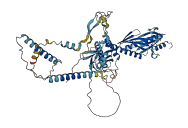
Descriptions
The autoinhibited protein was predicted that may have potential autoinhibitory elements via cis-regPred.
Autoinhibitory domains (AIDs)
Target domain |
|
Relief mechanism |
|
Assay |
cis-regPred |
Accessory elements
No accessory elements
Autoinhibited structure

Activated structure
1 structures for Q9VEC1
| Entry ID | Method | Resolution | Chain | Position | Source |
|---|---|---|---|---|---|
| AF-Q9VEC1-F1 | Predicted | AlphaFoldDB |
No variants for Q9VEC1
| Variant ID(s) | Position | Change | Description | Diseaes Association | Provenance |
|---|---|---|---|---|---|
| No variants for Q9VEC1 | |||||
No associated diseases with Q9VEC1
No regional properties for Q9VEC1
| Type | Name | Position | InterPro Accession |
|---|---|---|---|
| No domain, repeats, and functional sites for Q9VEC1 | |||
4 GO annotations of cellular component
| Name | Definition |
|---|---|
| core mediator complex | A protein complex that interacts with the carboxy-terminal domain of the largest subunit of RNA polymerase II and plays an active role in transducing the signal from a transcription factor to the transcriptional machinery. The core mediator complex has a stimulatory effect on basal transcription, and contains most of the same subdomains as the larger form of mediator complex -- a head domain comprising proteins known in Saccharomyces as Srb2, -4, and -5, Med6, -8, and -11, and Rox3 proteins; a middle domain comprising Med1, -4, and -7, Nut1 and -2, Cse2, Rgr1, Soh1, and Srb7 proteins; and a tail consisting of Gal11p, Med2p, Pgd1p, and Sin4p -- but lacks the regulatory subcomplex comprising Ssn2, -3, and -8, and Srb8 proteins. Metazoan core mediator complexes have similar modular structures and include homologs of yeast Srb and Med proteins. |
| mediator complex | A protein complex that interacts with the carboxy-terminal domain of the largest subunit of RNA polymerase II and plays an active role in transducing the signal from a transcription factor to the transcriptional machinery. The mediator complex is required for activation of transcription of most protein-coding genes, but can also act as a transcriptional corepressor. The Saccharomyces complex contains several identifiable subcomplexes: a head domain comprising Srb2, -4, and -5, Med6, -8, and -11, and Rox3 proteins; a middle domain comprising Med1, -4, and -7, Nut1 and -2, Cse2, Rgr1, Soh1, and Srb7 proteins; a tail consisting of Gal11p, Med2p, Pgd1p, and Sin4p; and a regulatory subcomplex comprising Ssn2, -3, and -8, and Srb8 proteins. Metazoan mediator complexes have similar modular structures and include homologs of yeast Srb and Med proteins. |
| nucleus | A membrane-bounded organelle of eukaryotic cells in which chromosomes are housed and replicated. In most cells, the nucleus contains all of the cell's chromosomes except the organellar chromosomes, and is the site of RNA synthesis and processing. In some species, or in specialized cell types, RNA metabolism or DNA replication may be absent. |
| pericentric heterochromatin | Heterochromatin that is located adjacent to the CENP-A rich centromere 'central core' and characterized by methylated H3 histone at lysine 9 (H3K9me2/H3K9me3). |
2 GO annotations of molecular function
| Name | Definition |
|---|---|
| DNA-binding transcription factor binding | Binding to a DNA-binding transcription factor, a protein that interacts with a specific DNA sequence (sometimes referred to as a motif) within the regulatory region of a gene to modulate transcription. |
| transcription coregulator activity | A transcription regulator activity that modulates the transcription of specific gene sets via binding to a DNA-bound DNA-binding transcription factor, either on its own or as part of a complex. Coregulators often act by altering chromatin structure and modifications. For example, one class of transcription coregulators modifies chromatin structure through covalent modification of histones. A second class remodels the conformation of chromatin in an ATP-dependent fashion. A third class modulates interactions of DNA-bound DNA-binding transcription factors with other transcription coregulators. |
5 GO annotations of biological process
| Name | Definition |
|---|---|
| cellular process | Any process that is carried out at the cellular level, but not necessarily restricted to a single cell. For example, cell communication occurs among more than one cell, but occurs at the cellular level. |
| positive regulation of transcription by RNA polymerase II | Any process that activates or increases the frequency, rate or extent of transcription from an RNA polymerase II promoter. |
| regulation of transcription by RNA polymerase II | Any process that modulates the frequency, rate or extent of transcription mediated by RNA polymerase II. |
| regulation of transcription initiation by RNA polymerase II | Any process that modulates the rate, frequency or extent of a process involved in starting transcription from an RNA polymerase II promoter. |
| sex comb development | The process whose specific outcome is the progression of the sex comb over time, from its formation to the mature structure. The sex combs are the male specific chaetae located on the prothoracic tarsal segment of the prothoracic leg. |
| 10 | 20 | 30 | 40 | 50 | 60 |
| MSNSVNISVE | TTCENQIREI | GYDGTELYQP | PPTLSESLAK | CAARIDFSKT | SLDDLKKEEK |
| 70 | 80 | 90 | 100 | 110 | 120 |
| SAAAAADEDK | DATQFQESLW | PWDAVRNKLK | DALTEICVLS | DVISIAKDKR | YLVLDPLLEE |
| 130 | 140 | 150 | 160 | 170 | 180 |
| ADDTKPIVQV | YSRKKAISQA | AQVLLSGAER | LRNAHSEQRN | RNVSDFHIEL | LRLRQNWRLK |
| 190 | 200 | 210 | 220 | 230 | 240 |
| KVSNAIIGDL | SYRTAGSKFG | MSGTFEVTKA | EETGDEDTAS | SSNSSSSVSG | NNGMQLKASS |
| 250 | 260 | 270 | 280 | 290 | 300 |
| ALRVIVPAEL | QGVAYIKVIT | QKDQEDLCTA | QLNLMGHGPN | ITAQVGVWQK | TLEFAQNVLF |
| 310 | 320 | 330 | 340 | 350 | 360 |
| CKELFAQLAR | EAIQLQAPIP | HVVIGNQIRA | TLLPNIQLII | SLCHSTTFDS | SQPAPINDHD |
| 370 | 380 | 390 | 400 | 410 | 420 |
| HVLEHSLHQL | LREVHYKNSH | HPFPHPASAP | LGPTKKRMLA | GPMAADRETL | LDMTKSQTIL |
| 430 | 440 | 450 | 460 | 470 | 480 |
| EQIIAQAQHI | FMRKRTQYVL | DTLARDVKDP | QIVSHWNAMN | SPTMSCVKIN | IVTHGYDAIG |
| 490 | 500 | 510 | 520 | 530 | 540 |
| RTSLVIHVKE | RSLKCICRDG | RVMRLSYEPQ | ELRDLILCQI | NSHQISCLIS | LARCMSWTVL |
| 550 | 560 | 570 | 580 | 590 | 600 |
| SNSNHLGIGK | VEPLGNASSC | LLASPNSDRM | IAVQIRCDPQ | IDVKVYIARS | PRQDFFPSPL |
| 610 | 620 | 630 | 640 | ||
| VPEKLWENLG | GTFKEVRFDK | IEGKSFLNKM | EFLMASLTSN | TA |