Q9V831
Gene name |
APC10 (CG11419) |
Protein name |
Anaphase-promoting complex subunit 10 |
Names |
APC10, Cyclosome subunit 10 |
Species |
Drosophila melanogaster (Fruit fly) |
KEGG Pathway |
dme:Dmel_CG11419 |
EC number |
|
Protein Class |
|
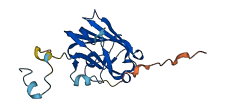
Descriptions
The autoinhibited protein was predicted that may have potential autoinhibitory elements via cis-regPred.
Autoinhibitory domains (AIDs)
Target domain |
|
Relief mechanism |
|
Assay |
cis-regPred |
Accessory elements
No accessory elements
Autoinhibited structure

Activated structure
1 structures for Q9V831
| Entry ID | Method | Resolution | Chain | Position | Source |
|---|---|---|---|---|---|
| AF-Q9V831-F1 | Predicted | AlphaFoldDB |
No variants for Q9V831
| Variant ID(s) | Position | Change | Description | Diseaes Association | Provenance |
|---|---|---|---|---|---|
| No variants for Q9V831 | |||||
No associated diseases with Q9V831
1 GO annotations of cellular component
| Name | Definition |
|---|---|
| anaphase-promoting complex | A ubiquitin ligase complex that degrades mitotic cyclins and anaphase inhibitory protein, thereby triggering sister chromatid separation and exit from mitosis. Substrate recognition by APC occurs through degradation signals, the most common of which is termed the Dbox degradation motif, originally discovered in cyclin B. |
No GO annotations of molecular function
| Name | Definition |
|---|---|
| No GO annotations for molecular function |
6 GO annotations of biological process
| Name | Definition |
|---|---|
| anaphase-promoting complex-dependent catabolic process | The chemical reactions and pathways resulting in the breakdown of a protein or peptide by hydrolysis of its peptide bonds, initiated by the covalent attachment of ubiquitin, with ubiquitin-protein ligation catalyzed by the anaphase-promoting complex, and mediated by the proteasome. |
| cell division | The process resulting in division and partitioning of components of a cell to form more cells; may or may not be accompanied by the physical separation of a cell into distinct, individually membrane-bounded daughter cells. |
| endomitotic cell cycle | A mitotic cell cycle in which chromosomes are replicated and sister chromatids separate, but spindle formation, nuclear membrane breakdown and nuclear division do not occur, resulting in an increased number of chromosomes in the cell. |
| mitotic cell cycle | Progression through the phases of the mitotic cell cycle, the most common eukaryotic cell cycle, which canonically comprises four successive phases called G1, S, G2, and M and includes replication of the genome and the subsequent segregation of chromosomes into daughter cells. In some variant cell cycles nuclear replication or nuclear division may not be followed by cell division, or G1 and G2 phases may be absent. |
| protein K11-linked ubiquitination | A protein ubiquitination process in which ubiquitin monomers are attached to a protein, and then ubiquitin polymers are formed by linkages between lysine residues at position 11 of the ubiquitin monomers. K11-linked polyubiquitination targets the substrate protein for degradation. The anaphase-promoting complex promotes the degradation of mitotic regulators by assembling K11-linked polyubiquitin chains. |
| regulation of stem cell differentiation | Any process that modulates the frequency, rate or extent of stem cell differentiation. |
No homologous proteins in AiPD
| UniProt AC | Gene Name | Protein Name | Species | Evidence Code |
|---|---|---|---|---|
| No homologous proteins | ||||
| 10 | 20 | 30 | 40 | 50 | 60 |
| MAASMDEDIT | ANPPPSSEED | PLAEERLGFV | REVGAQAVWS | LSSCKPGFGV | ERLRDNIMDT |
| 70 | 80 | 90 | 100 | 110 | 120 |
| YWQSDGQLPH | LVNIQFHKRT | NISQIYIYTD | YKLDESYTPS | RISIRSGTNF | NDLQELQVMD |
| 130 | 140 | 150 | 160 | 170 | 180 |
| LTEPTGWVQI | PIKDGNVKSI | RTFMLQIAVI | SNHQNGRDTH | MRQIRIHAPV | EGKHYPLELF |
| 190 | |||||
| GKFGTVDFQK | FATIR |