Q9V785
Gene name |
pcs (CG7761) |
Protein name |
SH3 domain-binding protein 5 homolog |
Names |
Protein parcase |
Species |
Drosophila melanogaster (Fruit fly) |
KEGG Pathway |
dme:Dmel_CG7761 |
EC number |
|
Protein Class |
|
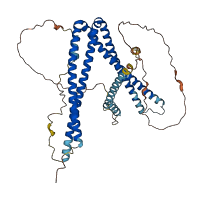
Descriptions
The autoinhibited protein was predicted that may have potential autoinhibitory elements via cis-regPred.
Autoinhibitory domains (AIDs)
Target domain |
|
Relief mechanism |
|
Assay |
cis-regPred |
Accessory elements
No accessory elements
Autoinhibited structure

Activated structure
1 structures for Q9V785
| Entry ID | Method | Resolution | Chain | Position | Source |
|---|---|---|---|---|---|
| AF-Q9V785-F1 | Predicted | AlphaFoldDB |
No variants for Q9V785
| Variant ID(s) | Position | Change | Description | Diseaes Association | Provenance |
|---|---|---|---|---|---|
| No variants for Q9V785 | |||||
No associated diseases with Q9V785
No regional properties for Q9V785
| Type | Name | Position | InterPro Accession |
|---|---|---|---|
| No domain, repeats, and functional sites for Q9V785 | |||
2 GO annotations of cellular component
| Name | Definition |
|---|---|
| cytoplasm | The contents of a cell excluding the plasma membrane and nucleus, but including other subcellular structures. |
| plasma membrane | The membrane surrounding a cell that separates the cell from its external environment. It consists of a phospholipid bilayer and associated proteins. |
3 GO annotations of molecular function
| Name | Definition |
|---|---|
| guanyl-nucleotide exchange factor activity | Stimulates the exchange of GDP to GTP on a signaling GTPase, changing its conformation to its active form. Guanine nucleotide exchange factors (GEFs) act by stimulating the release of guanosine diphosphate (GDP) to allow binding of guanosine triphosphate (GTP), which is more abundant in the cell under normal cellular physiological conditions. |
| protein kinase inhibitor activity | Binds to and stops, prevents or reduces the activity of a protein kinase, an enzyme which phosphorylates a protein. |
| SH3 domain binding | Binding to a SH3 domain (Src homology 3) of a protein, small protein modules containing approximately 50 amino acid residues found in a great variety of intracellular or membrane-associated proteins. |
8 GO annotations of biological process
| Name | Definition |
|---|---|
| anterior/posterior pattern specification | The regionalization process in which specific areas of cell differentiation are determined along the anterior-posterior axis. The anterior-posterior axis is defined by a line that runs from the head or mouth of an organism to the tail or opposite end of the organism. |
| female germline ring canal formation | Assembly of the intercellular bridges that connect the germ-line cells of a female cyst. |
| intracellular signal transduction | The process in which a signal is passed on to downstream components within the cell, which become activated themselves to further propagate the signal and finally trigger a change in the function or state of the cell. |
| mesoderm development | The process whose specific outcome is the progression of the mesoderm over time, from its formation to the mature structure. The mesoderm is the middle germ layer that develops into muscle, bone, cartilage, blood and connective tissue. |
| muscle cell fate specification | The process in which a cell becomes capable of differentiating autonomously into a muscle cell in an environment that is neutral with respect to the developmental pathway; upon specification, the cell fate can be reversed. |
| muscle organ development | The process whose specific outcome is the progression of the muscle over time, from its formation to the mature structure. The muscle is an organ consisting of a tissue made up of various elongated cells that are specialized to contract and thus to produce movement and mechanical work. |
| muscle organ morphogenesis | The process in which the anatomical structures of muscle are generated and organized. |
| negative regulation of protein tyrosine kinase activity | Any process that decreases the rate, frequency, or extent of protein tyrosine kinase activity. |
1 homologous proteins in AiPD
| UniProt AC | Gene Name | Protein Name | Species | Evidence Code |
|---|---|---|---|---|
| Q7L8J4 | SH3BP5L | SH3 domain-binding protein 5-like | Homo sapiens (Human) | PR |
| 10 | 20 | 30 | 40 | 50 | 60 |
| MSSAEDGELD | PQIQIELENL | NSATDEINKL | EIELEEANST | FRILLNESTR | RLKVSSKKLG |
| 70 | 80 | 90 | 100 | 110 | 120 |
| NCIEKARPYY | EALDKAREAQ | IECQKAAVKF | QRANEIHAAA | KETVALAEQR | FMSNSHEWQF |
| 130 | 140 | 150 | 160 | 170 | 180 |
| DNAWQEMLNH | ATQKVMDAET | QKADCHAEHQ | RLTKLFNAAE | QKLQQLEDRF | RRSINKSRPY |
| 190 | 200 | 210 | 220 | 230 | 240 |
| FEEKQVCQDQ | LQTQKNRIQE | LQQQVAGAKS | TYSTALRNLE | RISEDIHRQR | GDFPTPPGPR |
| 250 | 260 | 270 | 280 | 290 | 300 |
| EPGVGAELNS | PTSSALPSLP | DFQLELEKCD | YPSIAGSQMS | LGAKTPQAAA | ETEDEEDACD |
| 310 | 320 | 330 | 340 | 350 | 360 |
| YDETGAGELR | GVVDERDLEA | LRQKVKILAV | RPIEGGDGQQ | QNDVWEHELK | ATVDKLDHLM |
| 370 | 380 | 390 | 400 | 410 | 420 |
| MLKETAKRQQ | TNRLKSTEQR | PDSLGAEALK | RHCDVVEVKV | TSCATTASLP | VTPHHQLNHL |
| 430 | 440 | 450 | 460 | 470 | |
| APPTPIKKLQ | QQLAPLPSVN | VSMRELPLLA | RLSNELLDRS | SAAFGGVRKT | LRRRSLE |