Q9V122
Gene name |
psmA |
Protein name |
Proteasome subunit alpha |
Names |
20S proteasome alpha subunit, Proteasome core protein PsmA |
Species |
Pyrococcus abyssi (strain GE5 / Orsay) |
KEGG Pathway |
pab:PAB0417 |
EC number |
|
Protein Class |
|
Descriptions
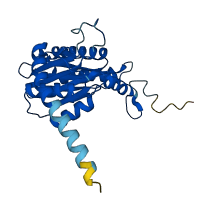
The autoinhibited protein was predicted that may have potential autoinhibitory elements via cis-regPred.
Autoinhibitory domains (AIDs)
Target domain |
|
Relief mechanism |
|
Assay |
cis-regPred |
Accessory elements
No accessory elements
Autoinhibited structure

Activated structure
1 structures for Q9V122
| Entry ID | Method | Resolution | Chain | Position | Source |
|---|---|---|---|---|---|
| AF-Q9V122-F1 | Predicted | AlphaFoldDB |
No variants for Q9V122
| Variant ID(s) | Position | Change | Description | Diseaes Association | Provenance |
|---|---|---|---|---|---|
| No variants for Q9V122 | |||||
No associated diseases with Q9V122
1 regional properties for Q9V122
| Type | Name | Position | InterPro Accession |
|---|---|---|---|
| domain | Proteasome alpha-subunit, N-terminal domain | 10 - 32 | IPR000426 |
2 GO annotations of cellular component
| Name | Definition |
|---|---|
| cytoplasm | The contents of a cell excluding the plasma membrane and nucleus, but including other subcellular structures. |
| proteasome core complex, alpha-subunit complex | The proteasome core subcomplex that constitutes the two outer rings of the proteasome core complex. An example of this component is found in Mus musculus. |
1 GO annotations of molecular function
| Name | Definition |
|---|---|
| threonine-type endopeptidase activity | Catalysis of the hydrolysis of internal peptide bonds in a polypeptide chain by a mechanism in which the hydroxyl group of a threonine residue at the active center acts as a nucleophile. |
2 GO annotations of biological process
| Name | Definition |
|---|---|
| proteasomal protein catabolic process | The chemical reactions and pathways resulting in the breakdown of a protein or peptide by hydrolysis of its peptide bonds that is mediated by the proteasome. |
| ubiquitin-dependent protein catabolic process | The chemical reactions and pathways resulting in the breakdown of a protein or peptide by hydrolysis of its peptide bonds, initiated by the covalent attachment of a ubiquitin group, or multiple ubiquitin groups, to the protein. |
No homologous proteins in AiPD
| UniProt AC | Gene Name | Protein Name | Species | Evidence Code |
|---|---|---|---|---|
| No homologous proteins | ||||
| 10 | 20 | 30 | 40 | 50 | 60 |
| MAFVPPQAGY | DRAITVFSPD | GRLFQVNYAR | EAVKRGATAV | GVKCKDGVVL | AVEKRITSRL |
| 70 | 80 | 90 | 100 | 110 | 120 |
| IEPESYEKIF | QIDDHIAAAS | SGIIADARVL | VNRARLEAQI | HRLTYGEPAP | LAVIVKKICD |
| 130 | 140 | 150 | 160 | 170 | 180 |
| LKQMHTQYGG | VRPFGAALLM | AGVNDKPELY | ETDPSGAYFA | WKAVAIGSGR | NTAMAIFEDK |
| 190 | 200 | 210 | 220 | 230 | 240 |
| YRDDMTLDEA | IKLAIFALAK | TMEKPSAENI | EVAVITVKDK | KFRKLSKEEI | EKFLGEVMKE |
| 250 | |||||
| VEEEEVKEKE | EDYSELDSHY |