Q9UZS9
Gene name |
fni |
Protein name |
Isopentenyl-diphosphate delta-isomerase |
Names |
IPP isomerase, Isopentenyl diphosphate:dimethylallyl diphosphate isomerase, Isopentenyl pyrophosphate isomerase, Type 2 isopentenyl diphosphate isomerase, IDI-2 |
Species |
Pyrococcus abyssi (strain GE5 / Orsay) |
KEGG Pathway |
pab:PAB1662 |
EC number |
5.3.3.2: Transposing C=C bonds |
Protein Class |
|
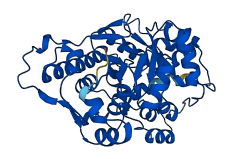
Descriptions
The autoinhibited protein was predicted that may have potential autoinhibitory elements via cis-regPred.
Autoinhibitory domains (AIDs)
Target domain |
|
Relief mechanism |
|
Assay |
cis-regPred |
Accessory elements
No accessory elements
Autoinhibited structure

Activated structure
1 structures for Q9UZS9
| Entry ID | Method | Resolution | Chain | Position | Source |
|---|---|---|---|---|---|
| AF-Q9UZS9-F1 | Predicted | AlphaFoldDB |
No variants for Q9UZS9
| Variant ID(s) | Position | Change | Description | Diseaes Association | Provenance |
|---|---|---|---|---|---|
| No variants for Q9UZS9 | |||||
No associated diseases with Q9UZS9
4 regional properties for Q9UZS9
Functions
| Description | ||
|---|---|---|
| EC Number | 5.3.3.2 | Transposing C=C bonds |
| Subcellular Localization |
|
|
| PANTHER Family | ||
| PANTHER Subfamily | ||
| PANTHER Protein Class | ||
| PANTHER Pathway Category | No pathway information available | |
1 GO annotations of cellular component
| Name | Definition |
|---|---|
| cytoplasm | The contents of a cell excluding the plasma membrane and nucleus, but including other subcellular structures. |
5 GO annotations of molecular function
| Name | Definition |
|---|---|
| FMN binding | Binding to flavin mono nucleotide. Flavin mono nucleotide (FMN) is the coenzyme or the prosthetic group of various flavoprotein oxidoreductase enzymes. |
| isopentenyl-diphosphate delta-isomerase activity | Catalysis of the reaction: isopentenyl diphosphate = dimethylallyl diphosphate. |
| magnesium ion binding | Binding to a magnesium (Mg) ion. |
| NADPH binding | Binding to the reduced form, NADPH, of nicotinamide-adenine dinucleotide phosphate, a coenzyme involved in many redox and biosynthetic reactions. |
| oxidoreductase activity | Catalysis of an oxidation-reduction (redox) reaction, a reversible chemical reaction in which the oxidation state of an atom or atoms within a molecule is altered. One substrate acts as a hydrogen or electron donor and becomes oxidized, while the other acts as hydrogen or electron acceptor and becomes reduced. |
1 GO annotations of biological process
| Name | Definition |
|---|---|
| isoprenoid biosynthetic process | The chemical reactions and pathways resulting in the formation of an isoprenoid compound, isoprene (2-methylbuta-1,3-diene) or compounds containing or derived from linked isoprene (3-methyl-2-butenylene) residues. |
No homologous proteins in AiPD
| UniProt AC | Gene Name | Protein Name | Species | Evidence Code |
|---|---|---|---|---|
| No homologous proteins | ||||
| 10 | 20 | 30 | 40 | 50 | 60 |
| MEEQTILRKF | EHIKHCLTKN | VEAHVTNGFE | DVHLIHKSLP | EIDKDEIDLS | VKFLGRKFDY |
| 70 | 80 | 90 | 100 | 110 | 120 |
| PIMITGMTGG | TRKGEIAWRI | NRTLAQAAQE | LNIPLGLGSQ | RAMIEKPETW | ESYYVRDVAP |
| 130 | 140 | 150 | 160 | 170 | 180 |
| DVFLVGNLGA | PQFGRNAKKR | YSVDEVLYAI | EKIEADAIAI | HMNPLQESIQ | PEGDTTFSGV |
| 190 | 200 | 210 | 220 | 230 | 240 |
| LEALAEITST | IDYPVIAKET | GAGVSKEVAV | ELEAVGVDAI | DISGLGGTSW | SAVEYYRTKD |
| 250 | 260 | 270 | 280 | 290 | 300 |
| GEKRNLALKF | WDWGIKTAIS | LAEVRWATNL | PIIASGGMRD | GITMAKALAM | GASMVGIALP |
| 310 | 320 | 330 | 340 | 350 | 360 |
| VLRPAAKGDV | EGVIRIIKGY | AEEIRNVMFL | VGARNIKELR | KVPLVITGFV | REWLLQRIDL |
| NSYLRARFKM |