Q9UW81
Gene name |
nop-1 (NCU10055) |
Protein name |
Opsin-1 |
Names |
NR |
Species |
Neurospora crassa (strain ATCC 24698 / 74-OR23-1A / CBS 708.71 / DSM 1257 / FGSC 987) |
KEGG Pathway |
ncr:NCU10055 |
EC number |
|
Protein Class |
|
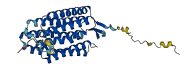
Descriptions
The autoinhibited protein was predicted that may have potential autoinhibitory elements via cis-regPred.
Autoinhibitory domains (AIDs)
Target domain |
|
Relief mechanism |
|
Assay |
cis-regPred |
Accessory elements
No accessory elements
Autoinhibited structure

Activated structure
1 structures for Q9UW81
| Entry ID | Method | Resolution | Chain | Position | Source |
|---|---|---|---|---|---|
| AF-Q9UW81-F1 | Predicted | AlphaFoldDB |
No variants for Q9UW81
| Variant ID(s) | Position | Change | Description | Diseaes Association | Provenance |
|---|---|---|---|---|---|
| No variants for Q9UW81 | |||||
No associated diseases with Q9UW81
2 GO annotations of cellular component
| Name | Definition |
|---|---|
| integral component of membrane | The component of a membrane consisting of the gene products and protein complexes having at least some part of their peptide sequence embedded in the hydrophobic region of the membrane. |
| plasma membrane | The membrane surrounding a cell that separates the cell from its external environment. It consists of a phospholipid bilayer and associated proteins. |
3 GO annotations of molecular function
| Name | Definition |
|---|---|
| all-trans retinal binding | Binding to all-trans retinal, a compound that plays an important role in the visual process in most vertebrates. All-trans retinal (trans r., visual yellow) results from the bleaching of rhodopsin by light, in which the 11-cis form is converted to the all-trans form. Retinal is one of the forms of vitamin A. |
| ion channel activity | Enables the facilitated diffusion of an ion (by an energy-independent process) by passage through a transmembrane aqueous pore or channel without evidence for a carrier-mediated mechanism. May be either selective (it enables passage of a specific ion only) or non-selective (it enables passage of two or more ions of same charge but different size). |
| photoreceptor activity | The function of absorbing and responding to incidental electromagnetic radiation, particularly visible light. The response may involve a change in conformation. |
2 GO annotations of biological process
| Name | Definition |
|---|---|
| phototransduction | The sequence of reactions within a cell required to convert absorbed photons into a molecular signal. |
| response to light stimulus | Any process that results in a change in state or activity of a cell or an organism (in terms of movement, secretion, enzyme production, gene expression, etc.) as a result of a light stimulus, electromagnetic radiation of wavelengths classified as infrared, visible or ultraviolet light. |
No homologous proteins in AiPD
| UniProt AC | Gene Name | Protein Name | Species | Evidence Code |
|---|---|---|---|---|
| No homologous proteins | ||||
| 10 | 20 | 30 | 40 | 50 | 60 |
| MIHPEQVADM | LRPTTSTTSS | HVPGPVPTVV | PTPTEYQTLG | ETGHRTLWVT | FALMVLSSGI |
| 70 | 80 | 90 | 100 | 110 | 120 |
| FALLSWNVPT | SKRLFHVITT | LITVVASLSY | FAMATGHATT | FNCDTAWDHH | KHVPDTSHQV |
| 130 | 140 | 150 | 160 | 170 | 180 |
| CRQVFWGRYV | DWALTTPLLL | LELCLLAGVD | GAHTLMAIVA | DVIMVLCGLF | AALGEGGNTA |
| 190 | 200 | 210 | 220 | 230 | 240 |
| QKWGWYTIGC | FSYLFVIWHV | ALHGSRTVTA | KGRGVSRLFT | GLAVFALLLW | TAYPIIWGIA |
| 250 | 260 | 270 | 280 | 290 | 300 |
| GGARRTNVDT | EILIYTVLDL | LAKPVFGFWL | LLSHRAMPET | NIDLPGYWSH | GLATEGRIRI |
| GEED |