Q9UUJ9
Gene name |
ach1 (SPAC1952.09c) |
Protein name |
Acetyl-CoA hydrolase |
Names |
Acetyl-CoA deacylase, Acetyl-CoA acylase |
Species |
Schizosaccharomyces pombe (strain 972 / ATCC 24843) (Fission yeast) |
KEGG Pathway |
spo:SPAC1952.09c |
EC number |
3.1.2.1: Thiolester hydrolases |
Protein Class |
|
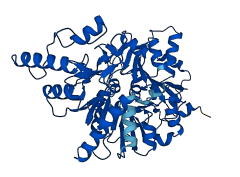
Descriptions
The autoinhibited protein was predicted that may have potential autoinhibitory elements via cis-regPred.
Autoinhibitory domains (AIDs)
Target domain |
|
Relief mechanism |
|
Assay |
cis-regPred |
Accessory elements
No accessory elements
Autoinhibited structure

Activated structure
1 structures for Q9UUJ9
| Entry ID | Method | Resolution | Chain | Position | Source |
|---|---|---|---|---|---|
| AF-Q9UUJ9-F1 | Predicted | AlphaFoldDB |
2 variants for Q9UUJ9
| Variant ID(s) | Position | Change | Description | Diseaes Association | Provenance |
|---|---|---|---|---|---|
| I_4982239_G_A | 221 | P>S | No | Jeffares_SNPs | |
| I_4981432_C_T | 490 | A>T | No | Jeffares_SNPs |
No associated diseases with Q9UUJ9
Functions
| Description | ||
|---|---|---|
| EC Number | 3.1.2.1 | Thiolester hydrolases |
| Subcellular Localization |
|
|
| PANTHER Family | ||
| PANTHER Subfamily | ||
| PANTHER Protein Class | ||
| PANTHER Pathway Category | No pathway information available | |
2 GO annotations of cellular component
| Name | Definition |
|---|---|
| cytosol | The part of the cytoplasm that does not contain organelles but which does contain other particulate matter, such as protein complexes. |
| mitochondrion | A semiautonomous, self replicating organelle that occurs in varying numbers, shapes, and sizes in the cytoplasm of virtually all eukaryotic cells. It is notably the site of tissue respiration. |
2 GO annotations of molecular function
| Name | Definition |
|---|---|
| acetate CoA-transferase activity | Catalysis of the reaction: acyl-CoA + acetate = a fatty acid anion + acetyl-CoA. |
| acetyl-CoA hydrolase activity | Catalysis of the reaction: acetyl-CoA + H(2)O = acetate + CoA + H(+). |
4 GO annotations of biological process
| Name | Definition |
|---|---|
| acetate metabolic process | The chemical reactions and pathways involving acetate, the anion of acetic acid. |
| acetyl-CoA metabolic process | The chemical reactions and pathways involving acetyl-CoA, a derivative of coenzyme A in which the sulfhydryl group is acetylated; it is a metabolite derived from several pathways (e.g. glycolysis, fatty acid oxidation, amino-acid catabolism) and is further metabolized by the tricarboxylic acid cycle. It is a key intermediate in lipid and terpenoid biosynthesis. |
| fatty acid biosynthetic process | The chemical reactions and pathways resulting in the formation of a fatty acid, any of the aliphatic monocarboxylic acids that can be liberated by hydrolysis from naturally occurring fats and oils. Fatty acids are predominantly straight-chain acids of 4 to 24 carbon atoms, which may be saturated or unsaturated; branched fatty acids and hydroxy fatty acids also occur, and very long chain acids of over 30 carbons are found in waxes. |
| propionate metabolic process, methylcitrate cycle | The chemical reactions and pathways involving propionate that occur in the methylcitrate cycle. |
No homologous proteins in AiPD
| UniProt AC | Gene Name | Protein Name | Species | Evidence Code |
|---|---|---|---|---|
| No homologous proteins | ||||
| 10 | 20 | 30 | 40 | 50 | 60 |
| MPSLLSSRIR | NAEFAKKIVT | DPAKLVPYFK | NGDYVGWSGF | TGVGYPKMIP | NALARHVEEN |
| 70 | 80 | 90 | 100 | 110 | 120 |
| NLQGKLRFKL | FVGASGGADT | ECKWAELNMI | ERRCPHQVGK | PISKGINSGR | IQFFDKHLSM |
| 130 | 140 | 150 | 160 | 170 | 180 |
| FPQDLLYGYY | TRNRESNTID | TAIIEATAIT | EDGGIVPGAS | VGASPELMQL | AEKIIIEVNT |
| 190 | 200 | 210 | 220 | 230 | 240 |
| AIPSFEGLHD | IVEIPNPPHR | TPININRVDD | RIGKPYIKVD | PKKVIGIVEA | DYGDITCANS |
| 250 | 260 | 270 | 280 | 290 | 300 |
| PQDETSQAIA | GHLVDFFHHE | VSVGRLPKNL | HPLQSGIGNI | ANAIIGGLAH | SPFKDLEVWT |
| 310 | 320 | 330 | 340 | 350 | 360 |
| EVLQDTFLPL | FDSEKLRFAT | ATSTRFSPQG | FEKFYSNYDY | YKERILLRPQ | VISNHPEIIR |
| 370 | 380 | 390 | 400 | 410 | 420 |
| RLGCIAMNTP | VEADIYAHAN | STNVLGSRML | NGLGGSADFL | RNAKLSIMHT | PSVRPSKKDP |
| 430 | 440 | 450 | 460 | 470 | 480 |
| TGITCIVPMA | THVDQTEHDL | DILVTEQGLA | DLRGLSPTER | AREVIDKCAH | PDYKPLLREY |
| 490 | 500 | 510 | 520 | ||
| FDIAENYCLA | RGAGHEPHIL | ANAFKMQLNL | LEKGTMKIDH | W |