Q9UUE6
Gene name |
krs1 (SPBC17G9.03c) |
Protein name |
Lysine--tRNA ligase, cytoplasmic |
Names |
Lysyl-tRNA synthetase, LysRS |
Species |
Schizosaccharomyces pombe (strain 972 / ATCC 24843) (Fission yeast) |
KEGG Pathway |
spo:SPBC17G9.03c |
EC number |
6.1.1.6: Ligases forming aminoacyl-tRNA and related compounds |
Protein Class |
|
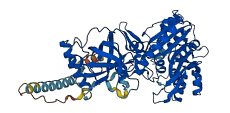
Descriptions
The autoinhibited protein was predicted that may have potential autoinhibitory elements via cis-regPred.
Autoinhibitory domains (AIDs)
Target domain |
|
Relief mechanism |
|
Assay |
cis-regPred |
Accessory elements
No accessory elements
Autoinhibited structure

Activated structure
1 structures for Q9UUE6
| Entry ID | Method | Resolution | Chain | Position | Source |
|---|---|---|---|---|---|
| AF-Q9UUE6-F1 | Predicted | AlphaFoldDB |
No variants for Q9UUE6
| Variant ID(s) | Position | Change | Description | Diseaes Association | Provenance |
|---|---|---|---|---|---|
| No variants for Q9UUE6 | |||||
No associated diseases with Q9UUE6
5 regional properties for Q9UUE6
| Type | Name | Position | InterPro Accession |
|---|---|---|---|
| domain | Aminoacyl-tRNA synthetase, class II (D/K/N) | 228 - 577 | IPR004364 |
| domain | OB-fold nucleic acid binding domain, AA-tRNA synthetase-type | 126 - 209 | IPR004365 |
| domain | Aminoacyl-tRNA synthetase, class II | 248 - 579 | IPR006195 |
| domain | Lysyl-tRNA synthetase, class II, C-terminal | 241 - 579 | IPR018149 |
| domain | Lysine-tRNA ligase, class II, N-terminal | 125 - 238 | IPR044136 |
Functions
| Description | ||
|---|---|---|
| EC Number | 6.1.1.6 | Ligases forming aminoacyl-tRNA and related compounds |
| Subcellular Localization |
|
|
| PANTHER Family | ||
| PANTHER Subfamily | ||
| PANTHER Protein Class | ||
| PANTHER Pathway Category | No pathway information available | |
1 GO annotations of cellular component
| Name | Definition |
|---|---|
| cytosol | The part of the cytoplasm that does not contain organelles but which does contain other particulate matter, such as protein complexes. |
3 GO annotations of molecular function
| Name | Definition |
|---|---|
| ATP binding | Binding to ATP, adenosine 5'-triphosphate, a universally important coenzyme and enzyme regulator. |
| lysine-tRNA ligase activity | Catalysis of the reaction: ATP + L-lysine + tRNA(Lys) = AMP + diphosphate + L-lysyl-tRNA(Lys). |
| tRNA binding | Binding to a transfer RNA. |
2 GO annotations of biological process
| Name | Definition |
|---|---|
| cytoplasmic translation | The chemical reactions and pathways resulting in the formation of a protein in the cytoplasm. This is a ribosome-mediated process in which the information in messenger RNA (mRNA) is used to specify the sequence of amino acids in the protein. |
| lysyl-tRNA aminoacylation | The process of coupling lysine to lysyl-tRNA, catalyzed by lysyl-tRNA synthetase. The lysyl-tRNA synthetase is a class-II synthetase. The activated amino acid is transferred to the 3'-OH group of a lysine-accetping tRNA. |
No homologous proteins in AiPD
| UniProt AC | Gene Name | Protein Name | Species | Evidence Code |
|---|---|---|---|---|
| No homologous proteins | ||||
| 10 | 20 | 30 | 40 | 50 | 60 |
| MSEEQVNGVT | QAVKALVLDP | VTGEQVSKTE | LKKREKQRAR | ELAKAKKQAE | KAASAPVAAP |
| 70 | 80 | 90 | 100 | 110 | 120 |
| KSSSKKEEDL | DPSQYFENRS | RTIMELRQTK | DPNPYPHKFQ | VTITLPEFIA | KYEGLARGET |
| 130 | 140 | 150 | 160 | 170 | 180 |
| KPEVEVAVAG | RVLGLRTAGN | KLRFYEIHAD | GKKLQVMCQA | QDADTVDFAA | QHEHLRRGDI |
| 190 | 200 | 210 | 220 | 230 | 240 |
| IGIRGYPGRS | NPKGRADGEL | SIFARQCVLL | SPCLRMLPKE | HYGLKDLEIR | HRQRYLDLIM |
| 250 | 260 | 270 | 280 | 290 | 300 |
| NRSTRDRFVM | RSRIIQYIRH | FFDSRDFMEV | ETPMMNMIAG | GATAKPFVTH | HNDLDMDLYM |
| 310 | 320 | 330 | 340 | 350 | 360 |
| RIAPELYLKM | LVVGGLDRVY | EIGRQFRNEG | ADLTHNPEFT | SIEFYQAYAD | YYDLMDTTEE |
| 370 | 380 | 390 | 400 | 410 | 420 |
| LLSGLVKDLT | GSYKVPYHPE | GPEGPKWELD | FSRPWRRINM | IEYLEEKLNT | KFPPGDQLHT |
| 430 | 440 | 450 | 460 | 470 | 480 |
| PEANAFLRDL | CAKHGVECAP | PQTCSRLLDK | LVGEFIESEC | INPTFIIGHP | QMMSPLAKYH |
| 490 | 500 | 510 | 520 | 530 | 540 |
| RSDAGLCERF | EAFVATKEIC | NAYTELNDIF | DQRARFEEQA | RQKAQGDDEA | QIIDENFCTA |
| 550 | 560 | 570 | 580 | 590 | |
| LEYGLPPTGG | WGMGVDRLVM | FLTDSNTIRE | VLLFPHMKPE | VQAAEPTVVK | E |