Q9UTR6
Gene name |
och1 |
Protein name |
Initiation-specific alpha-1,6-mannosyltransferase |
Names |
|
Species |
Schizosaccharomyces pombe (strain 972 / ATCC 24843) (Fission yeast) |
KEGG Pathway |
spo:SPAC1006.05c |
EC number |
2.4.1.232: Hexosyltransferases |
Protein Class |
|
Descriptions
The autoinhibited protein was predicted that may have potential autoinhibitory elements via cis-regPred.
Autoinhibitory domains (AIDs)
Target domain |
|
Relief mechanism |
|
Assay |
cis-regPred |
Accessory elements
No accessory elements
Autoinhibited structure

Activated structure
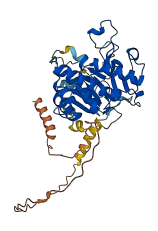
1 structures for Q9UTR6
| Entry ID | Method | Resolution | Chain | Position | Source |
|---|---|---|---|---|---|
| AF-Q9UTR6-F1 | Predicted | AlphaFoldDB |
2 variants for Q9UTR6
| Variant ID(s) | Position | Change | Description | Diseaes Association | Provenance |
|---|---|---|---|---|---|
| I_5079905_C_T | 158 | V>I | No | Jeffares_SNPs | |
| I_5079770_C_T | 203 | A>T | No | Jeffares_SNPs |
No associated diseases with Q9UTR6
6 regional properties for Q9UTR6
| Type | Name | Position | InterPro Accession |
|---|---|---|---|
| domain | Small GTP-binding protein domain | 161 - 327 | IPR005225 |
| domain | GTP binding domain | 161 - 274 | IPR006073 |
| conserved_site | GTP1/OBG, conserved site | 219 - 232 | IPR006074 |
| domain | GTP1/OBG domain | 1 - 159 | IPR006169 |
| domain | GTP-binding protein OBG, C-terminal | 357 - 435 | IPR015349 |
| domain | OBG-type guanine nucleotide-binding (G) domain | 160 - 332 | IPR031167 |
Functions
| Description | ||
|---|---|---|
| EC Number | 2.4.1.232 | Hexosyltransferases |
| Subcellular Localization |
|
|
| PANTHER Family | ||
| PANTHER Subfamily | ||
| PANTHER Protein Class | ||
| PANTHER Pathway Category | No pathway information available | |
4 GO annotations of cellular component
| Name | Definition |
|---|---|
| endoplasmic reticulum membrane | The lipid bilayer surrounding the endoplasmic reticulum. |
| Golgi apparatus | A membrane-bound cytoplasmic organelle of the endomembrane system that further processes the core oligosaccharides (e.g. N-glycans) added to proteins in the endoplasmic reticulum and packages them into membrane-bound vesicles. The Golgi apparatus operates at the intersection of the secretory, lysosomal, and endocytic pathways. |
| mannan polymerase complex | A protein complex with alpha-(1->6)-mannosyltransferase activity, located in the cis Golgi membrane; adds mannan to N-linked glycans on proteins. |
| mannan polymerase II complex | A complex with alpha-(1->6)-mannosyltransferase activity, located in the cis Golgi membrane; adds mannan to N-linked glycans on proteins as part of the elongation of alpha 1,6-linked Man backbone. In S. cerevisiae, contains Mnn9p, Anp1p, Mnn10p, Mnn11p, and Hoc1p. |
3 GO annotations of molecular function
| Name | Definition |
|---|---|
| alpha-1,6-mannosyltransferase activity | Catalysis of the transfer of a mannose residue to an oligosaccharide, forming an alpha-(1->6) linkage. |
| glycolipid 1,6-alpha-mannosyltransferase activity | Catalysis of the transfer of an alpha-D-mannosyl residue from GDP-mannose into lipid-linked oligosaccharide, forming an alpha-(1->6)-D-mannosyl-D-mannose linkage. |
| mannosyltransferase activity | Catalysis of the transfer of a mannosyl group to an acceptor molecule, typically another carbohydrate or a lipid. |
4 GO annotations of biological process
| Name | Definition |
|---|---|
| cell wall mannoprotein biosynthetic process | The chemical reactions and pathways resulting in the formation of cell wall mannoproteins, any cell wall protein that contains covalently bound mannose residues. |
| dolichol-linked oligosaccharide biosynthetic process | The chemical reactions and pathways resulting in the formation of dolichol-linked oligosaccharide, usually by a stepwise addition of glycosyl chains to endoplasmic reticulum membrane-bound dolichol-P. |
| glycoprotein biosynthetic process | The chemical reactions and pathways resulting in the formation of glycoproteins, a protein that contains covalently bound glycose (i.e. monosaccharide) residues; the glycose occurs most commonly as oligosaccharide or fairly small polysaccharide but occasionally as monosaccharide. |
| protein N-linked glycosylation | A protein glycosylation process in which a carbohydrate or carbohydrate derivative unit is added to a protein via the N4 atom of peptidyl-asparagine, the omega-N of arginine, or the N1' atom peptidyl-tryptophan. |
No homologous proteins in AiPD
| UniProt AC | Gene Name | Protein Name | Species | Evidence Code |
|---|---|---|---|---|
| No homologous proteins | ||||
| 10 | 20 | 30 | 40 | 50 | 60 |
| MLRLRLRSIV | IGAAIAGSIL | LLFNHGSIEG | MEDLTEISML | EDYTPEAANK | DYVGQQEEEE |
| 70 | 80 | 90 | 100 | 110 | 120 |
| LLYDQPSYIE | EEEDPDLEAY | LSDLEREELE | HSLEELDEEN | NYKLHLRYSF | SQLQDFDEEN |
| 130 | 140 | 150 | 160 | 170 | 180 |
| EAVHMIVPKD | TYEFEVPYHA | DIPKLIWQTS | KDPFDREVMK | YTRFWRINHP | SYSHAVLDDE |
| 190 | 200 | 210 | 220 | 230 | 240 |
| QSKALVISSF | GDSSVSKISQ | AYAMMPLPVL | KADFFRYLVL | LAKGGIYSDI | DTAPLKHINN |
| 250 | 260 | 270 | 280 | 290 | 300 |
| WIPREYRKRN | IRLIVGIEAD | PDRPDWNDYY | ARRVQFCQWT | IAAAPGHPIL | WELVRRITDE |
| 310 | 320 | 330 | 340 | 350 | 360 |
| TWKLHDSKKL | SKNGESVMEW | TGPGIWTDAI | MDYLNWQYGP | FSVENITNLE | EPYLVGDVLI |
| 370 | 380 | 390 | |||
| LPITAFSPGV | GHMGSKSPND | PMAYVQHFFA | GSWKDD |