Q9UTG2
Gene name |
pub2 (SPAC1805.15c) |
Protein name |
E3 ubiquitin-protein ligase pub2 |
Names |
HECT-type E3 ubiquitin transferase pub2 |
Species |
Schizosaccharomyces pombe (strain 972 / ATCC 24843) (Fission yeast) |
KEGG Pathway |
spo:SPAC1805.15c |
EC number |
2.3.2.26: Aminoacyltransferases |
Protein Class |
|
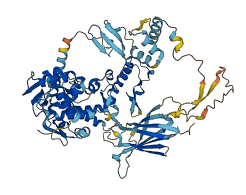
Descriptions
The autoinhibited protein was predicted that may have potential autoinhibitory elements via cis-regPred.
Autoinhibitory domains (AIDs)
Target domain |
|
Relief mechanism |
|
Assay |
cis-regPred |
Accessory elements
No accessory elements
Autoinhibited structure

Activated structure
1 structures for Q9UTG2
| Entry ID | Method | Resolution | Chain | Position | Source |
|---|---|---|---|---|---|
| AF-Q9UTG2-F1 | Predicted | AlphaFoldDB |
4 variants for Q9UTG2
| Variant ID(s) | Position | Change | Description | Diseaes Association | Provenance |
|---|---|---|---|---|---|
| I_2799569_T_C | 171 | K>E | No | Jeffares_SNPs | |
| I_2799448_A_G | 211 | L>S | No | Jeffares_SNPs | |
| I_2799440_T_G | 214 | N>H | No | Jeffares_SNPs | |
| I_2799116_T_C | 322 | S>G | No | Jeffares_SNPs |
No associated diseases with Q9UTG2
Functions
| Description | ||
|---|---|---|
| EC Number | 2.3.2.26 | Aminoacyltransferases |
| Subcellular Localization |
|
|
| PANTHER Family | ||
| PANTHER Subfamily | ||
| PANTHER Protein Class | ||
| PANTHER Pathway Category | No pathway information available | |
6 GO annotations of cellular component
| Name | Definition |
|---|---|
| cell cortex of cell tip | The region directly beneath the plasma membrane at the cell tip. The cell tip is the region at either end of the longest axis of a cylindrical or elongated cell. |
| cell division site | The eventual plane of cell division (also known as cell cleavage or cytokinesis) in a dividing cell. In Eukaryotes, the cleavage apparatus, composed of septin structures and the actomyosin contractile ring, forms along this plane, and the mitotic, or meiotic, spindle is aligned perpendicular to the division plane. In bacteria, the cell division site is generally located at mid-cell and is the site at which the cytoskeletal structure, the Z-ring, assembles. |
| cytoplasm | The contents of a cell excluding the plasma membrane and nucleus, but including other subcellular structures. |
| cytosol | The part of the cytoplasm that does not contain organelles but which does contain other particulate matter, such as protein complexes. |
| membrane | A lipid bilayer along with all the proteins and protein complexes embedded in it an attached to it. |
| nucleus | A membrane-bounded organelle of eukaryotic cells in which chromosomes are housed and replicated. In most cells, the nucleus contains all of the cell's chromosomes except the organellar chromosomes, and is the site of RNA synthesis and processing. In some species, or in specialized cell types, RNA metabolism or DNA replication may be absent. |
1 GO annotations of molecular function
| Name | Definition |
|---|---|
| ubiquitin protein ligase activity | Catalysis of the transfer of ubiquitin to a substrate protein via the reaction X-ubiquitin + S -> X + S-ubiquitin, where X is either an E2 or E3 enzyme, the X-ubiquitin linkage is a thioester bond, and the S-ubiquitin linkage is an amide bond: an isopeptide bond between the C-terminal glycine of ubiquitin and the epsilon-amino group of lysine residues in the substrate or, in the linear extension of ubiquitin chains, a peptide bond the between the C-terminal glycine and N-terminal methionine of ubiquitin residues. |
5 GO annotations of biological process
| Name | Definition |
|---|---|
| cytoplasm to vacuole transport by the NVT pathway | A pathway targeting soluble cytosolic proteins to the vacuole lumen. It uses a selective autophagy receptor protein Nbr1, which is an ortholog of mammalian NBR1, and is remotely related to S. cerevisiae Cvt pathway receptor protein Atg19. Similar to the Cvt pathway, the cargos transported by this pathway are hydrolases, which presumably contribute to the hydrolytic activities in the vacuole lumen. Different from the Cvt pathway, this pathway does not require the macroautophagy machinery, but instead relies on the ESCRT machinery for cargo sequestration. This pathway is observed in the fission yeast S. pombe. |
| proteasome-mediated ubiquitin-dependent protein catabolic process | The chemical reactions and pathways resulting in the breakdown of a protein or peptide by hydrolysis of its peptide bonds, initiated by the covalent attachment of ubiquitin, and mediated by the proteasome. |
| protein modification by small protein conjugation or removal | A protein modification process in which one or more groups of a small protein, such as ubiquitin or a ubiquitin-like protein, are covalently attached to or removed from a target protein. |
| protein polyubiquitination | Addition of multiple ubiquitin groups to a protein, forming a ubiquitin chain. |
| protein ubiquitination | The process in which one or more ubiquitin groups are added to a protein. |
No homologous proteins in AiPD
| UniProt AC | Gene Name | Protein Name | Species | Evidence Code |
|---|---|---|---|---|
| No homologous proteins | ||||
| 10 | 20 | 30 | 40 | 50 | 60 |
| MENIRFEVQL | TILHVEGLWK | NGLLRSLKPY | LLISVDDDQF | IKTNVASGTL | RLSWGFTQKL |
| 70 | 80 | 90 | 100 | 110 | 120 |
| TVSPQSIILL | QLFDEKQKNE | TSDGFVGLGA | AVVNSFLPFN | NPKDDYKTRI | TLRSPSGSYR |
| 130 | 140 | 150 | 160 | 170 | 180 |
| GSVVCLFKRS | KFLPEELPAD | KSQICTDIID | DASGCAWETR | IDEFGHVYYL | KSPQLSVISA |
| 190 | 200 | 210 | 220 | 230 | 240 |
| ISHEKLENLT | PKQLKEVFSQ | FLFNNQSKSS | LKINLEYKVI | KHLLEHYPLA | LSVRQQVAVE |
| 250 | 260 | 270 | 280 | 290 | 300 |
| KGPLPAGWEM | RLSEDYHVYF | VDHSTKTTTW | SDPRDNVVAS | DSVSENTDSI | QQINDEYQRK |
| 310 | 320 | 330 | 340 | 350 | 360 |
| IAYMYDRPEM | AVNDAQLQLK | VSRATTFEDA | YDIISKLSVS | DMKKKLLIRF | RNEDGLDYGG |
| 370 | 380 | 390 | 400 | 410 | 420 |
| VSREFFYILS | HAIFNPGYSL | FEYATDDNYG | LQISPLSSVN | PDFRSYFRFV | GRVMGLAIYH |
| 430 | 440 | 450 | 460 | 470 | 480 |
| RRYLDVQFVL | PFYKRILQKP | LCLEDVKDVD | EVYYESLKWI | KNNDVDESLC | LNFSVEENRF |
| 490 | 500 | 510 | 520 | 530 | 540 |
| GESVTVDLIP | NGRNIAVNNQ | NKMNYLKALT | EHKLVTSTEE | QFNALKGGLN | ELIPDSVLQI |
| 550 | 560 | 570 | 580 | 590 | 600 |
| FNENELDTLL | NGKRDIDVQD | WKRFTDYRSY | TETDDIVIWF | WELLSEWSPE | KKAKLLQFAT |
| 610 | 620 | 630 | 640 | 650 | 660 |
| GTSRLPLSGF | KDMHGSDGPR | KFTIEKVGHI | SQLPKAHTCF | NRLDIPPYNS | KEELEQKLTI |
| 670 | |||||
| AIQETAGFGT | E |