Q9UST2
Gene name |
SPBC336.13c |
Protein name |
Mitochondrial inner membrane protease subunit 2 |
Names |
|
Species |
Schizosaccharomyces pombe (strain 972 / ATCC 24843) (Fission yeast) |
KEGG Pathway |
spo:SPBC336.13c |
EC number |
|
Protein Class |
|
Descriptions
The autoinhibited protein was predicted that may have potential autoinhibitory elements via cis-regPred.
Autoinhibitory domains (AIDs)
Target domain |
|
Relief mechanism |
|
Assay |
cis-regPred |
Accessory elements
No accessory elements
Autoinhibited structure

Activated structure
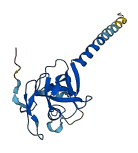
1 structures for Q9UST2
| Entry ID | Method | Resolution | Chain | Position | Source |
|---|---|---|---|---|---|
| AF-Q9UST2-F1 | Predicted | AlphaFoldDB |
No variants for Q9UST2
| Variant ID(s) | Position | Change | Description | Diseaes Association | Provenance |
|---|---|---|---|---|---|
| No variants for Q9UST2 | |||||
No associated diseases with Q9UST2
1 regional properties for Q9UST2
| Type | Name | Position | InterPro Accession |
|---|---|---|---|
| domain | Peptidase S26 | 23 - 148 | IPR019533 |
3 GO annotations of cellular component
| Name | Definition |
|---|---|
| integral component of membrane | The component of a membrane consisting of the gene products and protein complexes having at least some part of their peptide sequence embedded in the hydrophobic region of the membrane. |
| mitochondrial inner membrane peptidase complex | Protease complex of the mitochondrial inner membrane, consisting of at least two subunits, involved in processing of both nuclear- and mitochondrially-encoded proteins targeted to the intermembrane space. |
| mitochondrion | A semiautonomous, self replicating organelle that occurs in varying numbers, shapes, and sizes in the cytoplasm of virtually all eukaryotic cells. It is notably the site of tissue respiration. |
3 GO annotations of molecular function
| Name | Definition |
|---|---|
| endopeptidase activity | Catalysis of the hydrolysis of internal, alpha-peptide bonds in a polypeptide chain. |
| metalloendopeptidase activity | Catalysis of the hydrolysis of internal, alpha-peptide bonds in a polypeptide chain by a mechanism in which water acts as a nucleophile, one or two metal ions hold the water molecule in place, and charged amino acid side chains are ligands for the metal ions. |
| serine-type endopeptidase activity | Catalysis of the hydrolysis of internal, alpha-peptide bonds in a polypeptide chain by a catalytic mechanism that involves a catalytic triad consisting of a serine nucleophile that is activated by a proton relay involving an acidic residue (e.g. aspartate or glutamate) and a basic residue (usually histidine). |
2 GO annotations of biological process
| Name | Definition |
|---|---|
| protein processing involved in protein targeting to mitochondrion | The cleavage of peptide bonds in proteins, usually near the N terminus, contributing to the process of import into the mitochondrion. Several different peptidases mediate cleavage of proteins destined for different mitochondrial compartments. |
| signal peptide processing | The proteolytic removal of a signal peptide from a protein during or after transport to a specific location in the cell. |
No homologous proteins in AiPD
| UniProt AC | Gene Name | Protein Name | Species | Evidence Code |
|---|---|---|---|---|
| No homologous proteins | ||||
| 10 | 20 | 30 | 40 | 50 | 60 |
| MANPFVRNQS | FKSVFFKNLV | GITLWVPVLM | FVEQHVVSVG | TIEGRSMKPA | FNPETNMLQR |
| 70 | 80 | 90 | 100 | 110 | 120 |
| DRVLLWKWNK | DYKRGDVVIL | RSPENPEELL | VKRVLGVEYD | IMKTRPPKKL | SLVPVPEGHV |
| 130 | 140 | 150 | 160 | 170 | |
| WVEGDEQFHS | IDSNKFGPVS | TGLITAKVIA | ILFPFSRAGR | IDHEGFRKNA | VFLSGKRSVK |