Q9USP4
Gene name |
mug1 (SPCC11E10.03) |
Protein name |
Meiotically up-regulated gene 1 protein |
Names |
|
Species |
Schizosaccharomyces pombe (strain 972 / ATCC 24843) (Fission yeast) |
KEGG Pathway |
spo:SPCC11E10.03 |
EC number |
|
Protein Class |
|
Descriptions
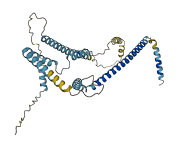
The autoinhibited protein was predicted that may have potential autoinhibitory elements via cis-regPred.
Autoinhibitory domains (AIDs)
Target domain |
|
Relief mechanism |
|
Assay |
cis-regPred |
Accessory elements
No accessory elements
Autoinhibited structure

Activated structure
1 structures for Q9USP4
| Entry ID | Method | Resolution | Chain | Position | Source |
|---|---|---|---|---|---|
| AF-Q9USP4-F1 | Predicted | AlphaFoldDB |
No variants for Q9USP4
| Variant ID(s) | Position | Change | Description | Diseaes Association | Provenance |
|---|---|---|---|---|---|
| No variants for Q9USP4 | |||||
No associated diseases with Q9USP4
No regional properties for Q9USP4
| Type | Name | Position | InterPro Accession |
|---|---|---|---|
| No domain, repeats, and functional sites for Q9USP4 | |||
3 GO annotations of cellular component
| Name | Definition |
|---|---|
| cytoplasm | The contents of a cell excluding the plasma membrane and nucleus, but including other subcellular structures. |
| cytosol | The part of the cytoplasm that does not contain organelles but which does contain other particulate matter, such as protein complexes. |
| dynactin complex | A 20S multiprotein assembly of total mass about 1.2 MDa that activates dynein-based activity in vivo. A large structural component of the complex is an actin-like 40 nm filament composed of actin-related protein, to which other components attach. |
No GO annotations of molecular function
| Name | Definition |
|---|---|
| No GO annotations for molecular function |
4 GO annotations of biological process
| Name | Definition |
|---|---|
| chromosome segregation | The process in which genetic material, in the form of chromosomes, is organized into specific structures and then physically separated and apportioned to two or more sets. In eukaryotes, chromosome segregation begins with the condensation of chromosomes, includes chromosome separation, and ends when chromosomes have completed movement to the spindle poles. |
| dynein-driven meiotic oscillatory nuclear movement | Oscillatory movement of the nucleus involved in meiosis I. This oscillatory movement is led by an astral microtubule array emanating from the spindle pole body, and driven by the microtubule motor cytoplasmic dynein. |
| mitotic spindle organization | A process that is carried out at the cellular level which results in the assembly, arrangement of constituent parts, or disassembly of the microtubule spindle during a mitotic cell cycle. |
| nuclear migration by microtubule mediated pushing forces | The directed movement of the nucleus by pushing forces exerted by polymerization of backward-extending microtubules. |
No homologous proteins in AiPD
| UniProt AC | Gene Name | Protein Name | Species | Evidence Code |
|---|---|---|---|---|
| No homologous proteins | ||||
| 10 | 20 | 30 | 40 | 50 | 60 |
| MKEMINLDSS | SEPSIVTKQF | SVEECLSKLK | EQHCYVPMRT | IGRLRLRKSS | DQTEKKCWKE |
| 70 | 80 | 90 | 100 | 110 | 120 |
| KLMKIRSELE | ELWEQSMMYE | EQKELTQLGE | MLDRLWDKHI | NSEGSKSETI | SDTAISGNDD |
| 130 | 140 | 150 | 160 | 170 | 180 |
| TMEKRLEQFS | DDTLQDTLET | EKNLNSKTSE | SLKSPTLSYP | FDLDSLDKRI | FKLESKIGYA |
| 190 | 200 | 210 | 220 | 230 | 240 |
| DEPLSELLNK | CMEKLEIVEQ | DPQFWQSRIE | SWKQLLAKDF | LKHHERNLCS | IEKQTTLKNS |
| 250 | 260 | 270 | 280 | 290 | 300 |
| SLKELCTEED | IVIMLEICSS | QLPFVEQYMP | ILPLLLERLK | SLQNMHTDAA | EAISSWQGSK |
| 310 | 320 | 330 | 340 | 350 | |
| DVMMTMQSEL | NEWKNTVERL | DHSKFYTQSV | EEMRRLSDTV | TQLEKRVLKL | Q |