Q9U5L1
Gene name |
SrpRalpha |
Protein name |
Signal recognition particle receptor subunit alpha homolog |
Names |
DP-alpha, Docking protein alpha, SR-alpha, GTP-binding protein |
Species |
Drosophila melanogaster (Fruit fly) |
KEGG Pathway |
dme:Dmel_CG2522 |
EC number |
|
Protein Class |
|
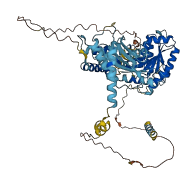
Descriptions
The autoinhibited protein was predicted that may have potential autoinhibitory elements via cis-regPred.
Autoinhibitory domains (AIDs)
Target domain |
|
Relief mechanism |
|
Assay |
cis-regPred |
Accessory elements
No accessory elements
Autoinhibited structure

Activated structure
1 structures for Q9U5L1
| Entry ID | Method | Resolution | Chain | Position | Source |
|---|---|---|---|---|---|
| AF-Q9U5L1-F1 | Predicted | AlphaFoldDB |
No variants for Q9U5L1
| Variant ID(s) | Position | Change | Description | Diseaes Association | Provenance |
|---|---|---|---|---|---|
| No variants for Q9U5L1 | |||||
No associated diseases with Q9U5L1
4 regional properties for Q9U5L1
| Type | Name | Position | InterPro Accession |
|---|---|---|---|
| domain | Signal recognition particle, SRP54 subunit, GTPase domain | 395 - 614 | IPR000897 |
| domain | AAA+ ATPase domain | 394 - 547 | IPR003593 |
| domain | Signal recognition particle receptor, alpha subunit, N-terminal | 27 - 267 | IPR007222 |
| domain | Signal recognition particle SRP54, helical bundle | 293 - 374 | IPR013822 |
Functions
4 GO annotations of cellular component
| Name | Definition |
|---|---|
| endomembrane system | A collection of membranous structures involved in transport within the cell. The main components of the endomembrane system are endoplasmic reticulum, Golgi bodies, vesicles, cell membrane and nuclear envelope. Members of the endomembrane system pass materials through each other or though the use of vesicles. |
| endoplasmic reticulum membrane | The lipid bilayer surrounding the endoplasmic reticulum. |
| membrane | A lipid bilayer along with all the proteins and protein complexes embedded in it an attached to it. |
| signal recognition particle receptor complex | A transmembrane heterodimeric protein located in the membrane of the rough endoplasmic reticulum. Both subunits contain GTPase domains with which signal recognition particle interacts. In the presence of GTP and SRP receptor, SRP is released from the ribosome-nascent chain complex. |
4 GO annotations of molecular function
| Name | Definition |
|---|---|
| GTP binding | Binding to GTP, guanosine triphosphate. |
| GTPase activity | Catalysis of the reaction: GTP + H2O = GDP + H+ + phosphate. |
| RNA binding | Binding to an RNA molecule or a portion thereof. |
| signal recognition particle binding | Binding to a signal recognition particle. |
5 GO annotations of biological process
| Name | Definition |
|---|---|
| axonogenesis | De novo generation of a long process of a neuron, including the terminal branched region. Refers to the morphogenesis or creation of shape or form of the developing axon, which carries efferent (outgoing) action potentials from the cell body towards target cells. |
| protein targeting | The process of targeting specific proteins to particular regions of the cell, typically membrane-bounded subcellular organelles. Usually requires an organelle specific protein sequence motif. |
| protein targeting to ER | The process of directing proteins towards the endoplasmic reticulum (ER) using signals contained within the protein. One common mechanism uses a 16- to 30-residue signal sequence, typically located at the N-terminus of the protein and containing positively charged amino acids followed by a continuous stretch of hydrophobic residues, which directs the ribosome to the ER membrane and initiates transport of the growing polypeptide across the ER membrane. |
| regulation of protein secretion | Any process that modulates the frequency, rate or extent of the controlled release of a protein from a cell. |
| SRP-dependent cotranslational protein targeting to membrane | The targeting of proteins to a membrane that occurs during translation and is dependent upon two key components, the signal-recognition particle (SRP) and the SRP receptor. SRP is a cytosolic particle that transiently binds to the endoplasmic reticulum (ER) signal sequence in a nascent protein, to the large ribosomal unit, and to the SRP receptor in the ER membrane. |
No homologous proteins in AiPD
| UniProt AC | Gene Name | Protein Name | Species | Evidence Code |
|---|---|---|---|---|
| No homologous proteins | ||||
| 10 | 20 | 30 | 40 | 50 | 60 |
| MLDFVVIFTK | GGVVLWHSNA | SGNSFASCIN | SLIRGVILEE | RNTEAKYYEE | DHLAVQFKLD |
| 70 | 80 | 90 | 100 | 110 | 120 |
| NELDLVYAAI | FQKVIKLNYL | DGFLADMQAA | FKEKYGDIRL | GDDYDFDREY | RRVLSAAEEA |
| 130 | 140 | 150 | 160 | 170 | 180 |
| SAKQVKAPKT | MRSYNESQKS | KKTVASMIQD | DKKPVEKRVN | IQEAPPPSKS | QPSSPPTGSP |
| 190 | 200 | 210 | 220 | 230 | 240 |
| MDKIIMEKRR | KLREKLTPTK | KTSPSDSKSS | KPEKAGKKPR | VWDLGGNSKD | AALLDRSRDS |
| 250 | 260 | 270 | 280 | 290 | 300 |
| PDDVQYQNIN | SELVGTMQGV | IRDLDVESED | EADNEDASSE | GEAEEQVQSK | KGKRGGLLSY |
| 310 | 320 | 330 | 340 | 350 | 360 |
| FKGIVGAKTM | SLADLQPALE | KMRDHLISKN | VASEIAAKLC | DSVAASLDGK | QMGTFDSIAS |
| 370 | 380 | 390 | 400 | 410 | 420 |
| QVKEALTESL | VRILSPKRRI | DIIRDALESK | RNGRPYTIIF | CGVNGVGKST | NLAKICFWLI |
| 430 | 440 | 450 | 460 | 470 | 480 |
| ENDFNVLIAA | CDTFRAGAVE | QLRTHTRHLN | ALHPAAKHDG | RNMVQLYEKG | YGKDAAGIAM |
| 490 | 500 | 510 | 520 | 530 | 540 |
| EAIKFAHDTR | VDVVLVDTAG | RMQDNEPLMR | SLSKLIKVNN | PDLVLFVGEA | LVGNEAVDQL |
| 550 | 560 | 570 | 580 | 590 | 600 |
| VKFNQSLADY | SSNENPHIID | GIVLTKFDTI | DDKVGAAISM | TYITGQPIVF | VGTGQTYADL |
| 610 | |||||
| KAINVNAVVN | SLMK |