Q9U3X4
Gene name |
sdhA (DDB_G0280535) |
Protein name |
Succinate dehydrogenase [ubiquinone] flavoprotein subunit, mitochondrial |
Names |
Flavoprotein subunit of complex II, FP |
Species |
Dictyostelium discoideum (Slime mold) |
KEGG Pathway |
ddi:DDB_G0280535 |
EC number |
1.3.5.1: With a quinone or related compound as acceptor |
Protein Class |
|
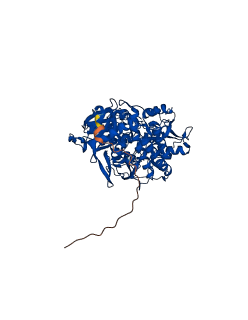
Descriptions
The autoinhibited protein was predicted that may have potential autoinhibitory elements via cis-regPred.
Autoinhibitory domains (AIDs)
Target domain |
|
Relief mechanism |
|
Assay |
cis-regPred |
Accessory elements
No accessory elements
Autoinhibited structure

Activated structure
1 structures for Q9U3X4
| Entry ID | Method | Resolution | Chain | Position | Source |
|---|---|---|---|---|---|
| AF-Q9U3X4-F1 | Predicted | AlphaFoldDB |
No variants for Q9U3X4
| Variant ID(s) | Position | Change | Description | Diseaes Association | Provenance |
|---|---|---|---|---|---|
| No variants for Q9U3X4 | |||||
No associated diseases with Q9U3X4
3 regional properties for Q9U3X4
| Type | Name | Position | InterPro Accession |
|---|---|---|---|
| binding_site | Fumarate reductase/succinate dehydrogenase, FAD-binding site | 75 - 84 | IPR003952 |
| domain | FAD-dependent oxidoreductase 2, FAD binding domain | 41 - 435 | IPR003953 |
| domain | Fumarate reductase/succinate dehydrogenase flavoprotein-like, C-terminal | 490 - 626 | IPR015939 |
Functions
| Description | ||
|---|---|---|
| EC Number | 1.3.5.1 | With a quinone or related compound as acceptor |
| Subcellular Localization |
|
|
| PANTHER Family | ||
| PANTHER Subfamily | ||
| PANTHER Protein Class | ||
| PANTHER Pathway Category | No pathway information available | |
3 GO annotations of cellular component
| Name | Definition |
|---|---|
| mitochondrial respiratory chain complex II, succinate dehydrogenase complex (ubiquinone) | A protein complex located in the mitochondrial inner membrane that forms part of the mitochondrial respiratory chain. Contains the four polypeptide subunits of succinate dehydrogenase, flavin-adenine dinucleotide and iron-sulfur. Catalyzes the oxidation of succinate by ubiquinone. Connects the TCA cycle with the respiratory chain. |
| mitochondrion | A semiautonomous, self replicating organelle that occurs in varying numbers, shapes, and sizes in the cytoplasm of virtually all eukaryotic cells. It is notably the site of tissue respiration. |
| phagocytic vesicle | A membrane-bounded intracellular vesicle that arises from the ingestion of particulate material by phagocytosis. |
4 GO annotations of molecular function
| Name | Definition |
|---|---|
| electron transfer activity | Any molecular entity that serves as an electron acceptor and electron donor in an electron transport chain. An electron transport chain is a process in which a series of electron carriers operate together to transfer electrons from donors to any of several different terminal electron acceptors to generate a transmembrane electrochemical gradient. |
| flavin adenine dinucleotide binding | Binding to FAD, flavin-adenine dinucleotide, the coenzyme or the prosthetic group of various flavoprotein oxidoreductase enzymes, in either the oxidized form, FAD, or the reduced form, FADH2. |
| succinate dehydrogenase (ubiquinone) activity | Catalysis of the reaction: succinate + ubiquinone = fumarate + ubiquinol. |
| succinate dehydrogenase activity | Catalysis of the reaction: succinate + acceptor = fumarate + reduced acceptor. |
3 GO annotations of biological process
| Name | Definition |
|---|---|
| mitochondrial electron transport, succinate to ubiquinone | The transfer of electrons from succinate to ubiquinone that occurs during oxidative phosphorylation, mediated by the multisubunit enzyme known as complex II. |
| positive phototaxis | The directed movement of a cell or organism towards a source of light. |
| tricarboxylic acid cycle | A nearly universal metabolic pathway in which the acetyl group of acetyl coenzyme A is effectively oxidized to two CO2 and four pairs of electrons are transferred to coenzymes. The acetyl group combines with oxaloacetate to form citrate, which undergoes successive transformations to isocitrate, 2-oxoglutarate, succinyl-CoA, succinate, fumarate, malate, and oxaloacetate again, thus completing the cycle. In eukaryotes the tricarboxylic acid is confined to the mitochondria. See also glyoxylate cycle. |
No homologous proteins in AiPD
| UniProt AC | Gene Name | Protein Name | Species | Evidence Code |
|---|---|---|---|---|
| No homologous proteins | ||||
| 10 | 20 | 30 | 40 | 50 | 60 |
| MLSSALKLTK | KVCSTKSNGL | IRSFSTQTQS | RDYAVVDHTY | DAIVVGAGGA | GLRAALGLTE |
| 70 | 80 | 90 | 100 | 110 | 120 |
| KGYKTACITK | LFPTRSHTVA | AQGGINAALG | NADQDDWRWH | AYDTVKGSDF | LGDQDAIHYM |
| 130 | 140 | 150 | 160 | 170 | 180 |
| CKEAVPTVLE | LEQYGVPFSR | MDDGRIYQRA | FGGQSKNFGK | GGQATRCCAA | ADRTGHALLH |
| 190 | 200 | 210 | 220 | 230 | 240 |
| TLYGQAVKHN | TKFFIEYFVT | DLIMENGDCR | GVVAINLEDG | TIHRFRSHAT | VIATGGYGRA |
| 250 | 260 | 270 | 280 | 290 | 300 |
| YFSATSAHTC | TGDGNAMVIR | AGLPCQDLEF | VQFHPTGIYG | SGCLITEGAR | GEGGYLLNSS |
| 310 | 320 | 330 | 340 | 350 | 360 |
| GERFMPRYAP | SVADLASRDV | VSRSETMEIR | EGRGVGPEKD | HCLLNLTHLS | PEIIDERLPG |
| 370 | 380 | 390 | 400 | 410 | 420 |
| IRETAMIFAG | VDVTKEPIPV | IPTVHYNMGG | IPTNYKGQVI | TQVDGKDKLV | KGLYAAGESA |
| 430 | 440 | 450 | 460 | 470 | 480 |
| CVSVHGANRL | GANSLLDIVV | FGRAVANEIE | NTLAKDTPHK | PLPPNAGEES | IANIDAIRFS |
| 490 | 500 | 510 | 520 | 530 | 540 |
| NGTRSTAEIR | LEMQKIMQRN | AAVFRDGQVL | KEGVELIDKC | ARSLINDLKT | TDRTMIWNTD |
| 550 | 560 | 570 | 580 | 590 | 600 |
| LIESLELQNL | MTQAVLTMHS | AEARKESRGA | HAREDYKERD | DANWMKHTLS | YLDVNTGKVT |
| 610 | 620 | ||||
| LNYRPVVSET | LDQSEMETIK | PFKRVY |