Q9TJ83
Gene name |
ftsH |
Protein name |
ATP-dependent zinc metalloprotease FtsH |
Names |
FtsHCP |
Species |
Cyanidioschyzon merolae (strain NIES-3377 / 10D) (Unicellular red alga) |
KEGG Pathway |
cme:CymeCp108 |
EC number |
|
Protein Class |
|
Descriptions
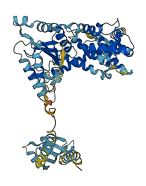
The autoinhibited protein was predicted that may have potential autoinhibitory elements via cis-regPred.
Autoinhibitory domains (AIDs)
Target domain |
|
Relief mechanism |
|
Assay |
cis-regPred |
Accessory elements
No accessory elements
Autoinhibited structure

Activated structure
1 structures for Q9TJ83
| Entry ID | Method | Resolution | Chain | Position | Source |
|---|---|---|---|---|---|
| AF-Q9TJ83-F1 | Predicted | AlphaFoldDB |
No variants for Q9TJ83
| Variant ID(s) | Position | Change | Description | Diseaes Association | Provenance |
|---|---|---|---|---|---|
| No variants for Q9TJ83 | |||||
No associated diseases with Q9TJ83
2 GO annotations of cellular component
| Name | Definition |
|---|---|
| chloroplast thylakoid membrane | The pigmented membrane of a chloroplast thylakoid. An example of this component is found in Arabidopsis thaliana. |
| integral component of membrane | The component of a membrane consisting of the gene products and protein complexes having at least some part of their peptide sequence embedded in the hydrophobic region of the membrane. |
5 GO annotations of molecular function
| Name | Definition |
|---|---|
| ATP binding | Binding to ATP, adenosine 5'-triphosphate, a universally important coenzyme and enzyme regulator. |
| ATP hydrolysis activity | Catalysis of the reaction: ATP + H2O = ADP + H+ phosphate. ATP hydrolysis is used in some reactions as an energy source, for example to catalyze a reaction or drive transport against a concentration gradient. |
| ATP-dependent peptidase activity | Catalysis of the hydrolysis of peptide bonds, driven by ATP hydrolysis. |
| metalloendopeptidase activity | Catalysis of the hydrolysis of internal, alpha-peptide bonds in a polypeptide chain by a mechanism in which water acts as a nucleophile, one or two metal ions hold the water molecule in place, and charged amino acid side chains are ligands for the metal ions. |
| zinc ion binding | Binding to a zinc ion (Zn). |
2 GO annotations of biological process
| Name | Definition |
|---|---|
| protein catabolic process | The chemical reactions and pathways resulting in the breakdown of a protein by the destruction of the native, active configuration, with or without the hydrolysis of peptide bonds. |
| proteolysis | The hydrolysis of proteins into smaller polypeptides and/or amino acids by cleavage of their peptide bonds. |
No homologous proteins in AiPD
| UniProt AC | Gene Name | Protein Name | Species | Evidence Code |
|---|---|---|---|---|
| No homologous proteins | ||||
| 10 | 20 | 30 | 40 | 50 | 60 |
| MKNLWIWSLP | LIVLAFIGWQ | ELANQMPVAT | SRMTYGRLLE | YMQMGWVKRI | DVYDRTALIE |
| 70 | 80 | 90 | 100 | 110 | 120 |
| ASSPETGWQW | IRVDLPANSS | DWLEQAKTLH | IDVDVHAVSN | WINVASNWII | PLIIIGVVIW |
| 130 | 140 | 150 | 160 | 170 | 180 |
| LLSRSASSNT | TGALNFGKSK | ARFQMVAKTG | IMFDDVAGIE | EAKEELAEVV | AFLKNPSKFL |
| 190 | 200 | 210 | 220 | 230 | 240 |
| AVGASIPKGV | LLVGPPGTGK | TLLAKAIAGE | ASVPFFSISG | SEFVEMFVGV | GASRVRDLFK |
| 250 | 260 | 270 | 280 | 290 | 300 |
| KAKQNAPCLV | FIDEIDAVGR | QRGAGIGGGN | DEREQTLNQL | LTEMDGFEGN | TGVIVIAATN |
| 310 | 320 | 330 | 340 | 350 | 360 |
| RVDVLDAALL | RPGRFDRQIM | VSMPDVKSRI | AILKVHANQK | KLHPQVSLEA | VARRTAGFAG |
| 370 | 380 | 390 | 400 | 410 | 420 |
| ADLANLLNEA | AILAVRRGLK | QITWKEIDDA | IDRVIAGMEG | TPIMDGKIKR | LIAYHETGHA |
| 430 | 440 | 450 | 460 | 470 | 480 |
| LTATLLPNHP | PVQKVTLIPR | RQAKGLTWFM | QDNERDLLSK | SQLMSMIMVA | LGGRAAEEAV |
| 490 | 500 | 510 | 520 | 530 | 540 |
| FGNAEVTTGA | SNDLQQVTNL | ARQMVTRFGM | SSLGPLCLET | GNEEIFLGRD | MRLMPEVSEE |
| 550 | 560 | 570 | 580 | 590 | 600 |
| VIAQIDAQVR | GMIEACYEKV | LELMQANRVV | MDRIVEELME | KETLDGKEFR | QLVSQAARLT |
| AVN |