Q9TEM3
Gene name |
mcsA |
Protein name |
2-methylcitrate synthase, mitochondrial |
Names |
Methylcitrate synthase, (2S,3S)-2-methylcitrate synthase, Citrate synthase 2 |
Species |
Emericella nidulans (strain FGSC A4 / ATCC 38163 / CBS 112.46 / NRRL 194 / M139) (Aspergillus nidulans) |
KEGG Pathway |
ani:AN6650.2 |
EC number |
2.3.3.5: Acyl groups converted into alkyl groups on transfer |
Protein Class |
|
Descriptions
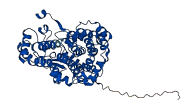
The autoinhibited protein was predicted that may have potential autoinhibitory elements via cis-regPred.
Autoinhibitory domains (AIDs)
Target domain |
|
Relief mechanism |
|
Assay |
cis-regPred |
Accessory elements
No accessory elements
Autoinhibited structure

Activated structure
1 structures for Q9TEM3
| Entry ID | Method | Resolution | Chain | Position | Source |
|---|---|---|---|---|---|
| AF-Q9TEM3-F1 | Predicted | AlphaFoldDB |
No variants for Q9TEM3
| Variant ID(s) | Position | Change | Description | Diseaes Association | Provenance |
|---|---|---|---|---|---|
| No variants for Q9TEM3 | |||||
No associated diseases with Q9TEM3
6 regional properties for Q9TEM3
| Type | Name | Position | InterPro Accession |
|---|---|---|---|
| domain | Translational (tr)-type GTP-binding domain | 187 - 354 | IPR000795 |
| domain | Small GTP-binding protein domain | 191 - 346 | IPR005225 |
| domain | Translation initiation factor IF-2, N-terminal | 1 - 49 | IPR006847-1 |
| domain | Translation initiation factor IF-2, N-terminal | 110 - 158 | IPR006847-2 |
| domain | Translation initiation factor IF- 2, domain 3 | 464 - 577 | IPR023115 |
| domain | Translation initiation factor IF-2, domain II | 362 - 457 | IPR044145 |
Functions
| Description | ||
|---|---|---|
| EC Number | 2.3.3.5 | Acyl groups converted into alkyl groups on transfer |
| Subcellular Localization |
|
|
| PANTHER Family | ||
| PANTHER Subfamily | ||
| PANTHER Protein Class | ||
| PANTHER Pathway Category | No pathway information available | |
1 GO annotations of cellular component
| Name | Definition |
|---|---|
| mitochondrial matrix | The gel-like material, with considerable fine structure, that lies in the matrix space, or lumen, of a mitochondrion. It contains the enzymes of the tricarboxylic acid cycle and, in some organisms, the enzymes concerned with fatty acid oxidation. |
2 GO annotations of molecular function
| Name | Definition |
|---|---|
| 2-methylcitrate synthase activity | Catalysis of the reaction: H(2)O + oxaloacetate + propanoyl-CoA = (2R,3S)-2-methylcitrate + CoA + H(+). |
| citrate (Si)-synthase activity | Catalysis of the reaction: acetyl-CoA + H2O + oxaloacetate = citrate + CoA, where the acetyl group is added to the si-face of oxaloacetate; acetyl-CoA thus provides the two carbon atoms of the pro-S carboxymethyl group. |
5 GO annotations of biological process
| Name | Definition |
|---|---|
| carbohydrate metabolic process | The chemical reactions and pathways involving carbohydrates, any of a group of organic compounds based of the general formula Cx(H2O)y. |
| propionate catabolic process, 2-methylcitrate cycle | The chemical reactions and pathways resulting in the breakdown of propionate that occurs in the 2-methylcitrate cycle. |
| propionate metabolic process, methylcitrate cycle | The chemical reactions and pathways involving propionate that occur in the methylcitrate cycle. |
| sterigmatocystin biosynthetic process | The chemical reactions and pathways resulting in the formation of sterigmatocystin, a carcinogenic mycotoxin produced in high yields by strains of the common molds. |
| tricarboxylic acid cycle | A nearly universal metabolic pathway in which the acetyl group of acetyl coenzyme A is effectively oxidized to two CO2 and four pairs of electrons are transferred to coenzymes. The acetyl group combines with oxaloacetate to form citrate, which undergoes successive transformations to isocitrate, 2-oxoglutarate, succinyl-CoA, succinate, fumarate, malate, and oxaloacetate again, thus completing the cycle. In eukaryotes the tricarboxylic acid is confined to the mitochondria. See also glyoxylate cycle. |
No homologous proteins in AiPD
| UniProt AC | Gene Name | Protein Name | Species | Evidence Code |
|---|---|---|---|---|
| No homologous proteins | ||||
| 10 | 20 | 30 | 40 | 50 | 60 |
| MALPLRTARH | ASRLAQTIGR | RGYATAEPDL | KSALKAVIPA | KRELLAEVKK | QGDEVIGEVK |
| 70 | 80 | 90 | 100 | 110 | 120 |
| VSNVIGGMRG | LKSMLWEGSV | LDADEGIRFH | GKTIKDCQKE | LPKGPTGTEM | LPEAMFWLLL |
| 130 | 140 | 150 | 160 | 170 | 180 |
| TGEVPSTSQV | RAFSKQLAEE | SHLPDHILDL | AKSFPKHMHP | MTQISIITAA | LNTESKFAKL |
| 190 | 200 | 210 | 220 | 230 | 240 |
| YEKGINKADY | WEPTFDDAIS | LLAKIPRVAA | LVFRPNEIDV | VGRQKLDPAQ | DWSYNFAELL |
| 250 | 260 | 270 | 280 | 290 | 300 |
| GKGGANNADF | HDLLRLYLAL | HGDHEGGNVS | AHATHLVGSA | LSDPFLSYSA | GLLGLAGPLH |
| 310 | 320 | 330 | 340 | 350 | 360 |
| GLAAQEVLRW | ILAMQEKIGT | KFTDEDVRAY | LWDTLKSGRV | VPGYGHGVLR | KPDPRFQALM |
| 370 | 380 | 390 | 400 | 410 | 420 |
| DFAATRKDVL | ANPVFQLVKK | NSEIAPGVLT | EHGKTKNPHP | NVDAASGVLF | YHYGFQQPLY |
| 430 | 440 | 450 | |||
| YTVTFGVSRA | LGPLVQLIWD | RALGLPIERP | KSINLLGLKK |