Q9SYH2
Gene name |
TAF9 (TAFII21, At1g54140, F15I1.24) |
Protein name |
Transcription initiation factor TFIID subunit 9 |
Names |
TATA binding protein associated factor 21kDa subunit, TBP-associated factor 9, AtTAF9 |
Species |
Arabidopsis thaliana (Mouse-ear cress) |
KEGG Pathway |
ath:AT1G54140 |
EC number |
|
Protein Class |
|
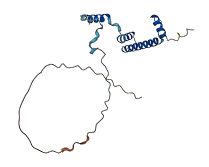
Descriptions
The autoinhibited protein was predicted that may have potential autoinhibitory elements via cis-regPred.
Autoinhibitory domains (AIDs)
Target domain |
|
Relief mechanism |
|
Assay |
cis-regPred |
Accessory elements
No accessory elements
Autoinhibited structure

Activated structure
1 structures for Q9SYH2
| Entry ID | Method | Resolution | Chain | Position | Source |
|---|---|---|---|---|---|
| AF-Q9SYH2-F1 | Predicted | AlphaFoldDB |
12 variants for Q9SYH2
| Variant ID(s) | Position | Change | Description | Diseaes Association | Provenance |
|---|---|---|---|---|---|
| tmp_1_20214821_T_C | 17 | K>E | No | 1000Genomes | |
| ENSVATH04958556 | 33 | I>L | No | 1000Genomes | |
| ENSVATH13565850 | 76 | V>A | No | 1000Genomes | |
| ENSVATH13565847 | 114 | P>S | No | 1000Genomes | |
| ENSVATH04958547 | 116 | Q>E | No | 1000Genomes | |
| tmp_1_20214249_C_A | 127 | V>L | No | 1000Genomes | |
| tmp_1_20214235_C_T,G | 131 | K>N | No | 1000Genomes | |
| tmp_1_20214196_T_A | 144 | E>D | No | 1000Genomes | |
| tmp_1_20214152_T_G | 159 | Q>P | No | 1000Genomes | |
| ENSVATH13565846 | 162 | Q>E | No | 1000Genomes | |
| tmp_1_20214128_G_A | 167 | P>L | No | 1000Genomes | |
| ENSVATH04958545 | 167 | P>S | No | 1000Genomes |
No associated diseases with Q9SYH2
No regional properties for Q9SYH2
| Type | Name | Position | InterPro Accession |
|---|---|---|---|
| No domain, repeats, and functional sites for Q9SYH2 | |||
2 GO annotations of cellular component
| Name | Definition |
|---|---|
| SAGA complex | A SAGA-type histone acetyltransferase complex that deubiquitinates H2A and/or H2B. This complex is organized into several functional submodules: a structural core including the activator binding module and consisting of ADA1 or a homolog, members of the SPT and TAF protein families as well as promotor recruitment factor TRRAP/TRA1, a histone acetyltransferase (HAT) module consisting of GCN5/KAT2A or PCAF/KAT2B, ADA2, ADA3/NGG1, and SGF29 or homologues thereof, a histone deubiquitinase (DUB) module consisting of ATXN7/SGF73, ATXN7L3/SGF11, ENY2/SUS1 and USP22/UBP8 or homologues thereof, and in some taxa a splicing module consisting of SF3B3 and SF3B5 or homologues thereof (not in fungi). In budding yeast also contains Spt8 which distinguishes it from SAGA-like (SLIK) complex (GO:0046695). |
| transcription factor TFIID complex | A complex composed of TATA binding protein (TBP) and TBP associated factors (TAFs); the total mass is typically about 800 kDa. Most of the TAFs are conserved across species. In TATA-containing promoters for RNA polymerase II (Pol II), TFIID is believed to recognize at least two distinct elements, the TATA element and a downstream promoter element. TFIID is also involved in recognition of TATA-less Pol II promoters. Binding of TFIID to DNA is necessary but not sufficient for transcription initiation from most RNA polymerase II promoters. |
2 GO annotations of molecular function
| Name | Definition |
|---|---|
| protein heterodimerization activity | Binding to a nonidentical protein to form a heterodimer. |
| transcription coactivator activity | A transcription coregulator activity that activates or increases the transcription of specific gene sets via binding to a DNA-bound DNA-binding transcription factor, either on its own or as part of a complex. Coactivators often act by altering chromatin structure and modifications. For example, one class of transcription coactivators modifies chromatin structure through covalent modification of histones. A second class remodels the conformation of chromatin in an ATP-dependent fashion. A third class modulates interactions of DNA-bound DNA-binding transcription factors with other transcription coregulators. A fourth class of coactivator activity is the bridging of a DNA-binding transcription factor to the general (basal) transcription machinery. The Mediator complex, which bridges sequence-specific DNA binding transcription factors and RNA polymerase, is also a transcription coactivator. |
2 GO annotations of biological process
| Name | Definition |
|---|---|
| histone H3 acetylation | The modification of histone H3 by the addition of an acetyl group. |
| RNA polymerase II preinitiation complex assembly | The aggregation, arrangement and bonding together of proteins on an RNA polymerase II promoter DNA to form the transcriptional preinitiation complex (PIC), the formation of which is a prerequisite for transcription by RNA polymerase. |
No homologous proteins in AiPD
| UniProt AC | Gene Name | Protein Name | Species | Evidence Code |
|---|---|---|---|---|
| No homologous proteins | ||||
| 10 | 20 | 30 | 40 | 50 | 60 |
| MAGEGEEDVP | RDAKIVKSLL | KSMGVEDYEP | RVIHQFLELW | YRYVVEVLTD | AQVYSEHASK |
| 70 | 80 | 90 | 100 | 110 | 120 |
| PNIDCDDVKL | AIQSKVNFSF | SQPPPREVLL | ELAASRNKIP | LPKSIAGPGV | PLPPEQDTLL |
| 130 | 140 | 150 | 160 | 170 | 180 |
| SPNYQLVIPK | KSVSTEPEET | EDDEEMTDPG | QSSQEQQQQQ | QQTSDLPSQT | PQRVSFPLSR |
| RPK |