Q9SXY1
Gene name |
FAS2 (NFB1, At5g64630, MUB3.9) |
Protein name |
Chromatin assembly factor 1 subunit FAS2 |
Names |
CAF-1 subunit FAS2, CAF-1 p60 homolog, Protein FASCIATA 2 |
Species |
Arabidopsis thaliana (Mouse-ear cress) |
KEGG Pathway |
ath:AT5G64630 |
EC number |
|
Protein Class |
|
Descriptions
The autoinhibited protein was predicted that may have potential autoinhibitory elements via cis-regPred.
Autoinhibitory domains (AIDs)
Target domain |
|
Relief mechanism |
|
Assay |
cis-regPred |
Accessory elements
No accessory elements
Autoinhibited structure

Activated structure
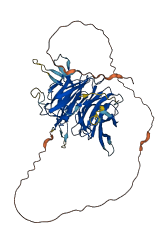
1 structures for Q9SXY1
| Entry ID | Method | Resolution | Chain | Position | Source |
|---|---|---|---|---|---|
| AF-Q9SXY1-F1 | Predicted | AlphaFoldDB |
37 variants for Q9SXY1
| Variant ID(s) | Position | Change | Description | Diseaes Association | Provenance |
|---|---|---|---|---|---|
| ENSVATH00751348 | 19 | V>L | No | 1000Genomes | |
| ENSVATH00751349 | 52 | P>R | No | 1000Genomes | |
| ENSVATH14648056 | 58 | S>T | No | 1000Genomes | |
| ENSVATH00751350 | 74 | P>S | No | 1000Genomes | |
| ENSVATH00751354 | 89 | F>I | No | 1000Genomes | |
| ENSVATH12928825 | 97 | E>D | No | 1000Genomes | |
| tmp_5_25834044_A_G | 106 | K>R | No | 1000Genomes | |
| ENSVATH07478706 | 125 | A>V | No | 1000Genomes | |
| tmp_5_25834321_A_G | 128 | I>V | No | 1000Genomes | |
| tmp_5_25834364_A_C | 142 | N>T | No | 1000Genomes | |
| ENSVATH07478707 | 198 | V>I | No | 1000Genomes | |
| tmp_5_25834650_C_T | 210 | R>W | No | 1000Genomes | |
| tmp_5_25834794_G_A | 232 | R>Q | No | 1000Genomes | |
| ENSVATH00751356 | 234 | L>F | No | 1000Genomes | |
| ENSVATH00751358 | 250 | F>S | No | 1000Genomes | |
| ENSVATH07478712 | 253 | S>L | No | 1000Genomes | |
| ENSVATH00751359 | 261 | A>T | No | 1000Genomes | |
| ENSVATH00751361 | 300 | S>N | No | 1000Genomes | |
| tmp_5_25835540_G_A | 337 | A>T | No | 1000Genomes | |
| tmp_5_25835558_G_C | 343 | A>P | No | 1000Genomes | |
| ENSVATH00751363 | 344 | I>V | No | 1000Genomes | |
| tmp_5_25835697_G_T | 357 | A>S | No | 1000Genomes | |
| ENSVATH12928833 | 381 | I>M | No | 1000Genomes | |
| tmp_5_25835849_G_C | 385 | K>N | No | 1000Genomes | |
| ENSVATH14648063 | 389 | D>N | No | 1000Genomes | |
| tmp_5_25835862_G_A | 390 | G>S | No | 1000Genomes | |
| tmp_5_25835863_G_T | 390 | G>V | No | 1000Genomes | |
| tmp_5_25835885_A_T | 397 | L>F | No | 1000Genomes | |
| tmp_5_25835916_A_G | 408 | T>A | No | 1000Genomes | |
| tmp_5_25835919_C_G | 409 | P>A | No | 1000Genomes | |
| tmp_5_25835952_C_G | 420 | Q>E | No | 1000Genomes | |
| tmp_5_25836001_G_A | 436 | G>D | No | 1000Genomes | |
| tmp_5_25836041_A_T | 449 | E>D | No | 1000Genomes | |
| ENSVATH12928834 | 449 | E>V | No | 1000Genomes | |
| ENSVATH03474435 | 475 | P>S | No | 1000Genomes | |
| ENSVATH14648064 | 485 | I>L | No | 1000Genomes | |
| ENSVATH07478720 | 486 | D>G | No | 1000Genomes |
No associated diseases with Q9SXY1
5 regional properties for Q9SXY1
| Type | Name | Position | InterPro Accession |
|---|---|---|---|
| repeat | WD40 repeat | 2 - 50 | IPR001680-1 |
| repeat | WD40 repeat | 53 - 101 | IPR001680-2 |
| repeat | WD40 repeat | 101 - 182 | IPR001680-3 |
| repeat | WD40 repeat | 329 - 369 | IPR001680-4 |
| conserved_site | WD40 repeat, conserved site | 127 - 141 | IPR019775 |
2 GO annotations of cellular component
| Name | Definition |
|---|---|
| CAF-1 complex | A conserved heterotrimeric protein complex that promotes histone H3 and H4 deposition onto newly synthesized DNA during replication or DNA repair; specifically facilitates replication-dependent nucleosome assembly with the major histone H3 (H3.1). In many species the CAF-1 subunits are designated p150, p60, and p48. |
| nucleus | A membrane-bounded organelle of eukaryotic cells in which chromosomes are housed and replicated. In most cells, the nucleus contains all of the cell's chromosomes except the organellar chromosomes, and is the site of RNA synthesis and processing. In some species, or in specialized cell types, RNA metabolism or DNA replication may be absent. |
No GO annotations of molecular function
| Name | Definition |
|---|---|
| No GO annotations for molecular function |
9 GO annotations of biological process
| Name | Definition |
|---|---|
| DNA recombination | Any process in which a new genotype is formed by reassortment of genes resulting in gene combinations different from those that were present in the parents. In eukaryotes genetic recombination can occur by chromosome assortment, intrachromosomal recombination, or nonreciprocal interchromosomal recombination. Interchromosomal recombination occurs by crossing over. In bacteria it may occur by genetic transformation, conjugation, transduction, or F-duction. |
| DNA replication-dependent chromatin assembly | The formation of nucleosomes on newly synthesized DNA, coupled to strand elongation. |
| double-strand break repair via homologous recombination | The error-free repair of a double-strand break in DNA in which the broken DNA molecule is repaired using homologous sequences. A strand in the broken DNA searches for a homologous region in an intact chromosome to serve as the template for DNA synthesis. The restoration of two intact DNA molecules results in the exchange, reciprocal or nonreciprocal, of genetic material between the intact DNA molecule and the broken DNA molecule. |
| heterochromatin assembly | An epigenetic gene silencing mechanism in which chromatin is compacted into heterochromatin, resulting in a chromatin conformation refractory to transcription. This process starts with heterochromatin nucleation, its spreading, and ends with heterochromatin boundary formation. |
| leaf development | The process whose specific outcome is the progression of the leaf over time, from its formation to the mature structure. |
| meristem structural organization | Organization of a region of tissue in a plant that is composed of one or more undifferentiated cells capable of undergoing mitosis and differentiation, thereby effecting growth and development of a plant by giving rise to more meristem or specialized tissue. |
| nucleosome assembly | The aggregation, arrangement and bonding together of a nucleosome, the beadlike structural units of eukaryotic chromatin composed of histones and DNA. |
| pollen development | The process whose specific outcome is the progression of the pollen grain over time, from its formation to the mature structure. The process begins with the meiosis of the microsporocyte to form four haploid microspores. The nucleus of each microspore then divides by mitosis to form a two-celled organism, the pollen grain, that contains a tube cell as well as a smaller generative cell. The pollen grain is surrounded by an elaborate cell wall. In some species, the generative cell immediately divides again to give a pair of sperm cells. In most flowering plants, however this division takes place later, in the tube that develops when a pollen grain germinates. |
| trichome differentiation | The process in which a relatively unspecialized epidermal cell acquires the specialized features of a trichome cell. An example of this process is found in Arabidopsis thaliana. |
No homologous proteins in AiPD
| UniProt AC | Gene Name | Protein Name | Species | Evidence Code |
|---|---|---|---|---|
| No homologous proteins | ||||
| 10 | 20 | 30 | 40 | 50 | 60 |
| MKGGTIQISW | HDGKPVLTVD | FHPISGLLAT | AGADYDIKLW | LINSGQAEKK | VPSVSYQSSL |
| 70 | 80 | 90 | 100 | 110 | 120 |
| TYHGCAVNTI | RFSPSGELLA | SGADGGELFI | WKLHPSETNQ | SWKVHKSLSF | HRKDVLDLQW |
| 130 | 140 | 150 | 160 | 170 | 180 |
| SPDDAYLISG | SVDNSCIIWD | VNKGSVHQIL | DAHCHYVQGV | AWDPLAKYVA | SLSSDRTCRI |
| 190 | 200 | 210 | 220 | 230 | 240 |
| YANKPQTKSK | GVEKMNYVCQ | HVIMKADQQR | GDETKTIKTH | LFHDETLPSF | FRRLSWSPDG |
| 250 | 260 | 270 | 280 | 290 | 300 |
| SFLLIPAGSF | KVSPTSEAVN | ATYVFSRKDL | SRPALQLPGA | SKPVVVVRFC | PVAFKLRGSS |
| 310 | 320 | 330 | 340 | 350 | 360 |
| SEEGFFKLPY | RLVFAIATLN | SVYIYDTECV | APIAVLAGLH | YAAITDITWS | PNASYLALSS |
| 370 | 380 | 390 | 400 | 410 | 420 |
| QDGYCTLVEF | EDKELGEAVS | ISVGKKPVDG | EEKKHDLEKG | DELMTETTPD | ESKKQAELEQ |
| 430 | 440 | 450 | 460 | 470 | 480 |
| NEESKQPLPS | KITTDGKEKE | HIMQKTDDEV | MTETRHEEEN | QPLQSKVNTP | VSNKPARKRI |
| TPMAIDP |