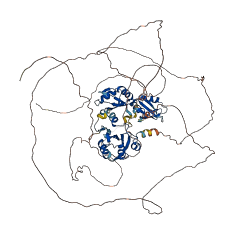
Descriptions
The autoinhibited protein was predicted that may have potential autoinhibitory elements via cis-regPred.
Autoinhibitory domains (AIDs)
Target domain |
|
Relief mechanism |
|
Assay |
cis-regPred |
Accessory elements
No accessory elements
Autoinhibited structure

Activated structure
1 structures for Q9SVV9
| Entry ID | Method | Resolution | Chain | Position | Source |
|---|---|---|---|---|---|
| AF-Q9SVV9-F1 | Predicted | AlphaFoldDB |
No variants for Q9SVV9
| Variant ID(s) | Position | Change | Description | Diseaes Association | Provenance |
|---|---|---|---|---|---|
| No variants for Q9SVV9 | |||||
No associated diseases with Q9SVV9
6 regional properties for Q9SVV9
| Type | Name | Position | InterPro Accession |
|---|---|---|---|
| domain | RNA recognition motif domain | 166 - 239 | IPR000504-1 |
| domain | RNA recognition motif domain | 251 - 324 | IPR000504-2 |
| domain | RNA recognition motif domain | 614 - 690 | IPR000504-3 |
| domain | Mei2-like, C-terminal RNA recognition motif | 612 - 708 | IPR007201 |
| domain | MEI2-like, RNA recognition motif 1 | 165 - 241 | IPR034453 |
| domain | MEI2-like, RNA recognition motif 3 | 615 - 700 | IPR034454 |
2 GO annotations of cellular component
| Name | Definition |
|---|---|
| nuclear speck | A discrete extra-nucleolar subnuclear domain, 20-50 in number, in which splicing factors are seen to be localized by immunofluorescence microscopy. |
| nucleus | A membrane-bounded organelle of eukaryotic cells in which chromosomes are housed and replicated. In most cells, the nucleus contains all of the cell's chromosomes except the organellar chromosomes, and is the site of RNA synthesis and processing. In some species, or in specialized cell types, RNA metabolism or DNA replication may be absent. |
1 GO annotations of molecular function
| Name | Definition |
|---|---|
| RNA binding | Binding to an RNA molecule or a portion thereof. |
4 GO annotations of biological process
| Name | Definition |
|---|---|
| meiotic cell cycle | Progression through the phases of the meiotic cell cycle, in which canonically a cell replicates to produce four offspring with half the chromosomal content of the progenitor cell via two nuclear divisions. |
| mRNA splicing, via spliceosome | The joining together of exons from one or more primary transcripts of messenger RNA (mRNA) and the excision of intron sequences, via a spliceosomal mechanism, so that mRNA consisting only of the joined exons is produced. |
| positive regulation of growth | Any process that activates or increases the rate or extent of growth, the increase in size or mass of all or part of an organism. |
| positive regulation of meiotic nuclear division | Any process that activates or increases the frequency, rate or extent of meiosis. |
No homologous proteins in AiPD
| UniProt AC | Gene Name | Protein Name | Species | Evidence Code |
|---|---|---|---|---|
| No homologous proteins | ||||
| 10 | 20 | 30 | 40 | 50 | 60 |
| MNIPSGTFSR | SDHFHASSDA | SLFSSSLPLI | QHQNINPRDS | YHQSVDEMAS | GLDHFSGGIG |
| 70 | 80 | 90 | 100 | 110 | 120 |
| NMLDDGDSHP | IGNMLPDDEE | ELFSGLMDDL | NLSSLPATLD | DLEDYDLFGS | GGGLELETDP |
| 130 | 140 | 150 | 160 | 170 | 180 |
| YDSLNKGFSR | MGFADSNVDN | VMPQNIFQNG | VGSIAGEHPY | GEHPSRTLFV | RNINSNVEDS |
| 190 | 200 | 210 | 220 | 230 | 240 |
| ELQALFEQYG | HIRTLYTACK | QRGFVMVSYN | DIRASRAAMR | ALQGKLLKKR | KLDIHFSIPK |
| 250 | 260 | 270 | 280 | 290 | 300 |
| DNPSEKDVNQ | GTLVVFNLAP | SVSNRDLENI | FGVYGEIKEI | RETPNKRHHK | FVEFFDVRSA |
| 310 | 320 | 330 | 340 | 350 | 360 |
| DAALKALNRT | EIAGKRIKLE | HSRPGGARRN | MMLQMNPELE | QDDSYSYLNH | VESPLASSPI |
| 370 | 380 | 390 | 400 | 410 | 420 |
| GNWRNSPIDH | PLQSFSKSPI | FGNLSPTKNI | RYPEFSMKTA | SVNNDQEGRR | FSHLDHLFSS |
| 430 | 440 | 450 | 460 | 470 | 480 |
| SSYNNASHKA | STFQQPQSFG | SVSSFGSLNS | HPSHVETLSG | SEFLWGSPSS | SAWPVNPFSS |
| 490 | 500 | 510 | 520 | 530 | 540 |
| NRENHRFPYS | AQNGSLHQLH | HIGSAPSGFF | PRSPETSSMG | SVAFRGASGN | MNAQRNLRET |
| 550 | 560 | 570 | 580 | 590 | 600 |
| SSPNFKMLSA | PRRSQLFTGN | GSYLWPAATM | VSIDDPLEDG | SNQQFDSNGN | QADIKIQFQL |
| 610 | 620 | 630 | 640 | 650 | 660 |
| DLSKIMRGED | PRTTLMIKNI | PNKYTRNMLL | AAIDEKNSGT | YDFLYLPIDF | KNKCNVGYAF |
| 670 | 680 | 690 | 700 | 710 | 720 |
| INMVSPKFTI | ALYEAFNGKK | WDKFNSEKVA | SLAYARIQGK | AALIAHFQNS | SLMNEDRRCQ |
| 730 | 740 | 750 | |||
| PIVFDGSESK | YPIIRENSQL | EASNSTVSHP | LVGENTHQS |