Descriptions
The autoinhibited protein was predicted that may have potential autoinhibitory elements via cis-regPred.
Autoinhibitory domains (AIDs)
Target domain |
|
Relief mechanism |
|
Assay |
cis-regPred |
Accessory elements
No accessory elements
Autoinhibited structure

Activated structure
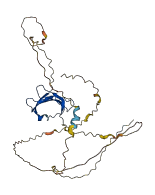
1 structures for Q9SUS1
| Entry ID | Method | Resolution | Chain | Position | Source |
|---|---|---|---|---|---|
| AF-Q9SUS1-F1 | Predicted | AlphaFoldDB |
No variants for Q9SUS1
| Variant ID(s) | Position | Change | Description | Diseaes Association | Provenance |
|---|---|---|---|---|---|
| No variants for Q9SUS1 | |||||
No associated diseases with Q9SUS1
1 regional properties for Q9SUS1
| Type | Name | Position | InterPro Accession |
|---|---|---|---|
| domain | WRKY domain | 128 - 194 | IPR003657 |
1 GO annotations of cellular component
| Name | Definition |
|---|---|
| nucleus | A membrane-bounded organelle of eukaryotic cells in which chromosomes are housed and replicated. In most cells, the nucleus contains all of the cell's chromosomes except the organellar chromosomes, and is the site of RNA synthesis and processing. In some species, or in specialized cell types, RNA metabolism or DNA replication may be absent. |
2 GO annotations of molecular function
| Name | Definition |
|---|---|
| DNA-binding transcription factor activity | A transcription regulator activity that modulates transcription of gene sets via selective and non-covalent binding to a specific double-stranded genomic DNA sequence (sometimes referred to as a motif) within a cis-regulatory region. Regulatory regions include promoters (proximal and distal) and enhancers. Genes are transcriptional units, and include bacterial operons. |
| transcription cis-regulatory region binding | Binding to a specific sequence of DNA that is part of a regulatory region that controls transcription of that section of the DNA. The transcribed region might be described as a gene, cistron, or operon. |
1 GO annotations of biological process
| Name | Definition |
|---|---|
| defense response | Reactions, triggered in response to the presence of a foreign body or the occurrence of an injury, which result in restriction of damage to the organism attacked or prevention/recovery from the infection caused by the attack. |
No homologous proteins in AiPD
| UniProt AC | Gene Name | Protein Name | Species | Evidence Code |
|---|---|---|---|---|
| No homologous proteins | ||||
| 10 | 20 | 30 | 40 | 50 | 60 |
| MDEGDLEAIV | RGYSGSGDAF | SGESSGTFSP | SFCLPMETSS | FYEPEMETSG | LDELGELYKP |
| 70 | 80 | 90 | 100 | 110 | 120 |
| FYPFSTQTIL | TSSVSLPEDS | KPFRDDKKQR | SHGCLLSNGS | RADHIRISES | KSKKSKKNQQ |
| 130 | 140 | 150 | 160 | 170 | 180 |
| KRVVEQVKEE | NLLSDAWAWR | KYGQKPIKGS | PYPRSYYRCS | SSKGCLARKQ | VERNPQNPEK |
| 190 | 200 | 210 | 220 | 230 | 240 |
| FTITYTNEHN | HELPTRRNSL | AGSTRAKTSQ | PKPTLTKKSE | KEVVSSPTSN | PMIPSADESS |
| 250 | 260 | 270 | 280 | 290 | 300 |
| VAVQEMSVAE | TSTHQAAGAI | EGRRLSNGLP | SDLMSGSGTF | PSFTGDFDEL | LNSQEFFSGY |
| LWNY |