Q9SJV5
Gene name |
TATC (APG2, UNE3, At2g01110, F23H14.8) |
Protein name |
Sec-independent protein translocase protein TATC, chloroplastic |
Names |
Protein ALBINO AND PALE GREEN 2, Protein TWIN-ARGININE TRANSLOCATION C, Protein UNFERTILIZED EMBRYO SAC 3 |
Species |
Arabidopsis thaliana (Mouse-ear cress) |
KEGG Pathway |
ath:AT2G01110 |
EC number |
|
Protein Class |
|
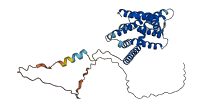
Descriptions
The autoinhibited protein was predicted that may have potential autoinhibitory elements via cis-regPred.
Autoinhibitory domains (AIDs)
Target domain |
|
Relief mechanism |
|
Assay |
cis-regPred |
Accessory elements
No accessory elements
Autoinhibited structure

Activated structure
1 structures for Q9SJV5
| Entry ID | Method | Resolution | Chain | Position | Source |
|---|---|---|---|---|---|
| AF-Q9SJV5-F1 | Predicted | AlphaFoldDB |
16 variants for Q9SJV5
| Variant ID(s) | Position | Change | Description | Diseaes Association | Provenance |
|---|---|---|---|---|---|
| ENSVATH01601117 | 19 | R>C | No | 1000Genomes | |
| tmp_2_84994_G_A | 32 | A>V | No | 1000Genomes | |
| tmp_2_84992_C_T | 33 | V>I | No | 1000Genomes | |
| tmp_2_84985_A_C | 35 | F>C | No | 1000Genomes | |
| ENSVATH05201243 | 42 | A>T | No | 1000Genomes | |
| tmp_2_84953_A_T | 46 | Y>N | No | 1000Genomes | |
| ENSVATH10473401 | 64 | D>E | No | 1000Genomes | |
| ENSVATH05201242 | 67 | S>L | No | 1000Genomes | |
| tmp_2_84715_G_A | 86 | S>L | No | 1000Genomes | |
| tmp_2_84697_C_T | 92 | S>N | No | 1000Genomes | |
| tmp_2_84658_A_T | 105 | L>H | No | 1000Genomes | |
| tmp_2_84653_C_A | 107 | D>Y | No | 1000Genomes | |
| tmp_2_84610_C_T | 121 | R>Q | No | 1000Genomes | |
| tmp_2_84323_A_G | 192 | I>T | No | 1000Genomes | |
| tmp_2_84281_C_T | 206 | R>K | No | 1000Genomes | |
| ENSVATH13852756 | 297 | V>M | No | 1000Genomes |
No associated diseases with Q9SJV5
1 regional properties for Q9SJV5
| Type | Name | Position | InterPro Accession |
|---|---|---|---|
| conserved_site | Sec-independent periplasmic protein translocase, conserved site | 255 - 274 | IPR019820 |
5 GO annotations of cellular component
| Name | Definition |
|---|---|
| chloroplast | A chlorophyll-containing plastid with thylakoids organized into grana and frets, or stroma thylakoids, and embedded in a stroma. |
| chloroplast thylakoid membrane | The pigmented membrane of a chloroplast thylakoid. An example of this component is found in Arabidopsis thaliana. |
| integral component of thylakoid membrane | The component of the thylakoid membrane consisting of the gene products having at least some part of their peptide sequence embedded in the hydrophobic region of the membrane. |
| receptor complex | Any protein complex that undergoes combination with a hormone, neurotransmitter, drug or intracellular messenger to initiate a change in cell function. |
| TAT protein transport complex | A complex of three proteins integral to the cytoplasmic membrane of bacteria and membranes of organelles derived from bacteria (chloroplasts and mitochondria) involved in membrane transport of folded proteins. |
1 GO annotations of molecular function
| Name | Definition |
|---|---|
| proton motive force dependent protein transmembrane transporter activity | Catalysis of the transfer of proteins from one side of a membrane to the other. Transportation is dependent on pH gradient across the membrane. |
4 GO annotations of biological process
| Name | Definition |
|---|---|
| double fertilization forming a zygote and endosperm | Fertilization where one of the two sperm nuclei from the pollen tube fuses with the egg nucleus to form a 2n zygote, and the other fuses with the two polar nuclei to form the 3n primary endosperm nucleus and then develops into the endosperm. The ploidy level of the 2n zygote and 3n primary endosperm nucleus is determined by the ploidy level of the parents involved. An example of this component is found in Arabidopsis thaliana. |
| intracellular protein transmembrane transport | The directed movement of proteins in a cell, from one side of a membrane to another by means of some agent such as a transporter or pore. |
| protein transport by the Tat complex | The process in which folded proteins are transported across cytoplasmic membranes of bacteria and membranes of organelles derived from bacteria (chloroplasts and mitochondria) by the TAT complex. |
| thylakoid membrane organization | A process that is carried out at the cellular level which results in the assembly, arrangement of constituent parts, or disassembly of the thylakoid membrane. |
No homologous proteins in AiPD
| UniProt AC | Gene Name | Protein Name | Species | Evidence Code |
|---|---|---|---|---|
| No homologous proteins | ||||
| 10 | 20 | 30 | 40 | 50 | 60 |
| MSSTSTSSAL | IHHFRLTTRN | LGSPTKQRCP | YAVTFCNSWR | EAGLRYSVTQ | RRSKGFGPVS |
| 70 | 80 | 90 | 100 | 110 | 120 |
| ALNDDDSPTE | TTPGVGSAVE | DRPPDSSEDR | SSSVYEFLYP | RKEELPDDKE | MTIFDHLEEL |
| 130 | 140 | 150 | 160 | 170 | 180 |
| RERIFVSVLA | VGAAILGCFA | FSKDLIVFLE | APVKTQGVRF | LQLAPGEFFF | TTLKVSGYCG |
| 190 | 200 | 210 | 220 | 230 | 240 |
| LLLGSPVILY | EIIAFVLPGL | TRAERRFLGP | IVFGSSLLFY | AGLAFSYWVL | TPAALNFFVN |
| 250 | 260 | 270 | 280 | 290 | 300 |
| YAEGVVESLW | SIDQYFEFVL | VLMFSTGLSF | QVPVIQLLLG | QVGVVSGDQM | LSIWRYVVVG |
| 310 | 320 | 330 | |||
| AVVAAAVVTP | STDPVTQMLL | ATPLLGLYLG | GAWMVKLTGR |