Q9S7H1
Gene name |
psaD1 (At4g02770, T5J8.7) |
Protein name |
Photosystem I reaction center subunit II-1, chloroplastic |
Names |
Photosystem I 20 kDa subunit 1, PSI-D1 |
Species |
Arabidopsis thaliana (Mouse-ear cress) |
KEGG Pathway |
ath:AT4G02770 |
EC number |
|
Protein Class |
|
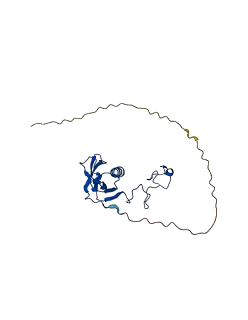
Descriptions
The autoinhibited protein was predicted that may have potential autoinhibitory elements via cis-regPred.
Autoinhibitory domains (AIDs)
Target domain |
|
Relief mechanism |
|
Assay |
cis-regPred |
Accessory elements
No accessory elements
Autoinhibited structure

Activated structure
1 structures for Q9S7H1
| Entry ID | Method | Resolution | Chain | Position | Source |
|---|---|---|---|---|---|
| AF-Q9S7H1-F1 | Predicted | AlphaFoldDB |
8 variants for Q9S7H1
| Variant ID(s) | Position | Change | Description | Diseaes Association | Provenance |
|---|---|---|---|---|---|
| tmp_4_1229782_T_G | 31 | H>P | No | 1000Genomes | |
| tmp_4_1229781_G_T | 31 | H>Q | No | 1000Genomes | |
| tmp_4_1229731_G_T | 48 | T>K | No | 1000Genomes | |
| ENSVATH10545251 | 48 | T>S | No | 1000Genomes | |
| tmp_4_1229695_G_A | 60 | T>M | No | 1000Genomes | |
| ENSVATH06427232 | 140 | T>R | No | 1000Genomes | |
| ENSVATH13885721 | 149 | T>A | No | 1000Genomes | |
| ENSVATH13885720 | 157 | P>S | No | 1000Genomes |
No associated diseases with Q9S7H1
No regional properties for Q9S7H1
| Type | Name | Position | InterPro Accession |
|---|---|---|---|
| No domain, repeats, and functional sites for Q9S7H1 | |||
8 GO annotations of cellular component
| Name | Definition |
|---|---|
| chloroplast | A chlorophyll-containing plastid with thylakoids organized into grana and frets, or stroma thylakoids, and embedded in a stroma. |
| chloroplast envelope | The double lipid bilayer enclosing the chloroplast and separating its contents from the rest of the cytoplasm; includes the intermembrane space. |
| chloroplast thylakoid | Sac-like membranous structures (cisternae) in a chloroplast combined into stacks (grana) and present singly in the stroma (stroma thylakoids or frets) as interconnections between grana. An example of this component is found in Arabidopsis thaliana. |
| chloroplast thylakoid membrane | The pigmented membrane of a chloroplast thylakoid. An example of this component is found in Arabidopsis thaliana. |
| cytosol | The part of the cytoplasm that does not contain organelles but which does contain other particulate matter, such as protein complexes. |
| photosystem I reaction center | A photochemical system containing P700, the chlorophyll a dimer that functions as a primary electron donor. Functioning as a light-dependent plastocyanin-ferredoxin oxidoreductase, it transfers electrons from plastocyanin to ferredoxin. |
| plastoglobule | A lipoprotein particle present in chloroplasts. They are rich in non-polar lipids (triglycerides, esters) as well as in prenylquinones, plastoquinone and tocopherols. Plastoglobules are often associated with thylakoid membranes, suggesting an exchange of lipids with thylakoids. |
| thylakoid | A membranous cellular structure that bears the photosynthetic pigments in plants, algae, and cyanobacteria. In cyanobacteria thylakoids are of various shapes and are attached to, or continuous with, the plasma membrane. In eukaryotes they are flattened, membrane-bounded disk-like structures located in the chloroplasts; in the chloroplasts of higher plants the thylakoids form dense stacks called grana. Isolated thylakoid preparations can carry out photosynthetic electron transport and the associated phosphorylation. |
2 GO annotations of molecular function
| Name | Definition |
|---|---|
| mRNA binding | Binding to messenger RNA (mRNA), an intermediate molecule between DNA and protein. mRNA includes UTR and coding sequences, but does not contain introns. |
| protein domain specific binding | Binding to a specific domain of a protein. |
2 GO annotations of biological process
| Name | Definition |
|---|---|
| acquisition of seed longevity | The acquisition of seed longevity is the ordered series of events during seed development, that prevent embryo deterioration and ROS damage and thus contribute to seed viability over time or in response to adverse environmental conditions. These events include protective (e.g. production of glassy cytoplasm ) and repair (e.g. oxidative stress responses) processes. |
| photosynthesis | The synthesis by organisms of organic chemical compounds, especially carbohydrates, from carbon dioxide (CO2) using energy obtained from light rather than from the oxidation of chemical compounds. |
| 10 | 20 | 30 | 40 | 50 | 60 |
| MATQAAGIFN | SAITTAATSG | VKKLHFFSTT | HRPKSLSFTK | TAIRAEKTDS | SAAAAAAPAT |
| 70 | 80 | 90 | 100 | 110 | 120 |
| KEAPVGFTPP | QLDPNTPSPI | FAGSTGGLLR | KAQVEEFYVI | TWNSPKEQIF | EMPTGGAAIM |
| 130 | 140 | 150 | 160 | 170 | 180 |
| REGPNLLKLA | RKEQCLALGT | RLRSKYKITY | QFYRVFPNGE | VQYLHPKDGV | YPEKANPGRE |
| 190 | 200 | ||||
| GVGLNMRSIG | KNVSPIEVKF | TGKQSYDL |