Q9S158
Gene name |
mhpA |
Protein name |
3-(3-hydroxy-phenyl)propionate/3-hydroxycinnamic acid hydroxylase |
Names |
3-HCI hydroxylase, 3-HPP hydroxylase |
Species |
Comamonas testosteroni (Pseudomonas testosteroni) |
KEGG Pathway |
|
EC number |
1.14.13.127: With NADH or NADPH as one donor, and incorporation of one atom of oxygen |
Protein Class |
|
Descriptions
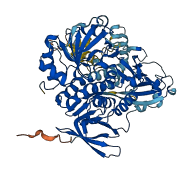
The autoinhibited protein was predicted that may have potential autoinhibitory elements via cis-regPred.
Autoinhibitory domains (AIDs)
Target domain |
|
Relief mechanism |
|
Assay |
cis-regPred |
Accessory elements
No accessory elements
Autoinhibited structure

Activated structure
1 structures for Q9S158
| Entry ID | Method | Resolution | Chain | Position | Source |
|---|---|---|---|---|---|
| AF-Q9S158-F1 | Predicted | AlphaFoldDB |
No variants for Q9S158
| Variant ID(s) | Position | Change | Description | Diseaes Association | Provenance |
|---|---|---|---|---|---|
| No variants for Q9S158 | |||||
No associated diseases with Q9S158
6 regional properties for Q9S158
| Type | Name | Position | InterPro Accession |
|---|---|---|---|
| domain | Helicase, C-terminal | 809 - 970 | IPR001650 |
| domain | CarD-like/TRCF, RNAP-interacting domain | 495 - 592 | IPR003711 |
| domain | Transcription-repair-coupling factor, C-terminal domain | 1021 - 1121 | IPR005118 |
| domain | DEAD/DEAH box helicase domain | 621 - 780 | IPR011545 |
| domain | Helicase superfamily 1/2, ATP-binding domain | 616 - 806 | IPR014001 |
| domain | UvrB, interaction domain | 140 - 227 | IPR041471 |
Functions
| Description | ||
|---|---|---|
| EC Number | 1.14.13.127 | With NADH or NADPH as one donor, and incorporation of one atom of oxygen |
| Subcellular Localization |
|
|
| PANTHER Family | ||
| PANTHER Subfamily | ||
| PANTHER Protein Class | ||
| PANTHER Pathway Category | No pathway information available | |
No GO annotations of cellular component
| Name | Definition |
|---|---|
| No GO annotations for cellular component |
2 GO annotations of molecular function
| Name | Definition |
|---|---|
| 3-(3-hydroxyphenyl)propionate hydroxylase activity | Catalysis of the reaction: 3-(3-hydroxyphenyl)propionate + NADH + oxygen + H+ = 3-(2,3-dihydroxyphenyl)propionate + NAD+ + H2O. |
| FAD binding | Binding to the oxidized form, FAD, of flavin-adenine dinucleotide, the coenzyme or the prosthetic group of various flavoprotein oxidoreductase enzymes. |
2 GO annotations of biological process
| Name | Definition |
|---|---|
| 3-(3-hydroxy)phenylpropionate catabolic process | The chemical reactions and pathways resulting in the breakdown of 3-(3-hydroxy)phenylpropionate, a hydroxylated derivative of phenylpropionate. |
| 3-phenylpropionate catabolic process | The chemical reactions and pathways resulting in the breakdown of 3-phenylpropionate, the anion of phenylpropanoic acid. |
No homologous proteins in AiPD
| UniProt AC | Gene Name | Protein Name | Species | Evidence Code |
|---|---|---|---|---|
| No homologous proteins | ||||
| 10 | 20 | 30 | 40 | 50 | 60 |
| MNAPQENQAS | QDDADVLIIG | AGPVGLTLAN | TLGMAGVRVI | VAEKLPRIID | YPRAIGIDDE |
| 70 | 80 | 90 | 100 | 110 | 120 |
| SLRTLQAAGL | SDQVQAHITP | HHWMRFYTAS | GQCFASIEPR | TDEYGWSRRN | AFIQPQVDDI |
| 130 | 140 | 150 | 160 | 170 | 180 |
| LYRGLQRFDQ | VQVLLGHELH | SFSQDDAGIT | ATLKDADGVE | RTLRAKYLVA | SDGGNSLVRR |
| 190 | 200 | 210 | 220 | 230 | 240 |
| MLNVAFEGRT | KPNQWIVVDV | RNDPLGTPHI | DMHCDPQRPY | VSAALPHGIR | RFEFMVMPGE |
| 250 | 260 | 270 | 280 | 290 | 300 |
| TEEQLSRPEN | LAQLMRKVVA | DPDKVDYIRK | RVYTHNARLA | AQFRVDRILL | AGDAAHIMPV |
| 310 | 320 | 330 | 340 | 350 | 360 |
| WQGQGYNSGM | RDASNLAWKL | AMVVKGEARS | DLLDSYEQER | RDHARSMIHL | SEVAGDIFAP |
| 370 | 380 | 390 | 400 | 410 | 420 |
| ESHTAAKVRD | TVMLALNAVP | PVKQYFAEMR | FKPMPRYEQG | VVLHHTGTGN | QGVRTPFAGL |
| 430 | 440 | 450 | 460 | 470 | 480 |
| LDRSGNTPLG | RLLGLMAEKK | ESLVGRLVHG | LETAASSPVG | RMFIQPRVAT | ANGHSGLLDD |
| 490 | 500 | 510 | 520 | 530 | 540 |
| FVGLNFCILA | WGTDPSYGMD | EEALNFWQRL | GARFIRAMPA | GQLLHPTPTR | DGVLTVGDEQ |
| 550 | 560 | 570 | 580 | ||
| GRLKDWFSAQ | GKSVVFVRPD | RFVAALASPQ | EVSAVTRQMA | RVLHSPLEA |