Q9RXR4
Gene name |
speA |
Protein name |
Biosynthetic arginine decarboxylase |
Names |
ADC |
Species |
Deinococcus radiodurans (strain ATCC 13939 / DSM 20539 / JCM 16871 / LMG 4051 / NBRC 15346 / NCIMB 9279 / R1 / VKM B-1422) |
KEGG Pathway |
dra:DR_0243 |
EC number |
4.1.1.19: Carboxy-lyases |
Protein Class |
|
Descriptions
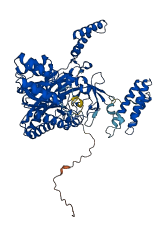
The autoinhibited protein was predicted that may have potential autoinhibitory elements via cis-regPred.
Autoinhibitory domains (AIDs)
Target domain |
|
Relief mechanism |
|
Assay |
cis-regPred |
Accessory elements
No accessory elements
Autoinhibited structure

Activated structure
1 structures for Q9RXR4
| Entry ID | Method | Resolution | Chain | Position | Source |
|---|---|---|---|---|---|
| AF-Q9RXR4-F1 | Predicted | AlphaFoldDB |
No variants for Q9RXR4
| Variant ID(s) | Position | Change | Description | Diseaes Association | Provenance |
|---|---|---|---|---|---|
| No variants for Q9RXR4 | |||||
No associated diseases with Q9RXR4
4 regional properties for Q9RXR4
| Type | Name | Position | InterPro Accession |
|---|---|---|---|
| domain | Orn/DAP/Arg decarboxylase 2, N-terminal | 101 - 368 | IPR022644 |
| binding_site | Orn/DAP/Arg decarboxylase 2, pyridoxal-phosphate binding site | 123 - 141 | IPR022653 |
| domain | Arginine decarboxylase, helical bundle domain | 397 - 478 | IPR040634 |
| domain | Arginine decarboxylase, C-terminal helical | 607 - 658 | IPR041128 |
Functions
| Description | ||
|---|---|---|
| EC Number | 4.1.1.19 | Carboxy-lyases |
| Subcellular Localization |
|
|
| PANTHER Family | ||
| PANTHER Subfamily | ||
| PANTHER Protein Class | ||
| PANTHER Pathway Category | No pathway information available | |
No GO annotations of cellular component
| Name | Definition |
|---|---|
| No GO annotations for cellular component |
2 GO annotations of molecular function
| Name | Definition |
|---|---|
| arginine decarboxylase activity | Catalysis of the reaction: L-arginine + H(+) = agmatine + CO(2). |
| metal ion binding | Binding to a metal ion. |
3 GO annotations of biological process
| Name | Definition |
|---|---|
| arginine catabolic process | The chemical reactions and pathways resulting in the breakdown of arginine, 2-amino-5-(carbamimidamido)pentanoic acid. |
| putrescine biosynthetic process from arginine | The chemical reactions and pathways resulting in the formation of putrescine, 1,4-diaminobutane, from other compounds, including arginine. |
| spermidine biosynthetic process | The chemical reactions and pathways resulting in the formation of spermidine, N-(3-aminopropyl)-1,4-diaminobutane. |
No homologous proteins in AiPD
| UniProt AC | Gene Name | Protein Name | Species | Evidence Code |
|---|---|---|---|---|
| No homologous proteins | ||||
| 10 | 20 | 30 | 40 | 50 | 60 |
| MCPARLRTPR | TASLPTHRRS | AMTTANPLNT | SFTSADAAEL | YQVPNWSGGW | FRVSDKGLME |
| 70 | 80 | 90 | 100 | 110 | 120 |
| ATPAPGLHAS | LRAIVDEIVD | RGESLPVILR | FPQVLAGRVK | HLNEAFQAAI | NEYNYSGHYQ |
| 130 | 140 | 150 | 160 | 170 | 180 |
| GVFPIKVNQR | RAVVETVAAA | GYDYAHGLEA | GSKAELALCL | AQKMHPDALL | CCNGFKDDGF |
| 190 | 200 | 210 | 220 | 230 | 240 |
| IKLALWGRTL | GKNVVITIEK | FTELDRILKQ | AKALGVKPAV | GVRFKLHARG | SGQWEESGGD |
| 250 | 260 | 270 | 280 | 290 | 300 |
| QAKFGLNAYE | LLRVVERLKE | ENMLDSLVML | HTHIGSQITD | IRRVKVAVRE | AAQTYAGLIA |
| 310 | 320 | 330 | 340 | 350 | 360 |
| AGADLKYLNV | GGGLGVDYDG | SKTTFYASMN | YTVKEYAADI | VYTVQEVCKA | REVPEPVIVS |
| 370 | 380 | 390 | 400 | 410 | 420 |
| ESGRALTAHH | AVLILPVVDV | TGPTRNLEDQ | ELTVPGEDSH | QIVRDMYETL | ENISMRNYRE |
| 430 | 440 | 450 | 460 | 470 | 480 |
| SYNDAVGDKQ | TLHNLFDLGY | VTLEDRARGE | ALFNAILRKI | AKLIQGEKYV | PDELEDLQKV |
| 490 | 500 | 510 | 520 | 530 | 540 |
| LADKFICNFS | LFQSLPDNWA | IGALFPIVPL | DRLNEQPTRQ | ATLVDITCDS | DGKVEKFIDL |
| 550 | 560 | 570 | 580 | 590 | 600 |
| RDVKATLPLH | EPGDRPYYLG | AFLMGAYQDV | LGSAHNLFGK | VSEAHVTVRP | GGRFNIDLFV |
| 610 | 620 | 630 | 640 | 650 | 660 |
| RGQKARRMIE | SMGYEEPMLR | DAIEDQADAA | IGRGTLTQEQ | EHELLEDYGE | ELLGYTYLEY |
| ES |