Q9RCG7
Gene name |
paxB |
Protein name |
Exotoxin translocation ATP-binding protein PaxB |
Names |
|
Species |
Pasteurella aerogenes |
KEGG Pathway |
|
EC number |
7.4.2.5: Linked to the hydrolysis of a nucleoside triphosphate |
Protein Class |
|
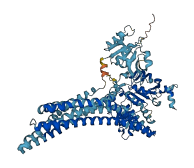
Descriptions
The autoinhibited protein was predicted that may have potential autoinhibitory elements via cis-regPred.
Autoinhibitory domains (AIDs)
Target domain |
|
Relief mechanism |
|
Assay |
cis-regPred |
Accessory elements
No accessory elements
Autoinhibited structure

Activated structure
1 structures for Q9RCG7
| Entry ID | Method | Resolution | Chain | Position | Source |
|---|---|---|---|---|---|
| AF-Q9RCG7-F1 | Predicted | AlphaFoldDB |
No variants for Q9RCG7
| Variant ID(s) | Position | Change | Description | Diseaes Association | Provenance |
|---|---|---|---|---|---|
| No variants for Q9RCG7 | |||||
No associated diseases with Q9RCG7
6 regional properties for Q9RCG7
| Type | Name | Position | InterPro Accession |
|---|---|---|---|
| domain | ABC transporter-like, ATP-binding domain | 472 - 707 | IPR003439 |
| domain | AAA+ ATPase domain | 498 - 684 | IPR003593 |
| domain | Peptidase C39, bacteriocin processing | 8 - 133 | IPR005074 |
| domain | ABC transporter type 1, transmembrane domain | 161 - 440 | IPR011527 |
| conserved_site | ABC transporter-like, conserved site | 610 - 624 | IPR017871 |
| domain | Peptidase C39-like A | 8 - 129 | IPR039395 |
Functions
| Description | ||
|---|---|---|
| EC Number | 7.4.2.5 | Linked to the hydrolysis of a nucleoside triphosphate |
| Subcellular Localization |
|
|
| PANTHER Family | ||
| PANTHER Subfamily | ||
| PANTHER Protein Class | ||
| PANTHER Pathway Category | No pathway information available | |
3 GO annotations of cellular component
| Name | Definition |
|---|---|
| integral component of membrane | The component of a membrane consisting of the gene products and protein complexes having at least some part of their peptide sequence embedded in the hydrophobic region of the membrane. |
| plasma membrane | The membrane surrounding a cell that separates the cell from its external environment. It consists of a phospholipid bilayer and associated proteins. |
| type I protein secretion system complex | A complex of three secretory proteins that carry out secretion in the type I secretion system: an inner membrane transport ATPase (termed ABC protein for ATP-binding cassette), which provides the energy for protein secretion; an outer membrane protein, which is exported via the sec pathway; and a membrane fusion protein, which is anchored in the inner membrane and spans the periplasmic space. |
4 GO annotations of molecular function
| Name | Definition |
|---|---|
| ABC-type peptide transporter activity | Catalysis of the reaction: ATP + H2O + peptide(in) = ADP + phosphate + peptide(out). Peptides exported include alpha-hemolysin, cyclolysin, colicin V and siderophores from Gram-negative bacteria, and bacteriocin, subtilin, competence factor and pediocin from Gram-positive bacteria. |
| ABC-type protein transporter activity | Enables the transfer of a solute or solutes from one side of a membrane to the other according to the reaction: ATP + H2O + protein(out) = ADP + phosphate + protein(in). |
| ATP binding | Binding to ATP, adenosine 5'-triphosphate, a universally important coenzyme and enzyme regulator. |
| peptidase activity | Catalysis of the hydrolysis of a peptide bond. A peptide bond is a covalent bond formed when the carbon atom from the carboxyl group of one amino acid shares electrons with the nitrogen atom from the amino group of a second amino acid. |
2 GO annotations of biological process
| Name | Definition |
|---|---|
| protein secretion by the type I secretion system | The process in which proteins are secreted into the extracellular milieu via the type I secretion system; secretion occurs in a continuous process without the distinct presence of periplasmic intermediates and does not involve proteolytic processing of secreted proteins. |
| proteolysis | The hydrolysis of proteins into smaller polypeptides and/or amino acids by cleavage of their peptide bonds. |
No homologous proteins in AiPD
| UniProt AC | Gene Name | Protein Name | Species | Evidence Code |
|---|---|---|---|---|
| No homologous proteins | ||||
| 10 | 20 | 30 | 40 | 50 | 60 |
| MEPLMSFKQK | NDYGLHALVI | LAQYHNIAVS | PEEIKHKFDP | EGKGIDLVAW | LLAAKSFELK |
| 70 | 80 | 90 | 100 | 110 | 120 |
| AKKVKKSIDR | LPFIHLPALI | WRDDGQHFIL | TKIDTQTNRY | LIFDLEERNP | KVLSAVEFQQ |
| 130 | 140 | 150 | 160 | 170 | 180 |
| VFQGNVILLT | SRASIMGKLA | KFDFTWFIPA | IIKYRKIFVE | VMIVSIFLQL | FALITPLFFQ |
| 190 | 200 | 210 | 220 | 230 | 240 |
| VVMDKVLVHR | GFSTLNVITV | ALAIVVIFEI | VLSGLRTYVF | SHSTSRIDVE | LGAKLFRHLL |
| 250 | 260 | 270 | 280 | 290 | 300 |
| ALPISYFENR | RVGDTVARVR | ELDQIRNFLT | GQALTSVLDL | LFSFIFFAVM | WYYSPKLTIV |
| 310 | 320 | 330 | 340 | 350 | 360 |
| ILLSLPCYIA | WSIFISPILR | RRLDEKFTRN | ADNQAFLVES | VTAIDTIKAL | AVTPQMTNIW |
| 370 | 380 | 390 | 400 | 410 | 420 |
| DKQLASYVSA | DFRVTVLATI | GQQGVQLIQK | TVMIINLWLG | AHLVISGDLS | IGQLIAFNML |
| 430 | 440 | 450 | 460 | 470 | 480 |
| SGQVIAPVIR | LAQLWQDFQQ | VGISITRLGD | VLNAPTENFQ | GKLSLPEING | DVTFKNIRFR |
| 490 | 500 | 510 | 520 | 530 | 540 |
| YKPDAPIILN | DVNLTIKQGE | VIGIVGRSGS | GKSTLTKLLQ | RFYIPENGQV | LIDGHDLALA |
| 550 | 560 | 570 | 580 | 590 | 600 |
| DPNWLRRQIG | VVLQDNVLLN | RSIRDNIALT | DPSMPMEQVI | HAAKLAGAHD | FISELREGYN |
| 610 | 620 | 630 | 640 | 650 | 660 |
| TMVGEQGAGL | SGGQRQRIAI | ARALVNNPRI | LIFDEATSAL | DYESEHIIMR | NMQQICHGRT |
| 670 | 680 | 690 | 700 | 710 | |
| VIIIAHRLST | VRKADRIIVM | EKGHIVERGK | HSELLENKDG | LYYYLNQLQS | I |