Descriptions
The autoinhibited protein was predicted that may have potential autoinhibitory elements via cis-regPred.
Autoinhibitory domains (AIDs)
Target domain |
|
Relief mechanism |
|
Assay |
cis-regPred |
Accessory elements
No accessory elements
Autoinhibited structure

Activated structure
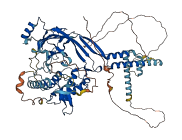
1 structures for Q9R1N2
| Entry ID | Method | Resolution | Chain | Position | Source |
|---|---|---|---|---|---|
| AF-Q9R1N2-F1 | Predicted | AlphaFoldDB |
No variants for Q9R1N2
| Variant ID(s) | Position | Change | Description | Diseaes Association | Provenance |
|---|---|---|---|---|---|
| No variants for Q9R1N2 | |||||
No associated diseases with Q9R1N2
1 regional properties for Q9R1N2
| Type | Name | Position | InterPro Accession |
|---|---|---|---|
| conserved_site | Epithelial sodium channel, conserved site | 435 - 455 | IPR020903 |
Functions
8 GO annotations of cellular component
| Name | Definition |
|---|---|
| acrosomal vesicle | A structure in the head of a spermatozoon that contains acid hydrolases, and is concerned with the breakdown of the outer membrane of the ovum during fertilization. It lies just beneath the plasma membrane and is derived from the lysosome. |
| apical plasma membrane | The region of the plasma membrane located at the apical end of the cell. |
| ciliary membrane | The portion of the plasma membrane surrounding a cilium. |
| cytoplasm | The contents of a cell excluding the plasma membrane and nucleus, but including other subcellular structures. |
| integral component of plasma membrane | The component of the plasma membrane consisting of the gene products and protein complexes having at least some part of their peptide sequence embedded in the hydrophobic region of the membrane. |
| motile cilium | A cilium which may have a variable arrangement of axonemal microtubules and also contains molecular motors. It may beat with a whip-like pattern that promotes cell motility or transport of fluids and other cells across a cell surface, such as on epithelial cells that line the lumenal ducts of various tissues; or they may display a distinct twirling motion that directs fluid flow asymmetrically across the cellular surface to affect asymmetric body plan organization. Motile cilia can be found in single as well as multiple copies per cell. |
| sodium channel complex | An ion channel complex through which sodium ions pass. |
| sperm principal piece | The segment of the sperm flagellum where the mitochondrial sheath ends, and the outer dense fibers (ODFs) associated with outer axonemal doublets 3 and 8 are replaced by the 2 longitudinal columns of the fibrous sheath (FS) which run the length of the principal piece and are stabilized by circumferential ribs. The principal piece makes up ~2/3 of the length of the sperm flagellum and is defined by the presence of the FS and of only 7 (rather than 9) ODFs which taper and then terminate near the distal end of the principal piece. |
1 GO annotations of molecular function
| Name | Definition |
|---|---|
| ligand-gated sodium channel activity | Enables the transmembrane transfer of a sodium ion by a channel that opens when a specific ligand has been bound by the channel complex or one of its constituent parts. |
5 GO annotations of biological process
| Name | Definition |
|---|---|
| multicellular organismal water homeostasis | Any process involved in the maintenance of an internal steady state of water within a tissue, organ, or a multicellular organism. |
| response to stimulus | Any process that results in a change in state or activity of a cell or an organism (in terms of movement, secretion, enzyme production, gene expression, etc.) as a result of a stimulus. The process begins with detection of the stimulus and ends with a change in state or activity or the cell or organism. |
| sensory perception of taste | The series of events required for an organism to receive a gustatory stimulus, convert it to a molecular signal, and recognize and characterize the signal. Gustation involves the direct detection of chemical composition, usually through contact with chemoreceptor cells. This is a neurological process. |
| sodium ion homeostasis | Any process involved in the maintenance of an internal steady state of sodium ions within an organism or cell. |
| sodium ion transmembrane transport | A process in which a sodium ion is transported from one side of a membrane to the other by means of some agent such as a transporter or pore. |
No homologous proteins in AiPD
| UniProt AC | Gene Name | Protein Name | Species | Evidence Code |
|---|---|---|---|---|
| No homologous proteins | ||||
| 10 | 20 | 30 | 40 | 50 | 60 |
| MLMRLLPLPS | LTDGRPLGCC | CTCQGSMKGD | ELKAQGPLPP | QPLQGPLKGD | KCEQPGLGPE |
| 70 | 80 | 90 | 100 | 110 | 120 |
| PTAPQQHTEE | EEALIEFHRS | YRELFQFFCN | NTTIHGAIRL | VCSKHNRMKT | AFWAVLWLCT |
| 130 | 140 | 150 | 160 | 170 | 180 |
| FGMMYWQFAL | LFGEYFSYPV | SLNINLNSDK | LVFPAVTVCT | LNPYRYKEIK | EQLRELDRIT |
| 190 | 200 | 210 | 220 | 230 | 240 |
| QQTLFDLYNY | NASSTLLAGA | RSRRSLADTL | PYPLQRIPVQ | PEPRRARSSD | PSSVRDNNPR |
| 250 | 260 | 270 | 280 | 290 | 300 |
| VDRRDWRVGF | QLCNQNKSDC | FYQTSSSGVD | GVREWYRFHY | INILAQVADT | SPRWEEETLG |
| 310 | 320 | 330 | 340 | 350 | 360 |
| NFIFACRFNQ | APCTQENYSH | FHHPIYGNCY | TFNNKNDSSL | WMASMPGINN | GLSLTLRTEQ |
| 370 | 380 | 390 | 400 | 410 | 420 |
| NDYIPLLSTV | TGARVTVHGQ | DEPAFMDDGG | FNLRPGVETS | ISMRKEALDR | LGGSYGDCTQ |
| 430 | 440 | 450 | 460 | 470 | 480 |
| DGSDVPVQNL | YPSKYTQQVC | IHSCFQENMI | KQCGCAYIFY | PKPKGVEFCD | YTNHSAWGYC |
| 490 | 500 | 510 | 520 | 530 | 540 |
| YYKLQGAFSS | DSLGCFNKCR | KPCNVTIYKL | SAGYSRWPSA | ASQDWIFQML | SLQNNYTISN |
| 550 | 560 | 570 | 580 | 590 | 600 |
| KRNGVAKLNI | YFKELNYRTN | SESPSVTMVT | LLSNLGSQWS | LWFGSSVLSV | VEMAEFMFDL |
| 610 | 620 | 630 | 640 | 650 | 660 |
| LVITLLMLLR | RFRSRYWSPG | RGARAAREVA | CTPPPSLPSR | FCAHSAFPTL | TAPPPAYATL |
| 670 | 680 | ||||
| SACPPLQGLA | GASSAACAPR | EP |