Q9R099
Gene name |
Tbl2 |
Protein name |
Transducin beta-like protein 2 |
Names |
|
Species |
Mus musculus (Mouse) |
KEGG Pathway |
mmu:27368 |
EC number |
|
Protein Class |
|
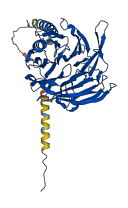
Descriptions
The autoinhibited protein was predicted that may have potential autoinhibitory elements via cis-regPred.
Autoinhibitory domains (AIDs)
Target domain |
|
Relief mechanism |
|
Assay |
cis-regPred |
Accessory elements
No accessory elements
Autoinhibited structure

Activated structure
1 structures for Q9R099
| Entry ID | Method | Resolution | Chain | Position | Source |
|---|---|---|---|---|---|
| AF-Q9R099-F1 | Predicted | AlphaFoldDB |
24 variants for Q9R099
| Variant ID(s) | Position | Change | Description | Diseaes Association | Provenance |
|---|---|---|---|---|---|
| rs230785214 | 44 | Q>L | No | EVA | |
| rs245033064 | 60 | N>T | No | EVA | |
| rs257872324 | 74 | T>M | No | EVA | |
| rs3388796662 | 143 | D>G | No | EVA | |
| rs3388783826 | 165 | R>W | No | EVA | |
| rs3388794803 | 218 | L>R | No | EVA | |
| rs240967829 | 219 | S>A | No | EVA | |
| rs3388783772 | 227 | N>K | No | EVA | |
| rs3388804393 | 248 | D>N | No | EVA | |
| rs3388804371 | 289 | R>G | No | EVA | |
| rs3388790610 | 305 | D>Y | No | EVA | |
| rs3388778834 | 309 | K>* | No | EVA | |
| rs3388797626 | 317 | L>I | No | EVA | |
| rs3388790663 | 369 | E>G | No | EVA | |
| rs254006661 | 382 | F>L | No | EVA | |
| rs3388799433 | 394 | F>L | No | EVA | |
| rs3388768329 | 396 | N>T | No | EVA | |
| rs3388796696 | 418 | S>N | No | EVA | |
| rs3388793275 | 428 | T>I | No | EVA | |
| rs3396211405 | 431 | Q>H | No | EVA | |
| rs3388778831 | 431 | Q>L | No | EVA | |
| rs3388778831 | 431 | Q>P | No | EVA | |
| rs3396301512 | 433 | A>G | No | EVA | |
| rs3396009482 | 436 | S>G | No | EVA |
No associated diseases with Q9R099
9 regional properties for Q9R099
| Type | Name | Position | InterPro Accession |
|---|---|---|---|
| repeat | WD40 repeat | 75 - 114 | IPR001680-1 |
| repeat | WD40 repeat | 173 - 214 | IPR001680-2 |
| repeat | WD40 repeat | 214 - 253 | IPR001680-3 |
| repeat | WD40 repeat | 264 - 303 | IPR001680-4 |
| repeat | WD40 repeat | 358 - 395 | IPR001680-5 |
| conserved_site | WD40 repeat, conserved site | 199 - 213 | IPR019775 |
| repeat | G-protein beta WD-40 repeat | 101 - 115 | IPR020472-1 |
| repeat | G-protein beta WD-40 repeat | 199 - 213 | IPR020472-2 |
| repeat | G-protein beta WD-40 repeat | 290 - 304 | IPR020472-3 |
1 GO annotations of cellular component
| Name | Definition |
|---|---|
| endoplasmic reticulum | The irregular network of unit membranes, visible only by electron microscopy, that occurs in the cytoplasm of many eukaryotic cells. The membranes form a complex meshwork of tubular channels, which are often expanded into slitlike cavities called cisternae. The ER takes two forms, rough (or granular), with ribosomes adhering to the outer surface, and smooth (with no ribosomes attached). |
3 GO annotations of molecular function
| Name | Definition |
|---|---|
| phosphoprotein binding | Binding to a phosphorylated protein. |
| protein kinase binding | Binding to a protein kinase, any enzyme that catalyzes the transfer of a phosphate group, usually from ATP, to a protein substrate. |
| translation initiation factor binding | Binding to a translation initiation factor, any polypeptide factor involved in the initiation of ribosome-mediated translation. |
3 GO annotations of biological process
| Name | Definition |
|---|---|
| cellular response to glucose starvation | Any process that results in a change in state or activity of a cell (in terms of movement, secretion, enzyme production, gene expression, etc.) as a result of deprivation of glucose. |
| cellular response to hypoxia | Any process that results in a change in state or activity of a cell (in terms of movement, secretion, enzyme production, gene expression, etc.) as a result of a stimulus indicating lowered oxygen tension. Hypoxia, defined as a decline in O2 levels below normoxic levels of 20.8 - 20.95%, results in metabolic adaptation at both the cellular and organismal level. |
| endoplasmic reticulum unfolded protein response | The series of molecular signals generated as a consequence of the presence of unfolded proteins in the endoplasmic reticulum (ER) or other ER-related stress; results in changes in the regulation of transcription and translation. |
1 homologous proteins in AiPD
| UniProt AC | Gene Name | Protein Name | Species | Evidence Code |
|---|---|---|---|---|
| Q9Y4P3 | TBL2 | Transducin beta-like protein 2 | Homo sapiens (Human) | PR |
| 10 | 20 | 30 | 40 | 50 | 60 |
| MELPQMPELM | GLSLLVGLLA | LVATAAVARG | WLRAEEKPSQ | PVCQKENEPK | KSGSKKQKQN |
| 70 | 80 | 90 | 100 | 110 | 120 |
| QRVRKEKPQQ | HSFTHPLLAA | ALKSHSGNIS | CMDFSSNGKY | LATCADDRTV | RIWSTKDFLQ |
| 130 | 140 | 150 | 160 | 170 | 180 |
| REHRSMRANV | ELDHATLVRF | SPDCRAFIVW | LANGDTLRVF | KMTKREDGGF | TFTATPEDFP |
| 190 | 200 | 210 | 220 | 230 | 240 |
| KKHKAPIINI | GIADTGKFIM | TASSDTTVLI | WNLKGQVLST | INTNQMNNSH | AVISPCSRFV |
| 250 | 260 | 270 | 280 | 290 | 300 |
| GSCGFTPDVK | VWEVCFGKKG | EFQEVLRAFE | LKGHSASVHS | FAFSNDSRRM | ASVSKDGTWK |
| 310 | 320 | 330 | 340 | 350 | 360 |
| LWDTDVEYKK | QQDPYLLRTG | RFEEASTMPC | RLALSPDTHV | LALATGTNIH | LFNTRRGEKE |
| 370 | 380 | 390 | 400 | 410 | 420 |
| EYFECVHGEC | IADLTFDITG | RFLASCGDRA | VRLFHNTPGH | RAVVEEMQSL | LKRASSESTR |
| 430 | 440 | ||||
| QRLQQQLTQA | QEALKSLGAL | KK |