Q9QXV1
Gene name |
Cbx8 (Pc3) |
Protein name |
Chromobox protein homolog 8 |
Names |
Polycomb 3 homolog, Pc3, mPc3 |
Species |
Mus musculus (Mouse) |
KEGG Pathway |
mmu:30951 |
EC number |
|
Protein Class |
|
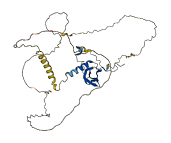
Descriptions
The autoinhibited protein was predicted that may have potential autoinhibitory elements via cis-regPred.
Autoinhibitory domains (AIDs)
Target domain |
|
Relief mechanism |
|
Assay |
cis-regPred |
Accessory elements
No accessory elements
Autoinhibited structure

Activated structure
2 structures for Q9QXV1
| Entry ID | Method | Resolution | Chain | Position | Source |
|---|---|---|---|---|---|
| 2DNV | NMR | - | A | 8-58 | PDB |
| AF-Q9QXV1-F1 | Predicted | AlphaFoldDB |
8 variants for Q9QXV1
| Variant ID(s) | Position | Change | Description | Diseaes Association | Provenance |
|---|---|---|---|---|---|
| rs3389217623 | 140 | R>M | No | EVA | |
| rs3389196545 | 157 | R>P | No | EVA | |
| rs258616854 | 207 | T>A | No | EVA | |
| rs246316287 | 208 | S>P | No | EVA | |
| rs3403155182 | 227 | Q>PLLS* | No | EVA | |
| rs3389185181 | 270 | Q>K | No | EVA | |
| rs262698722 | 323 | S>T | No | EVA | |
| rs864290294 | 360 | E>K | No | EVA |
No associated diseases with Q9QXV1
7 GO annotations of cellular component
| Name | Definition |
|---|---|
| chromatin | The ordered and organized complex of DNA, protein, and sometimes RNA, that forms the chromosome. |
| heterochromatin | A compact and highly condensed form of chromatin that is refractory to transcription. |
| nucleoplasm | That part of the nuclear content other than the chromosomes or the nucleolus. |
| nucleus | A membrane-bounded organelle of eukaryotic cells in which chromosomes are housed and replicated. In most cells, the nucleus contains all of the cell's chromosomes except the organellar chromosomes, and is the site of RNA synthesis and processing. In some species, or in specialized cell types, RNA metabolism or DNA replication may be absent. |
| PcG protein complex | A chromatin-associated multiprotein complex containing Polycomb Group proteins. In Drosophila, Polycomb group proteins are involved in the long-term maintenance of gene repression, and PcG protein complexes associate with Polycomb group response elements (PREs) in target genes to regulate higher-order chromatin structure. |
| PRC1 complex | A multiprotein complex that mediates monoubiquitination of lysine residues of histone H2A (lysine-118 in Drosophila or lysine-119 in mammals). The complex is required for stable long-term maintenance of transcriptionally repressed states and is involved in chromatin remodeling. |
| ubiquitin ligase complex | A protein complex that includes a ubiquitin-protein ligase and enables ubiquitin protein ligase activity. The complex also contains other proteins that may confer substrate specificity on the complex. |
4 GO annotations of molecular function
| Name | Definition |
|---|---|
| chromatin binding | Binding to chromatin, the network of fibers of DNA, protein, and sometimes RNA, that make up the chromosomes of the eukaryotic nucleus during interphase. |
| methylated histone binding | Binding to a histone in which a residue has been modified by methylation. |
| single-stranded RNA binding | Binding to single-stranded RNA. |
| ubiquitin-protein transferase activator activity | Binds to and increases the activity of a ubiquitin-protein transferase, an enzyme that catalyzes the covalent attachment of ubiquitin to lysine in a substrate protein. |
6 GO annotations of biological process
| Name | Definition |
|---|---|
| heterochromatin assembly | An epigenetic gene silencing mechanism in which chromatin is compacted into heterochromatin, resulting in a chromatin conformation refractory to transcription. This process starts with heterochromatin nucleation, its spreading, and ends with heterochromatin boundary formation. |
| histone ubiquitination | The modification of histones by addition of ubiquitin groups. |
| negative regulation of transcription by RNA polymerase II | Any process that stops, prevents, or reduces the frequency, rate or extent of transcription mediated by RNA polymerase II. |
| positive regulation of cell population proliferation | Any process that activates or increases the rate or extent of cell proliferation. |
| positive regulation of collagen biosynthetic process | Any process that activates or increases the frequency, rate or extent of the chemical reactions and pathways resulting in the formation of collagen, any of a group of fibrous proteins of very high tensile strength that form the main component of connective tissue in animals. |
| positive regulation of DNA repair | Any process that activates or increases the frequency, rate or extent of DNA repair. |
1 homologous proteins in AiPD
| UniProt AC | Gene Name | Protein Name | Species | Evidence Code |
|---|---|---|---|---|
| Q9HC52 | CBX8 | Chromobox protein homolog 8 | Homo sapiens (Human) | PR |
| 10 | 20 | 30 | 40 | 50 | 60 |
| MELSAVGERV | FAAEALLKRR | IRKGRMEYLV | KWKGWSQKYS | TWEPEENILD | ARLLAAFEER |
| 70 | 80 | 90 | 100 | 110 | 120 |
| EREMELYGPK | KRGPKPKTFL | LKAQAKAKAK | TYEFRSDSTR | GIRIPYPGRS | PQDLASTSRA |
| 130 | 140 | 150 | 160 | 170 | 180 |
| REGLRNTGLP | PPGSSTSTCR | ADPPRDRDRE | RDRGTSRVDD | KPSSPGDSSK | KRGPKPRKEP |
| 190 | 200 | 210 | 220 | 230 | 240 |
| LDPSQRPLGE | PSAGLGEYLK | GRKLDETSSG | TGKFPAGHSV | IQLARRQDSD | LVQYGVTSPS |
| 250 | 260 | 270 | 280 | 290 | 300 |
| SAEASSKLAV | DTFPARVIKH | RAAFLEAKGQ | GALDPGGARV | RHSSGTPASV | GSLYRDMGAQ |
| 310 | 320 | 330 | 340 | 350 | 360 |
| GGRPSLIARI | PVARILGDPE | EESWSPSLTN | LEKVVVTDVT | SNFLTVTIKE | SNTDQGFFKE |
| KR |