Q9QUP4
Gene name |
Chst5 (Gst4) |
Protein name |
Carbohydrate sulfotransferase 5 |
Names |
Galactose/N-acetylglucosamine/N-acetylglucosamine 6-O-sulfotransferase 4, GST4, Intestinal N-acetylglucosamine-6-O-sulfotransferase, I-GlcNAc6ST, Intestinal GlcNAc-6-sulfotransferase, mIGn6ST, N-acetylglucosamine 6-O-sulfotransferase 3, GlcNAc6ST-3, Gn6st-3 |
Species |
Mus musculus (Mouse) |
KEGG Pathway |
mmu:56773 |
EC number |
|
Protein Class |
|
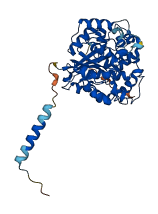
Descriptions
The autoinhibited protein was predicted that may have potential autoinhibitory elements via cis-regPred.
Autoinhibitory domains (AIDs)
Target domain |
|
Relief mechanism |
|
Assay |
cis-regPred |
Accessory elements
No accessory elements
Autoinhibited structure

Activated structure
1 structures for Q9QUP4
| Entry ID | Method | Resolution | Chain | Position | Source |
|---|---|---|---|---|---|
| AF-Q9QUP4-F1 | Predicted | AlphaFoldDB |
15 variants for Q9QUP4
| Variant ID(s) | Position | Change | Description | Diseaes Association | Provenance |
|---|---|---|---|---|---|
| rs3389007184 | 6 | F>Y | No | EVA | |
| rs3389007177 | 33 | S>F | No | EVA | |
| rs3389007186 | 39 | E>D | No | EVA | |
| rs234787366 | 40 | R>H | No | EVA | |
| rs3389018417 | 42 | H>L | No | EVA | |
| rs3388989772 | 56 | V>L | No | EVA | |
| rs243546430 | 79 | T>A | No | EVA | |
| rs237034005 | 136 | E>D | No | EVA | |
| rs246616535 | 171 | V>I | No | EVA | |
| rs3389006602 | 201 | V>M | No | EVA | |
| rs3399863125 | 204 | P>A | No | EVA | |
| rs3389012011 | 225 | V>I | No | EVA | |
| rs3389007216 | 230 | G>V | No | EVA | |
| rs3388989810 | 231 | T>K | No | EVA | |
| rs251699736 | 243 | N>S | No | EVA |
No associated diseases with Q9QUP4
1 regional properties for Q9QUP4
| Type | Name | Position | InterPro Accession |
|---|---|---|---|
| domain | Sulfotransferase domain | 42 - 356 | IPR000863 |
4 GO annotations of cellular component
| Name | Definition |
|---|---|
| Golgi apparatus | A membrane-bound cytoplasmic organelle of the endomembrane system that further processes the core oligosaccharides (e.g. N-glycans) added to proteins in the endoplasmic reticulum and packages them into membrane-bound vesicles. The Golgi apparatus operates at the intersection of the secretory, lysosomal, and endocytic pathways. |
| Golgi membrane | The lipid bilayer surrounding any of the compartments of the Golgi apparatus. |
| integral component of membrane | The component of a membrane consisting of the gene products and protein complexes having at least some part of their peptide sequence embedded in the hydrophobic region of the membrane. |
| trans-Golgi network | The network of interconnected tubular and cisternal structures located within the Golgi apparatus on the side distal to the endoplasmic reticulum, from which secretory vesicles emerge. The trans-Golgi network is important in the later stages of protein secretion where it is thought to play a key role in the sorting and targeting of secreted proteins to the correct destination. |
2 GO annotations of molecular function
| Name | Definition |
|---|---|
| keratan sulfotransferase activity | Catalysis of the reaction: 3'-phosphoadenosine 5'-phosphosulfate + keratan = adenosine 3',5'-bisphosphate + keratan 6'-sulfate. |
| N-acetylglucosamine 6-O-sulfotransferase activity | Catalysis of the reaction: 3'-phosphoadenosine 5'-phosphosulfate + N-acetyl-D-glucosamine = adenosine 3',5'-bisphosphate + N-acetyl-D-glucosamine 6-sulfate. |
4 GO annotations of biological process
| Name | Definition |
|---|---|
| carbohydrate metabolic process | The chemical reactions and pathways involving carbohydrates, any of a group of organic compounds based of the general formula Cx(H2O)y. |
| keratan sulfate biosynthetic process | The chemical reactions and pathways resulting in the formation of keratan sulfate, a glycosaminoglycan with repeat units consisting of beta-1,4-linked D-galactopyranosyl-beta-(1,4)-N-acetyl-D-glucosamine 6-sulfate and with variable amounts of fucose, sialic acid and mannose units; keratan sulfate chains are covalently linked by a glycosidic attachment through the trisaccharide galactosyl-galactosyl-xylose to peptidyl-threonine or serine residues. |
| N-acetylglucosamine metabolic process | The chemical reactions and pathways involving N-acetylglucosamine. The D isomer is a common structural unit of glycoproteins in plants, bacteria and animals; it is often the terminal sugar of an oligosaccharide group of a glycoprotein. |
| sulfur compound metabolic process | The chemical reactions and pathways involving the nonmetallic element sulfur or compounds that contain sulfur, such as the amino acids methionine and cysteine or the tripeptide glutathione. |
No homologous proteins in AiPD
| UniProt AC | Gene Name | Protein Name | Species | Evidence Code |
|---|---|---|---|---|
| No homologous proteins | ||||
| 10 | 20 | 30 | 40 | 50 | 60 |
| MRLPRFSSTV | MLSLLMVQTG | ILVFLVSRQV | PSSPAGLGER | VHVLVLSSWR | SGSSFVGQLF |
| 70 | 80 | 90 | 100 | 110 | 120 |
| SQHPDVFYLM | EPAWHVWDTL | SQGSAPALHM | AVRDLIRSVF | LCDMDVFDAY | LPWRRNISDL |
| 130 | 140 | 150 | 160 | 170 | 180 |
| FQWAVSRALC | SPPVCEAFAR | GNISSEEVCK | PLCATRPFGL | AQEACSSYSH | VVLKEVRFFN |
| 190 | 200 | 210 | 220 | 230 | 240 |
| LQVLYPLLSD | PALNLRIVHL | VRDPRAVLRS | REQTAKALAR | DNGIVLGTNG | TWVEADPRLR |
| 250 | 260 | 270 | 280 | 290 | 300 |
| VVNEVCRSHV | RIAEAALHKP | PPFLQDRYRL | VRYEDLARDP | LTVIRELYAF | TGLGLTPQLQ |
| 310 | 320 | 330 | 340 | 350 | 360 |
| TWIHNITHGS | GPGARREAFK | TTSRDALSVS | QAWRHTLPFA | KIRRVQELCG | GALQLLGYRS |
| 370 | 380 | 390 | |||
| VHSELEQRDL | SLDLLLPRGM | DSFKWASSTE | KQPES |