Q9QUM4
Gene name |
Slamf1 (Slam) |
Protein name |
Signaling lymphocytic activation molecule |
Names |
|
Species |
Mus musculus (Mouse) |
KEGG Pathway |
mmu:27218 |
EC number |
|
Protein Class |
|
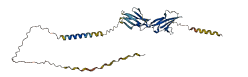
Descriptions
The autoinhibited protein was predicted that may have potential autoinhibitory elements via cis-regPred.
Autoinhibitory domains (AIDs)
Target domain |
|
Relief mechanism |
|
Assay |
cis-regPred |
Accessory elements
No accessory elements
Autoinhibited structure

Activated structure
1 structures for Q9QUM4
| Entry ID | Method | Resolution | Chain | Position | Source |
|---|---|---|---|---|---|
| AF-Q9QUM4-F1 | Predicted | AlphaFoldDB |
27 variants for Q9QUM4
| Variant ID(s) | Position | Change | Description | Diseaes Association | Provenance |
|---|---|---|---|---|---|
| rs3388516701 | 12 | L>P | No | EVA | |
| rs3388513999 | 36 | L>I | No | EVA | |
| rs224105047 | 69 | T>K | No | EVA | |
| rs3388513845 | 88 | S>G | No | EVA | |
| rs3388517572 | 90 | P>S | No | EVA | |
| rs3390905654 | 101 | S>A | No | EVA | |
| rs3388518863 | 104 | L>M | No | EVA | |
| rs3388516430 | 110 | G>E | No | EVA | |
| rs3388516982 | 112 | R>G | No | EVA | |
| rs3388516967 | 114 | E>V | No | EVA | |
| rs3388513808 | 125 | E>K | No | EVA | |
| rs3388518877 | 126 | N>Y | No | EVA | |
| rs3388517520 | 144 | P>T | No | EVA | |
| rs3388514157 | 184 | G>D | No | EVA | |
| rs3388513994 | 211 | N>I | No | EVA | |
| rs260037896 | 221 | I>L | No | EVA | |
| rs228613136 | 221 | I>S | No | EVA | |
| rs254008487 | 244 | M>I | No | EVA | |
| rs213334742 | 246 | Y>N | No | EVA | |
| rs252517540 | 254 | V>I | No | EVA | |
| rs3388516674 | 266 | M>L | No | EVA | |
| rs239601061 | 273 | S>P | No | EVA | |
| rs3390989875 | 277 | Q>* | No | EVA | |
| rs3390903139 | 277 | Q>R | No | EVA | |
| rs263979481 | 323 | P>S | No | EVA | |
| rs3388511834 | 326 | V>I | No | EVA | |
| rs3388511852 | 331 | P>S | No | EVA |
No associated diseases with Q9QUM4
Functions
4 GO annotations of cellular component
| Name | Definition |
|---|---|
| cell surface | The external part of the cell wall and/or plasma membrane. |
| external side of plasma membrane | The leaflet of the plasma membrane that faces away from the cytoplasm and any proteins embedded or anchored in it or attached to its surface. |
| integral component of membrane | The component of a membrane consisting of the gene products and protein complexes having at least some part of their peptide sequence embedded in the hydrophobic region of the membrane. |
| phagocytic vesicle | A membrane-bounded intracellular vesicle that arises from the ingestion of particulate material by phagocytosis. |
3 GO annotations of molecular function
| Name | Definition |
|---|---|
| identical protein binding | Binding to an identical protein or proteins. |
| SH2 domain binding | Binding to a SH2 domain (Src homology 2) of a protein, a protein domain of about 100 amino-acid residues and belonging to the alpha + beta domain class. |
| signaling receptor activity | Receiving a signal and transmitting it in the cell to initiate a change in cell activity. A signal is a physical entity or change in state that is used to transfer information in order to trigger a response. |
23 GO annotations of biological process
| Name | Definition |
|---|---|
| adaptive immune response | An immune response mediated by cells expressing specific receptors for antigen produced through a somatic diversification process, and allowing for an enhanced secondary response to subsequent exposures to the same antigen (immunological memory). |
| cell adhesion | The attachment of a cell, either to another cell or to an underlying substrate such as the extracellular matrix, via cell adhesion molecules. |
| innate immune response | Innate immune responses are defense responses mediated by germline encoded components that directly recognize components of potential pathogens. |
| leukocyte chemotaxis involved in inflammatory response | The movement of an immune cell in response to an external stimulus contributing to an inflammatory response. |
| myeloid dendritic cell activation involved in immune response | The change in morphology and behavior of a myeloid dendritic cell resulting from exposure to a cytokine, chemokine, cellular ligand, or soluble factor, leading to the initiation or perpetuation of an immune response. |
| natural killer cell differentiation | The process in which a relatively unspecialized cell acquires the specialized features of a natural killer cell. |
| natural killer cell proliferation | The expansion of a natural killer cell population by cell division. |
| negative regulation of CD40 signaling pathway | Any process that stops, prevents or reduces the frequency, rate or extent of signaling via the CD40 signaling pathway. |
| negative regulation of interferon-gamma production | Any process that stops, prevents, or reduces the frequency, rate, or extent of interferon-gamma production. Interferon-gamma is also known as type II interferon. |
| negative regulation of interleukin-12 production | Any process that stops, prevents, or reduces the frequency, rate, or extent of interleukin-12 production. |
| negative regulation of interleukin-6 production | Any process that stops, prevents, or reduces the frequency, rate, or extent of interleukin-6 production. |
| negative regulation of T cell cytokine production | Any process that stops, prevents, or reduces the frequency, rate, or extent of T cell cytokine production. |
| negative regulation of tumor necrosis factor production | Any process that stops, prevents, or reduces the frequency, rate, or extent of tumor necrosis factor production. |
| phagocytosis | A vesicle-mediated transport process that results in the engulfment of external particulate material by phagocytes and their delivery to the lysosome. The particles are initially contained within phagocytic vacuoles (phagosomes), which then fuse with primary lysosomes to effect digestion of the particles. |
| positive regulation of activated T cell proliferation | Any process that activates or increases the rate or extent of activated T cell proliferation. |
| positive regulation of dendritic cell chemotaxis | Any process that activates or increases the frequency, rate or extent of dendritic cell chemotaxis. |
| positive regulation of ERK1 and ERK2 cascade | Any process that activates or increases the frequency, rate or extent of signal transduction mediated by the ERK1 and ERK2 cascade. |
| positive regulation of interferon-gamma production | Any process that activates or increases the frequency, rate, or extent of interferon-gamma production. Interferon-gamma is also known as type II interferon. |
| positive regulation of JNK cascade | Any process that activates or increases the frequency, rate or extent of signal transduction mediated by the JNK cascade. |
| positive regulation of macrophage chemotaxis | Any process that increases the rate, frequency or extent of macrophage chemotaxis. Macrophage chemotaxis is the movement of a macrophage in response to an external stimulus. |
| positive regulation of T-helper 1 cell cytokine production | Any process that activates or increases the frequency, rate or extent of T-helper 1 cell cytokine production. |
| regulation of catalytic activity | Any process that modulates the activity of an enzyme. |
| regulation of vesicle fusion | Any process that modulates the frequency, rate or extent of vesicle fusion. |
1 homologous proteins in AiPD
| UniProt AC | Gene Name | Protein Name | Species | Evidence Code |
|---|---|---|---|---|
| Q9UIB8 | CD84 | SLAM family member 5 | Homo sapiens (Human) | PR |
| 10 | 20 | 30 | 40 | 50 | 60 |
| MDPKGSLSWR | ILLFLSLAFE | LSYGTGGGVM | DCPVILQKLG | QDTWLPLTNE | HQINKSVNKS |
| 70 | 80 | 90 | 100 | 110 | 120 |
| VRILVTMATS | PGSKSNKKIV | SFDLSKGSYP | DHLEDGYHFQ | SKNLSLKILG | NRRESEGWYL |
| 130 | 140 | 150 | 160 | 170 | 180 |
| VSVEENVSVQ | QFCKQLKLYE | QVSPPEIKVL | NKTQENENGT | CSLLLACTVK | KGDHVTYSWS |
| 190 | 200 | 210 | 220 | 230 | 240 |
| DEAGTHLLSR | ANRSHLLHIT | LSNQHQDSIY | NCTASNPVSS | ISRTFNLSSQ | ACKQESSSES |
| 250 | 260 | 270 | 280 | 290 | 300 |
| SPWMQYTLVP | LGVVIIFILV | FTAIIMMKRQ | GKSNHCQPPV | EEKSLTIYAQ | VQKSGPQEKK |
| 310 | 320 | 330 | 340 | ||
| LHDALTDQDP | CTTIYVAATE | PAPESVQEPN | PTTVYASVTL | PES |