Q9PVX8
Gene name |
stat3.1 (stat3) |
Protein name |
Signal transducer and activator of transcription 3.1 |
Names |
Protein Stat3, Xstat3 |
Species |
Xenopus laevis (African clawed frog) |
KEGG Pathway |
xla:779100 |
EC number |
|
Protein Class |
|
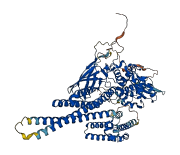
Descriptions
The autoinhibited protein was predicted that may have potential autoinhibitory elements via cis-regPred.
Autoinhibitory domains (AIDs)
Target domain |
|
Relief mechanism |
|
Assay |
cis-regPred |
Accessory elements
No accessory elements
Autoinhibited structure

Activated structure
1 structures for Q9PVX8
| Entry ID | Method | Resolution | Chain | Position | Source |
|---|---|---|---|---|---|
| AF-Q9PVX8-F1 | Predicted | AlphaFoldDB |
No variants for Q9PVX8
| Variant ID(s) | Position | Change | Description | Diseaes Association | Provenance |
|---|---|---|---|---|---|
| No variants for Q9PVX8 | |||||
No associated diseases with Q9PVX8
4 regional properties for Q9PVX8
| Type | Name | Position | InterPro Accession |
|---|---|---|---|
| domain | ATP-citrate lyase/succinyl-CoA ligase | 260 - 376 | IPR005811 |
| domain | ATP-grasp fold | 9 - 245 | IPR011761 |
| domain | ATP-grasp fold, succinyl-CoA synthetase-type | 2 - 196 | IPR013650 |
| conserved_site | Succinyl-CoA synthetase, beta subunit, conserved site | 253 - 278 | IPR017866 |
Functions
3 GO annotations of cellular component
| Name | Definition |
|---|---|
| cytoplasm | The contents of a cell excluding the plasma membrane and nucleus, but including other subcellular structures. |
| nucleus | A membrane-bounded organelle of eukaryotic cells in which chromosomes are housed and replicated. In most cells, the nucleus contains all of the cell's chromosomes except the organellar chromosomes, and is the site of RNA synthesis and processing. In some species, or in specialized cell types, RNA metabolism or DNA replication may be absent. |
| plasma membrane | The membrane surrounding a cell that separates the cell from its external environment. It consists of a phospholipid bilayer and associated proteins. |
5 GO annotations of molecular function
| Name | Definition |
|---|---|
| DNA binding | Any molecular function by which a gene product interacts selectively and non-covalently with DNA (deoxyribonucleic acid). |
| DNA-binding transcription factor activity | A transcription regulator activity that modulates transcription of gene sets via selective and non-covalent binding to a specific double-stranded genomic DNA sequence (sometimes referred to as a motif) within a cis-regulatory region. Regulatory regions include promoters (proximal and distal) and enhancers. Genes are transcriptional units, and include bacterial operons. |
| protein dimerization activity | The formation of a protein dimer, a macromolecular structure consists of two noncovalently associated identical or nonidentical subunits. |
| protein kinase binding | Binding to a protein kinase, any enzyme that catalyzes the transfer of a phosphate group, usually from ATP, to a protein substrate. |
| sequence-specific DNA binding | Binding to DNA of a specific nucleotide composition, e.g. GC-rich DNA binding, or with a specific sequence motif or type of DNA e.g. promotor binding or rDNA binding. |
10 GO annotations of biological process
| Name | Definition |
|---|---|
| eating behavior | The specific behavior of an organism relating to the intake of food, any substance (usually solid) that can be metabolized by an organism to give energy and build tissue. |
| eye photoreceptor cell differentiation | The process in which a relatively unspecialized cell acquires the specialized features of a photoreceptor cell, as found in the eye, the primary visual organ of most organisms. |
| glucose homeostasis | Any process involved in the maintenance of an internal steady state of glucose within an organism or cell. |
| growth hormone receptor signaling pathway via JAK-STAT | The process in which STAT proteins (Signal Transducers and Activators of Transcription) are activated by members of the JAK (janus activated kinase) family of tyrosine kinases, following the binding of physiological ligands to the growth hormone receptor. Once activated, STATs dimerize and translocate to the nucleus and modulate the expression of target genes. |
| mesoderm formation | The process that gives rise to the mesoderm. This process pertains to the initial formation of the structure from unspecified parts. |
| neural crest cell differentiation | The process in which a relatively unspecialized cell acquires specialized features of a neural crest cell. |
| positive regulation of DNA-templated transcription | Any process that activates or increases the frequency, rate or extent of cellular DNA-templated transcription. |
| regulation of transcription by RNA polymerase II | Any process that modulates the frequency, rate or extent of transcription mediated by RNA polymerase II. |
| sexual reproduction | A type of reproduction that combines the genetic material of two gametes (such as a sperm or egg cell or fungal spores). The gametes have an haploid genome (with a single set of chromosomes, the product of a meiotic division) and combines with one another to produce a zygote (diploid). |
| temperature homeostasis | A homeostatic process in which an organism modulates its internal body temperature. |
No homologous proteins in AiPD
| UniProt AC | Gene Name | Protein Name | Species | Evidence Code |
|---|---|---|---|---|
| No homologous proteins | ||||
| 10 | 20 | 30 | 40 | 50 | 60 |
| MAQWNQLQQL | DTRYLEQLHQ | LYSDSFPMEL | RQFLAPWIES | QDWAFAASKE | SHATLVFHNL |
| 70 | 80 | 90 | 100 | 110 | 120 |
| LGEIDQQYSR | FLQESNVLYQ | HNLRRIKQFL | QSRYLEKPME | IARIVARCLW | EEGRLLQTAA |
| 130 | 140 | 150 | 160 | 170 | 180 |
| AAAQQGGPAS | HPNAAVVTEK | QQMLEQHLQD | VRKKVQDLEQ | KMKVVENLQD | DFDFNYKTLK |
| 190 | 200 | 210 | 220 | 230 | 240 |
| SQSDLSELNG | NNQSVTRQKM | QQLEQMLTAL | DQLRRTIISD | LASLLSAMEY | VQKTLTDEEL |
| 250 | 260 | 270 | 280 | 290 | 300 |
| ADWKRRQQIA | CIGGPPNICL | DRLENWITSL | AESQLQIRQQ | IKKLEELQQK | VSYKGDPIVQ |
| 310 | 320 | 330 | 340 | 350 | 360 |
| HRPMLEERIV | ELFRNLMKSA | FVVERQPCMP | MHPDRPLVIK | TGVQFTNKVR | LLVKFPELNY |
| 370 | 380 | 390 | 400 | 410 | 420 |
| QLKIKVCIDK | DSGDVAALRG | SRKFNILGTN | TKVMNMEESN | NGSLSAEFKH | LTLREQRCGN |
| 430 | 440 | 450 | 460 | 470 | 480 |
| GGRANCDASL | IVTEELHLIT | FETEVYHQGL | KIDLETHSLP | VVVISNICQM | PNAWASILWY |
| 490 | 500 | 510 | 520 | 530 | 540 |
| NMLTNNPKNV | NFFTKPPIGT | WDQVAEVLSW | QFSSTTKRGL | SIEQLTTLAE | KLLGPGVNYS |
| 550 | 560 | 570 | 580 | 590 | 600 |
| GCQITWAKFC | KENMAGKGFS | FWVWLDNIID | LVKKYILALW | NEGYIMGFIS | KERERAILST |
| 610 | 620 | 630 | 640 | 650 | 660 |
| KPPGTFLLRF | SESSKEGGIT | FTWVEKDISG | KTQIQSVEPY | TKQQLNNMSF | AEIIMGYKIM |
| 670 | 680 | 690 | 700 | 710 | 720 |
| DATNILVSPL | VYLYPDIPKE | EAFGKYCRPE | SQEHQEPTDP | GSTAPYLKTK | FICVTPTTCS |
| 730 | 740 | 750 | 760 | ||
| STLDLPMSPR | TLDSLMQFPG | EGADSSAGNQ | FETLTFDMEL | TSECASSPM |