Descriptions
The autoinhibited protein was predicted that may have potential autoinhibitory elements via cis-regPred.
Autoinhibitory domains (AIDs)
Target domain |
|
Relief mechanism |
|
Assay |
cis-regPred |
Accessory elements
No accessory elements
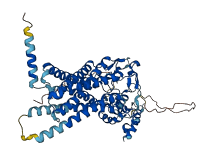
Autoinhibited structure

Activated structure
1 structures for Q9PUK8
| Entry ID | Method | Resolution | Chain | Position | Source |
|---|---|---|---|---|---|
| AF-Q9PUK8-F1 | Predicted | AlphaFoldDB |
No variants for Q9PUK8
| Variant ID(s) | Position | Change | Description | Diseaes Association | Provenance |
|---|---|---|---|---|---|
| No variants for Q9PUK8 | |||||
No associated diseases with Q9PUK8
4 regional properties for Q9PUK8
Functions
3 GO annotations of cellular component
| Name | Definition |
|---|---|
| endosome membrane | The lipid bilayer surrounding an endosome. |
| integral component of membrane | The component of a membrane consisting of the gene products and protein complexes having at least some part of their peptide sequence embedded in the hydrophobic region of the membrane. |
| plasma membrane | The membrane surrounding a cell that separates the cell from its external environment. It consists of a phospholipid bilayer and associated proteins. |
4 GO annotations of molecular function
| Name | Definition |
|---|---|
| G protein-coupled receptor activity | Combining with an extracellular signal and transmitting the signal across the membrane by activating an associated G-protein; promotes the exchange of GDP for GTP on the alpha subunit of a heterotrimeric G-protein complex. |
| syndecan binding | Binding to syndecan, an integral membrane proteoglycan (250-300 kDa) associated largely with epithelial cells. |
| Wnt receptor activity | Combining with a Wnt protein and transmitting the signal across the plasma membrane to initiate a change in cell activity. |
| Wnt-protein binding | Binding to a Wnt-protein, a secreted growth factor involved in signaling. |
8 GO annotations of biological process
| Name | Definition |
|---|---|
| canonical Wnt signaling pathway | The series of molecular signals initiated by binding of a Wnt protein to a frizzled family receptor on the surface of the target cell, followed by propagation of the signal via beta-catenin, and ending with a change in transcription of target genes. In this pathway, the activated receptor signals via downstream effectors that result in the inhibition of beta-catenin phosphorylation, thereby preventing degradation of beta-catenin. Stabilized beta-catenin can then accumulate and travel to the nucleus to trigger changes in transcription of target genes. |
| convergent extension involved in gastrulation | The morphogenetic process in which an epithelium narrows along one axis and lengthens in a perpendicular axis usually resulting in the formation of the three primary germ layers, ectoderm, mesoderm and endoderm. |
| dorsal/ventral axis specification | The establishment, maintenance and elaboration of the dorsal/ventral axis. The dorsal/ventral axis is defined by a line that runs orthogonal to both the anterior/posterior and left/right axes. The dorsal end is defined by the upper or back side of an organism. The ventral end is defined by the lower or front side of an organism. |
| mesoderm formation | The process that gives rise to the mesoderm. This process pertains to the initial formation of the structure from unspecified parts. |
| positive regulation of transcription by RNA polymerase II | Any process that activates or increases the frequency, rate or extent of transcription from an RNA polymerase II promoter. |
| protein localization | Any process in which a protein is transported to, or maintained in, a specific location. |
| tissue morphogenesis | The process in which the anatomical structures of a tissue are generated and organized. |
| Wnt signaling pathway | The series of molecular signals initiated by binding of a Wnt protein to a frizzled family receptor on the surface of the target cell and ending with a change in cell state. |
No homologous proteins in AiPD
| UniProt AC | Gene Name | Protein Name | Species | Evidence Code |
|---|---|---|---|---|
| No homologous proteins | ||||
| 10 | 20 | 30 | 40 | 50 | 60 |
| MSSTVSLLFC | CLFLQLCPSA | QQYHGEKGIS | VPDHGFCQPI | SIPLCTDIAY | NQTIMPNLLG |
| 70 | 80 | 90 | 100 | 110 | 120 |
| HTNQEDAGLE | VHQFYPLVKV | QCSPELRFFL | CSMYAPVCTV | LEQAIPPCRS | LCERARQGCE |
| 130 | 140 | 150 | 160 | 170 | 180 |
| ALMNKFGFQW | PERLRCENFP | VHGAGEICVG | QNTSDNSPSG | PTARPSPYLP | DSITFQPHPH |
| 190 | 200 | 210 | 220 | 230 | 240 |
| RDFTCPRQLK | VPPYLAYRFL | GEKDCGAPCE | PGKANGLMYF | KEEEVRFARL | WVGIWAILCC |
| 250 | 260 | 270 | 280 | 290 | 300 |
| ISTLFTVLTY | LVDMRRFSYP | ERPIIFLSGC | YFMVAVAYTA | GFLLEERAVC | VERFSEDSYR |
| 310 | 320 | 330 | 340 | 350 | 360 |
| TVAQGTKKEG | CTILFMILYF | FGMASSIWWV | ILSLTWFLSA | GMKWGHEAIE | ANSQYFHLAA |
| 370 | 380 | 390 | 400 | 410 | 420 |
| WAVPAVKTIT | ILAMGQVDGD | VLSGVCYVGI | NSVDSLRGFV | LAPLFVYLFI | GTSFLLAGFV |
| 430 | 440 | 450 | 460 | 470 | 480 |
| SLFRIRTIMK | HDGTKTEKLE | KLMVRIGVFS | VMYTVPATIV | LACYFYEQAF | RDTWEKTWLV |
| 490 | 500 | 510 | 520 | 530 | 540 |
| QTCKGYAVPC | PNYNFAPMSP | DFTVFMIKYL | MTMIVGITSS | FWIWSGKTLQ | SWRRFYHRLS |
| NGSKGETAV |