Q9P974
Gene name |
TIF45 (CAGL0E01463g) |
Protein name |
Eukaryotic translation initiation factor 4E |
Names |
eIF-4E, eIF4E, eIF-4F 25 kDa subunit, mRNA cap-binding protein |
Species |
Candida glabrata (strain ATCC 2001 / CBS 138 / JCM 3761 / NBRC 0622 / NRRL Y-65) (Yeast) (Torulopsis glabrata) |
KEGG Pathway |
cgr:CAGL0E01463g |
EC number |
|
Protein Class |
|
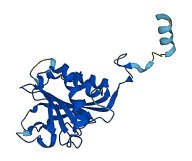
Descriptions
The autoinhibited protein was predicted that may have potential autoinhibitory elements via cis-regPred.
Autoinhibitory domains (AIDs)
Target domain |
|
Relief mechanism |
|
Assay |
cis-regPred |
Accessory elements
No accessory elements
Autoinhibited structure

Activated structure
1 structures for Q9P974
| Entry ID | Method | Resolution | Chain | Position | Source |
|---|---|---|---|---|---|
| AF-Q9P974-F1 | Predicted | AlphaFoldDB |
No variants for Q9P974
| Variant ID(s) | Position | Change | Description | Diseaes Association | Provenance |
|---|---|---|---|---|---|
| No variants for Q9P974 | |||||
No associated diseases with Q9P974
1 regional properties for Q9P974
| Type | Name | Position | InterPro Accession |
|---|---|---|---|
| conserved_site | Eukaryotic translation initiation factor 4E (eIF-4E), conserved site | 88 - 111 | IPR019770 |
3 GO annotations of cellular component
| Name | Definition |
|---|---|
| cytoplasmic stress granule | A dense aggregation in the cytosol composed of proteins and RNAs that appear when the cell is under stress. |
| eukaryotic translation initiation factor 4F complex | The eukaryotic translation initiation factor 4F complex is composed of eIF4E, eIF4A and eIF4G; it is involved in the recognition of the mRNA cap, ATP-dependent unwinding of the 5'-terminal secondary structure and recruitment of the mRNA to the ribosome. |
| nucleus | A membrane-bounded organelle of eukaryotic cells in which chromosomes are housed and replicated. In most cells, the nucleus contains all of the cell's chromosomes except the organellar chromosomes, and is the site of RNA synthesis and processing. In some species, or in specialized cell types, RNA metabolism or DNA replication may be absent. |
3 GO annotations of molecular function
| Name | Definition |
|---|---|
| mRNA cap binding | Binding to a 7-methylguanosine (m7G) group or derivative located at the 5' end of an mRNA molecule. |
| phosphatidylinositol-3-phosphate binding | Binding to phosphatidylinositol-3-phosphate, a derivative of phosphatidylinositol in which the inositol ring is phosphorylated at the 3' position. |
| translation initiation factor activity | Functions in the initiation of ribosome-mediated translation of mRNA into a polypeptide. |
3 GO annotations of biological process
| Name | Definition |
|---|---|
| nuclear-transcribed mRNA catabolic process, nonsense-mediated decay | The nonsense-mediated decay pathway for nuclear-transcribed mRNAs degrades mRNAs in which an amino-acid codon has changed to a nonsense codon; this prevents the translation of such mRNAs into truncated, and potentially harmful, proteins. |
| positive regulation of formation of translation preinitiation complex | Any process that activates or increases the frequency, rate or extent of formation of translation preinitiation complex. |
| regulation of cell cycle | Any process that modulates the rate or extent of progression through the cell cycle. |
No homologous proteins in AiPD
| UniProt AC | Gene Name | Protein Name | Species | Evidence Code |
|---|---|---|---|---|
| No homologous proteins | ||||
| 10 | 20 | 30 | 40 | 50 | 60 |
| MSVDEVTKKF | EETVSVDGPK | TVLSDAKDFE | VKHPLNTKWT | LWYTKPAVDK | SESWSDLLRP |
| 70 | 80 | 90 | 100 | 110 | 120 |
| VTSFQSVEEF | WAIVQNIPEP | HELPLKSDYH | VFRNDIRPEW | EDSANAKGGK | WSFQVRGRGA |
| 130 | 140 | 150 | 160 | 170 | 180 |
| EIDELWLRTL | LAVIGETIDE | EDSQINGVVL | NVRKGGNRFA | LWTKSCDKEP | LSNIGARFKQ |
| 190 | 200 | ||||
| VLKLADEDTL | EFFPHSTAND | RHSQPTITL |