Q9P7X0
Gene name |
sdh4 (tim18, SPBP23A10.16) |
Protein name |
Succinate dehydrogenase [ubiquinone] cytochrome b small subunit, mitochondrial |
Names |
CybS, Succinate-ubiquinone reductase membrane anchor subunit |
Species |
Schizosaccharomyces pombe (strain 972 / ATCC 24843) (Fission yeast) |
KEGG Pathway |
spo:SPBP23A10.16 |
EC number |
|
Protein Class |
|
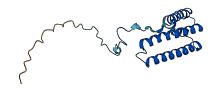
Descriptions
The autoinhibited protein was predicted that may have potential autoinhibitory elements via cis-regPred.
Autoinhibitory domains (AIDs)
Target domain |
|
Relief mechanism |
|
Assay |
cis-regPred |
Accessory elements
No accessory elements
Autoinhibited structure

Activated structure
1 structures for Q9P7X0
| Entry ID | Method | Resolution | Chain | Position | Source |
|---|---|---|---|---|---|
| AF-Q9P7X0-F1 | Predicted | AlphaFoldDB |
No variants for Q9P7X0
| Variant ID(s) | Position | Change | Description | Diseaes Association | Provenance |
|---|---|---|---|---|---|
| No variants for Q9P7X0 | |||||
No associated diseases with Q9P7X0
No regional properties for Q9P7X0
| Type | Name | Position | InterPro Accession |
|---|---|---|---|
| No domain, repeats, and functional sites for Q9P7X0 | |||
5 GO annotations of cellular component
| Name | Definition |
|---|---|
| integral component of membrane | The component of a membrane consisting of the gene products and protein complexes having at least some part of their peptide sequence embedded in the hydrophobic region of the membrane. |
| mitochondrial inner membrane | The inner, i.e. lumen-facing, lipid bilayer of the mitochondrial envelope. It is highly folded to form cristae. |
| mitochondrial respiratory chain complex II, succinate dehydrogenase complex (ubiquinone) | A protein complex located in the mitochondrial inner membrane that forms part of the mitochondrial respiratory chain. Contains the four polypeptide subunits of succinate dehydrogenase, flavin-adenine dinucleotide and iron-sulfur. Catalyzes the oxidation of succinate by ubiquinone. Connects the TCA cycle with the respiratory chain. |
| mitochondrion | A semiautonomous, self replicating organelle that occurs in varying numbers, shapes, and sizes in the cytoplasm of virtually all eukaryotic cells. It is notably the site of tissue respiration. |
| TIM22 mitochondrial import inner membrane insertion complex | A multi-subunit complex embedded in the mitochondrial inner membrane that mediates the inner membrane insertion of multi-transmembrane spanning proteins that contain internal targeting elements. In yeast cells, TIM22 is a 300-kDa complex, consisting of four membrane integral subunits, Tim22, Tim54, Tim18 and Sdh3, and a peripheral chaperone complex consisting of the small TIM proteins, Tim9-Tim10-Tim12. |
4 GO annotations of molecular function
| Name | Definition |
|---|---|
| heme binding | Binding to a heme, a compound composed of iron complexed in a porphyrin (tetrapyrrole) ring. |
| metal ion binding | Binding to a metal ion. |
| protein-membrane adaptor activity | The binding activity of a molecule that brings together a protein or a protein complex with a membrane, or bringing together two membranes, either via membrane lipid binding or by interacting with a membrane protein, to establish or maintain the localization of the protein, protein complex or organelle. |
| ubiquinone binding | Binding to ubiquinone, a quinone derivative with a tail of isoprene units. |
3 GO annotations of biological process
| Name | Definition |
|---|---|
| mitochondrial electron transport, succinate to ubiquinone | The transfer of electrons from succinate to ubiquinone that occurs during oxidative phosphorylation, mediated by the multisubunit enzyme known as complex II. |
| protein insertion into mitochondrial inner membrane | The processes mediating the insertion of proteins into the mitochondrial inner membrane. Mitochondrial inner membrane proteins can get inserted from the cytosol, by crossing the outer membrane and being guided by an inner membrane translocase complex into their final destination in the inner membrane. Some proteins present in the intermembrane space can get inserted into the inner mitochondrial membrane. Finally, some proteins are inserted into the inner membrane from the matrix side of the membrane. |
| tricarboxylic acid cycle | A nearly universal metabolic pathway in which the acetyl group of acetyl coenzyme A is effectively oxidized to two CO2 and four pairs of electrons are transferred to coenzymes. The acetyl group combines with oxaloacetate to form citrate, which undergoes successive transformations to isocitrate, 2-oxoglutarate, succinyl-CoA, succinate, fumarate, malate, and oxaloacetate again, thus completing the cycle. In eukaryotes the tricarboxylic acid is confined to the mitochondria. See also glyoxylate cycle. |
No homologous proteins in AiPD
| UniProt AC | Gene Name | Protein Name | Species | Evidence Code |
|---|---|---|---|---|
| No homologous proteins | ||||
| 10 | 20 | 30 | 40 | 50 | 60 |
| MLQTRLGLGA | LRQGRLLFAV | KSFSTTSVAK | IFPPPPQTIK | GTVNDAAVFP | HHSKLHGSYH |
| 70 | 80 | 90 | 100 | 110 | 120 |
| WDFERIIAIA | MVPQVMIPLF | TGTSHPLMDA | ALACTLITHA | HLGFESCVID | YFPARRFKKL |
| 130 | 140 | 150 | |||
| SPLMHWILRG | CTVLTLIGVY | EFNTNDIGLT | EGIKKLWKS |