Q9P7Q4
Gene name |
sec18 (SPAC1834.11c) |
Protein name |
Vesicular-fusion protein sec18 |
Names |
|
Species |
Schizosaccharomyces pombe (strain 972 / ATCC 24843) (Fission yeast) |
KEGG Pathway |
spo:SPAC1834.11c |
EC number |
|
Protein Class |
|
Descriptions
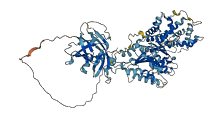
The autoinhibited protein was predicted that may have potential autoinhibitory elements via cis-regPred.
Autoinhibitory domains (AIDs)
Target domain |
|
Relief mechanism |
|
Assay |
cis-regPred |
Accessory elements
No accessory elements
Autoinhibited structure

Activated structure
1 structures for Q9P7Q4
| Entry ID | Method | Resolution | Chain | Position | Source |
|---|---|---|---|---|---|
| AF-Q9P7Q4-F1 | Predicted | AlphaFoldDB |
7 variants for Q9P7Q4
| Variant ID(s) | Position | Change | Description | Diseaes Association | Provenance |
|---|---|---|---|---|---|
| I_4721106_C_T | 4 | R>K | No | Jeffares_SNPs | |
| I_4721066_C_A | 17 | E>D | No | Jeffares_SNPs | |
| I_4721064_T_G | 18 | Q>P | No | Jeffares_SNPs | |
| I_4720081_C_T | 346 | V>I | No | Jeffares_SNPs | |
| I_4719931_C_T | 396 | G>S | No | Jeffares_SNPs | |
| I_4719714_T_C | 468 | N>S | No | Jeffares_SNPs | |
| I_4719712_C_T | 469 | G>S | No | Jeffares_SNPs |
No associated diseases with Q9P7Q4
8 regional properties for Q9P7Q4
| Type | Name | Position | InterPro Accession |
|---|---|---|---|
| domain | CDC48, N-terminal subdomain | 60 - 136 | IPR003338 |
| domain | AAA+ ATPase domain | 303 - 450 | IPR003593-1 |
| domain | AAA+ ATPase domain | 584 - 720 | IPR003593-2 |
| domain | ATPase, AAA-type, core | 307 - 447 | IPR003959-1 |
| domain | ATPase, AAA-type, core | 588 - 717 | IPR003959-2 |
| conserved_site | ATPase, AAA-type, conserved site | 418 - 436 | IPR003960 |
| domain | CDC48, domain 2 | 163 - 235 | IPR004201 |
| domain | AAA ATPase, AAA+ lid domain | 474 - 509 | IPR041569 |
2 GO annotations of cellular component
| Name | Definition |
|---|---|
| cytoplasm | The contents of a cell excluding the plasma membrane and nucleus, but including other subcellular structures. |
| Golgi stack | The set of thin, flattened membrane-bounded compartments, called cisternae, that form the central portion of the Golgi complex. The stack usually comprises cis, medial, and trans cisternae; the cis- and trans-Golgi networks are not considered part of the stack. |
2 GO annotations of molecular function
| Name | Definition |
|---|---|
| ATP binding | Binding to ATP, adenosine 5'-triphosphate, a universally important coenzyme and enzyme regulator. |
| ATP hydrolysis activity | Catalysis of the reaction: ATP + H2O = ADP + H+ phosphate. ATP hydrolysis is used in some reactions as an energy source, for example to catalyze a reaction or drive transport against a concentration gradient. |
6 GO annotations of biological process
| Name | Definition |
|---|---|
| endoplasmic reticulum to Golgi vesicle-mediated transport | The directed movement of substances from the endoplasmic reticulum (ER) to the Golgi, mediated by COP II vesicles. Small COP II coated vesicles form from the ER and then fuse directly with the cis-Golgi. Larger structures are transported along microtubules to the cis-Golgi. |
| Golgi to plasma membrane protein transport | The directed movement of proteins from the Golgi to the plasma membrane in transport vesicles that move from the trans-Golgi network to the plasma membrane. |
| intra-Golgi vesicle-mediated transport | The directed movement of substances within the Golgi, mediated by small transport vesicles. These either fuse with the cis-Golgi or with each other to form the membrane stacks known as the cis-Golgi reticulum (network). |
| intracellular protein transport | The directed movement of proteins in a cell, including the movement of proteins between specific compartments or structures within a cell, such as organelles of a eukaryotic cell. |
| SNARE complex disassembly | The disaggregation of the SNARE protein complex into its constituent components. The SNARE complex is a protein complex involved in membrane fusion; a stable ternary complex consisting of a four-helix bundle, usually formed from one R-SNARE and three Q-SNAREs with an ionic layer sandwiched between hydrophobic layers. |
| vacuole fusion, non-autophagic | The fusion of two vacuole membranes to form a single vacuole. |
No homologous proteins in AiPD
| UniProt AC | Gene Name | Protein Name | Species | Evidence Code |
|---|---|---|---|---|
| No homologous proteins | ||||
| 10 | 20 | 30 | 40 | 50 | 60 |
| MDSRWKLPFM | SNKGTPEQPM | RKPLSGSYSH | NSAGPTPNMS | PFEQKPPLPT | HMDVRRPSGP |
| 70 | 80 | 90 | 100 | 110 | 120 |
| FRIVKATSTE | DALTNCIIVS | PMDFKQQYII | VDNSRVFSTK | PVPGFPQGCL | GASQPHREWA |
| 130 | 140 | 150 | 160 | 170 | 180 |
| SWSLNQQVHV | ADYDPYGPHG | APYLHSMTLE | VDFQNRNRTT | NEPFDGEEMA | KLFCSSYQSQ |
| 190 | 200 | 210 | 220 | 230 | 240 |
| VFSPGQKIVF | DFRSYNIKAT | VRTISCVDLL | IGENQDAENT | ADTSKRGLLT | SQTEIQFFKA |
| 250 | 260 | 270 | 280 | 290 | 300 |
| AHSALRLKAS | MTRPASNAIL | QPGFKFEDMG | IGGLDSEFSA | IFRRAFASRL | FPPGMVEKLG |
| 310 | 320 | 330 | 340 | 350 | 360 |
| INHVKGILLY | GPPGTGKTLI | ARQIGKMLNA | REPKIVNGPE | ILNKYVGQSE | ENVRKLFADA |
| 370 | 380 | 390 | 400 | 410 | 420 |
| EREYRDRGEE | SGLHIIIFDE | LDAICKKRGS | SGGDTGVGDQ | VVNQLLAKMD | GVDQLNNILV |
| 430 | 440 | 450 | 460 | 470 | 480 |
| IGMTNRKDMI | DEALLRPGRL | EVHMEISLPD | EHGRLQILKI | HTSRMASNGI | LENDVDMEEL |
| 490 | 500 | 510 | 520 | 530 | 540 |
| ASLTKNFSGA | EIAGLIKSAS | SFAFYRHIKV | GTTAAVSGNL | ENIKVNRNDF | LNALSEVRPA |
| 550 | 560 | 570 | 580 | 590 | 600 |
| YGVSEEELES | RVQGGIINFG | KHIEEIITEG | KLFVQQVKNS | ERTRLVSVLL | SGPIASGKTA |
| 610 | 620 | 630 | 640 | 650 | 660 |
| LAATIALGSE | FPFVKLVSAE | SMVGMNENAR | VAHVNRVFED | SYKSPLSVIV | VDEIERIIDW |
| 670 | 680 | 690 | 700 | 710 | 720 |
| VPIGPRFSNT | LLQTLMVLFK | KQPPKGHRLL | ILATTSERTM | LSRMDMTQSF | DAEIAVPNVS |
| 730 | 740 | 750 | 760 | 770 | 780 |
| NVTELDRIIQ | SIDSFADSNV | RADTLQRLQN | FTGTDAVNVG | VAKILMIAET | AKQDVDVVSC |
| 790 | |||||
| FVEAMARAIP | ME |