Q9P779
Gene name |
SPBC1711.11 |
Protein name |
Sorting nexin C1711.11 |
Names |
|
Species |
Schizosaccharomyces pombe (strain 972 / ATCC 24843) (Fission yeast) |
KEGG Pathway |
spo:SPBC1711.11 |
EC number |
|
Protein Class |
|
Descriptions
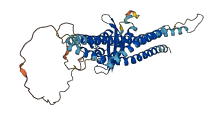
The autoinhibited protein was predicted that may have potential autoinhibitory elements via cis-regPred.
Autoinhibitory domains (AIDs)
Target domain |
|
Relief mechanism |
|
Assay |
cis-regPred |
Accessory elements
No accessory elements
Autoinhibited structure

Activated structure
1 structures for Q9P779
| Entry ID | Method | Resolution | Chain | Position | Source |
|---|---|---|---|---|---|
| AF-Q9P779-F1 | Predicted | AlphaFoldDB |
No variants for Q9P779
| Variant ID(s) | Position | Change | Description | Diseaes Association | Provenance |
|---|---|---|---|---|---|
| No variants for Q9P779 | |||||
No associated diseases with Q9P779
1 regional properties for Q9P779
| Type | Name | Position | InterPro Accession |
|---|---|---|---|
| domain | Phox homology | 1 - 123 | IPR001683 |
8 GO annotations of cellular component
| Name | Definition |
|---|---|
| autophagosome | A double-membrane-bounded compartment that engulfs endogenous cellular material as well as invading microorganisms to target them to the lytic vacuole/lysosome for degradation as part of macroautophagy. |
| cell division site | The eventual plane of cell division (also known as cell cleavage or cytokinesis) in a dividing cell. In Eukaryotes, the cleavage apparatus, composed of septin structures and the actomyosin contractile ring, forms along this plane, and the mitotic, or meiotic, spindle is aligned perpendicular to the division plane. In bacteria, the cell division site is generally located at mid-cell and is the site at which the cytoskeletal structure, the Z-ring, assembles. |
| cytoplasm | The contents of a cell excluding the plasma membrane and nucleus, but including other subcellular structures. |
| cytosol | The part of the cytoplasm that does not contain organelles but which does contain other particulate matter, such as protein complexes. |
| early endosome | A membrane-bounded organelle that receives incoming material from primary endocytic vesicles that have been generated by clathrin-dependent and clathrin-independent endocytosis; vesicles fuse with the early endosome to deliver cargo for sorting into recycling or degradation pathways. |
| membrane | A lipid bilayer along with all the proteins and protein complexes embedded in it an attached to it. |
| nucleus | A membrane-bounded organelle of eukaryotic cells in which chromosomes are housed and replicated. In most cells, the nucleus contains all of the cell's chromosomes except the organellar chromosomes, and is the site of RNA synthesis and processing. In some species, or in specialized cell types, RNA metabolism or DNA replication may be absent. |
| phagophore assembly site | Punctate structures proximal to the endoplasmic reticulum which are the sites where the Atg machinery assembles upon autophagy induction. |
1 GO annotations of molecular function
| Name | Definition |
|---|---|
| phosphatidylinositol-3-phosphate binding | Binding to phosphatidylinositol-3-phosphate, a derivative of phosphatidylinositol in which the inositol ring is phosphorylated at the 3' position. |
6 GO annotations of biological process
| Name | Definition |
|---|---|
| autophagy of mitochondrion | The autophagic process in which mitochondria are delivered to a type of vacuole and degraded in response to changing cellular conditions. |
| endocytic recycling | The directed movement of membrane-bounded vesicles from endosomes back to the plasma membrane, a trafficking pathway that promotes the recycling of internalized transmembrane proteins. |
| piecemeal microautophagy of the nucleus | Degradation of a cell nucleus by lysosomal microautophagy. |
| positive regulation of autophagosome assembly | Any process that activates or increases the frequency, rate or extent of autophagic vacuole assembly. |
| protein transport | The directed movement of proteins into, out of or within a cell, or between cells, by means of some agent such as a transporter or pore. |
| reticulophagy | The selective autohagy process in which parts of the endoplasmic reticulum are loaded into autophagosomes, delivered to the vacuole, and degraded in response to changing cellular conditions. |
No homologous proteins in AiPD
| UniProt AC | Gene Name | Protein Name | Species | Evidence Code |
|---|---|---|---|---|
| No homologous proteins | ||||
| 10 | 20 | 30 | 40 | 50 | 60 |
| MLKCTIKNEQ | IETLRSGDTF | VSYEIETESD | LPVFEDKKFS | VRRRYKDFEM | LHNILSHDYN |
| 70 | 80 | 90 | 100 | 110 | 120 |
| GYAIPPLPRK | YTVSSFSGGS | LSPIFIARRM | QSLQTFLDRC | STHPVISNSM | HMYQFLENNS |
| 130 | 140 | 150 | 160 | 170 | 180 |
| WKSYYHNAWM | QSENTKSKGN | NVSGGIESSI | QNLDPYAQSL | YETAKQLLQN | ADTDLSKLEK |
| 190 | 200 | 210 | 220 | 230 | 240 |
| TCVQYMNSVQ | NFPTDIPVPS | NLSISNLDVV | SVEFKRLKRN | SIFLINSFHS | KVITSIQDLE |
| 250 | 260 | 270 | 280 | 290 | 300 |
| DYMVVFKSLI | KSREQKVKQF | EHFQQIVQSN | SNNPDQSSRS | DPNFVEATPV | VQQTPELKPS |
| 310 | 320 | 330 | 340 | 350 | 360 |
| PNTTIRTSSL | FSIPKFFKKK | RYSLGQDDAN | PMELLQLSFQ | ELCIFNEKLE | QELNFLRERI |
| 370 | 380 | ||||
| DVEMRKTLQM | VCDCHVEYFS | GILEQHAVKE |