Q9P6L2
Gene name |
set13 |
Protein name |
Ribosomal lysine N-methyltransferase 4 |
Names |
SET domain-containing protein 13 |
Species |
Schizosaccharomyces pombe (strain 972 / ATCC 24843) (Fission yeast) |
KEGG Pathway |
spo:SPAC688.14 |
EC number |
|
Protein Class |
|
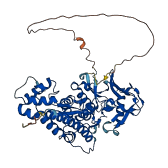
Descriptions
The autoinhibited protein was predicted that may have potential autoinhibitory elements via cis-regPred.
Autoinhibitory domains (AIDs)
Target domain |
|
Relief mechanism |
|
Assay |
cis-regPred |
Accessory elements
No accessory elements
Autoinhibited structure

Activated structure
1 structures for Q9P6L2
| Entry ID | Method | Resolution | Chain | Position | Source |
|---|---|---|---|---|---|
| AF-Q9P6L2-F1 | Predicted | AlphaFoldDB |
7 variants for Q9P6L2
| Variant ID(s) | Position | Change | Description | Diseaes Association | Provenance |
|---|---|---|---|---|---|
| I_3141521_C_T | 20 | T>I | No | Jeffares_SNPs | |
| I_3142132_G_T | 208 | D>Y | No | Jeffares_SNPs | |
| I_3142142_A_G | 211 | K>R | No | Jeffares_SNPs | |
| I_3142202_G_A | 231 | G>D | No | Jeffares_SNPs | |
| I_3142231_G_A | 241 | E>K | No | Jeffares_SNPs | |
| I_3142552_G_A | 326 | V>I | No | Jeffares_SNPs | |
| I_3142899_T_G | 424 | D>E | No | Jeffares_SNPs |
No associated diseases with Q9P6L2
1 GO annotations of cellular component
| Name | Definition |
|---|---|
| nucleus | A membrane-bounded organelle of eukaryotic cells in which chromosomes are housed and replicated. In most cells, the nucleus contains all of the cell's chromosomes except the organellar chromosomes, and is the site of RNA synthesis and processing. In some species, or in specialized cell types, RNA metabolism or DNA replication may be absent. |
1 GO annotations of molecular function
| Name | Definition |
|---|---|
| protein-lysine N-methyltransferase activity | Catalysis of the transfer of a methyl group from S-adenosyl-L-methionine to the epsilon-amino group of a lysine residue in a protein substrate. |
2 GO annotations of biological process
| Name | Definition |
|---|---|
| negative regulation of cytoplasmic translational initiation in response to stress | Any process that stops, prevents or reduces the rate of cytoplasmic translation initiation as a result of a stimulus indicating the organism is under stress. |
| peptidyl-lysine monomethylation | The methylation of peptidyl-lysine to form peptidyl-N6-methyl-L-lysine. |
No homologous proteins in AiPD
| UniProt AC | Gene Name | Protein Name | Species | Evidence Code |
|---|---|---|---|---|
| No homologous proteins | ||||
| 10 | 20 | 30 | 40 | 50 | 60 |
| MLKQAESMLK | WAIEKDNYTT | SEKIGLNDYR | HVHESLGIGF | IALEDIKEDE | KLVSFKKDSV |
| 70 | 80 | 90 | 100 | 110 | 120 |
| LCLTNSDLAQ | LPEVQSLPSW | AALLLVMATE | NASPNSFWRP | YLSIFPTKER | ITSPFYWDEN |
| 130 | 140 | 150 | 160 | 170 | 180 |
| KKDALLRGTV | LESNEDCNEI | TQLWIDRIEP | IIKLYPNRFS | QVSYEDFLRM | SAVMLAYSFD |
| 190 | 200 | 210 | 220 | 230 | 240 |
| IEKTKSPISN | ENEKSAAETS | IKEDKNGDAA | KKNEGSANQD | DEKLHSQSLV | GNNCEVNSED |
| 250 | 260 | 270 | 280 | 290 | 300 |
| EFSDLESEVD | PDELEKAMCP | ISDMFNGDDE | LCNIRLYDIN | GTLTMIATRD | IKKGEQLWNT |
| 310 | 320 | 330 | 340 | 350 | 360 |
| YGELDNSELF | RKYGFTKKKG | TPHDFVLIKK | EHWLPEYIEK | LGFEEVEARL | ELLCREELLY |
| 370 | 380 | 390 | 400 | 410 | 420 |
| NLEGDFTFSK | ADLTFKEICL | AFVLMEKEKE | LISVPSKSDI | KPKHYRKLLK | IIEKRINMYP |
| 430 | 440 | 450 | 460 | ||
| KISDPKNFDE | ENAKTLIEGE | IDILQNLSAK | VKEALTKNRP | KKKQKVDH |