Q9P6J3
Gene name |
mal1 (SPBC1683.07) |
Protein name |
Alpha-glucosidase |
Names |
Maltase |
Species |
Schizosaccharomyces pombe (strain 972 / ATCC 24843) (Fission yeast) |
KEGG Pathway |
spo:SPBC1683.07 |
EC number |
3.2.1.20: Glycosidases, ie enzymes hydrolyzing O- and S-glycosyl compounds |
Protein Class |
|
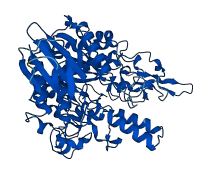
Descriptions
The autoinhibited protein was predicted that may have potential autoinhibitory elements via cis-regPred.
Autoinhibitory domains (AIDs)
Target domain |
|
Relief mechanism |
|
Assay |
cis-regPred |
Accessory elements
No accessory elements
Autoinhibited structure

Activated structure
1 structures for Q9P6J3
| Entry ID | Method | Resolution | Chain | Position | Source |
|---|---|---|---|---|---|
| AF-Q9P6J3-F1 | Predicted | AlphaFoldDB |
No variants for Q9P6J3
| Variant ID(s) | Position | Change | Description | Diseaes Association | Provenance |
|---|---|---|---|---|---|
| No variants for Q9P6J3 | |||||
No associated diseases with Q9P6J3
1 regional properties for Q9P6J3
| Type | Name | Position | InterPro Accession |
|---|---|---|---|
| domain | Glycosyl hydrolase, family 13, catalytic domain | 21 - 440 | IPR006047 |
Functions
| Description | ||
|---|---|---|
| EC Number | 3.2.1.20 | Glycosidases, ie enzymes hydrolyzing O- and S-glycosyl compounds |
| Subcellular Localization |
|
|
| PANTHER Family | ||
| PANTHER Subfamily | ||
| PANTHER Protein Class | ||
| PANTHER Pathway Category | No pathway information available | |
2 GO annotations of cellular component
| Name | Definition |
|---|---|
| cytosol | The part of the cytoplasm that does not contain organelles but which does contain other particulate matter, such as protein complexes. |
| nucleus | A membrane-bounded organelle of eukaryotic cells in which chromosomes are housed and replicated. In most cells, the nucleus contains all of the cell's chromosomes except the organellar chromosomes, and is the site of RNA synthesis and processing. In some species, or in specialized cell types, RNA metabolism or DNA replication may be absent. |
7 GO annotations of molecular function
| Name | Definition |
|---|---|
| alpha-amylase activity | Catalysis of the endohydrolysis of (1->4)-alpha-D-glucosidic linkages in polysaccharides containing three or more alpha-(1->4)-linked D-glucose units. |
| dextrin alpha-glucosidase activity | Catalysis of the reaction: dextrin + H2O = alpha-D-glucose. |
| glucan 1,4-alpha-maltotriohydrolase activity | Catalysis of the hydrolysis of (1->4)-alpha-D-glucosidic linkages in amylaceous polysaccharides, to remove successive maltotriose residues from the non-reducing chain ends. |
| maltose alpha-glucosidase activity | Catalysis of the reaction: alpha-maltose + H2O = 2 alpha-D-glucose. |
| oligo-1,6-glucosidase activity | Catalysis of the hydrolysis of (1->6)-alpha-D-glucosidic linkages in some oligosaccharides produced from starch and glycogen by alpha-amylase, and in isomaltose. Releases a free alpha-D-glucose. |
| starch alpha-glucosidase activity | Catalysis of the reaction: starch + H2O = alpha-D-glucose. |
| sucrose alpha-glucosidase activity | Catalysis of the reaction: sucrose + H2O = alpha-D-glucose + beta-D-fructose. |
4 GO annotations of biological process
| Name | Definition |
|---|---|
| cellular polysaccharide catabolic process | The chemical reactions and pathways resulting in the breakdown of polysaccharides, polymers of many (typically more than 10) monosaccharide residues linked glycosidically, as carried out by individual cells. |
| maltose catabolic process | The chemical reactions and pathways resulting in the breakdown of the disaccharide maltose (4-O-alpha-D-glucopyranosyl-D-glucopyranose). |
| oligosaccharide catabolic process | The chemical reactions and pathways resulting in the breakdown of oligosaccharides, molecules with between two and (about) 20 monosaccharide residues connected by glycosidic linkages. |
| sucrose catabolic process | The chemical reactions and pathways resulting in the breakdown of sucrose, the disaccharide fructofuranosyl-glucopyranoside. |
No homologous proteins in AiPD
| UniProt AC | Gene Name | Protein Name | Species | Evidence Code |
|---|---|---|---|---|
| No homologous proteins | ||||
| 10 | 20 | 30 | 40 | 50 | 60 |
| MKVVPSEKIK | PNWWRETSVY | QIYPASFKDS | NGDGFGDLEG | IISKVDYLKA | LNVESIWLCP |
| 70 | 80 | 90 | 100 | 110 | 120 |
| IYPSPLKDMG | YDVSDYKQID | SRYGTLEDLD | RLMKALHERD | MKLVMDLVLN | HTSDQHEWFK |
| 130 | 140 | 150 | 160 | 170 | 180 |
| ESRSSKTNPK | RDWYFWKPAR | YNEKGERLPP | NNWRSYFDTS | AWEWDEATQE | YYLHLWSVGQ |
| 190 | 200 | 210 | 220 | 230 | 240 |
| PDLNWETPKV | REAVHDILRF | WLDRGVDGFR | LDAINMISKD | QRFLDAPITD | DRYEYQLAYQ |
| 250 | 260 | 270 | 280 | 290 | 300 |
| YYANGPRIHE | YLNGIGNILT | EYDAFSVGEM | PYVLDTNEIL | HVVGADRREL | TMIFQFDFVD |
| 310 | 320 | 330 | 340 | 350 | 360 |
| LDLDPNQHKY | IEGSWELSDL | KKSLKKWQSA | LLSGGGWNAS | FIENHDQTRT | VSRYLSDSPK |
| 370 | 380 | 390 | 400 | 410 | 420 |
| YRAYSSKLMA | LFIIFQSGTP | FVFQGQELAL | ANIPRDWPID | EYLDVETQNF | WKLFMSGNPS |
| 430 | 440 | 450 | 460 | 470 | 480 |
| QEEIEKTMDI | VNKRARDNGR | TPMHWDSSPN | GGFTKAGVKP | WMRVTNDYKE | WNAANQVNDP |
| 490 | 500 | 510 | 520 | 530 | 540 |
| ESPYTFWSKA | LELRKELKDA | VVYGSFELIS | EEDPSIVAFV | RESSTYKLII | LLNFTGNKVS |
| 550 | 560 | 570 | |||
| YDCPLNLTSY | EILLDNYKDF | ICMTSPVTLN | PYQAVLLKL |