Q9P3W4
Gene name |
dil1 (SPAC458.04c) |
Protein name |
Dynein intermediate light chain dil1 |
Names |
|
Species |
Schizosaccharomyces pombe (strain 972 / ATCC 24843) (Fission yeast) |
KEGG Pathway |
spo:SPAC458.04c |
EC number |
|
Protein Class |
|
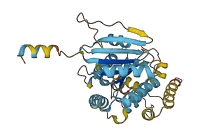
Descriptions
The autoinhibited protein was predicted that may have potential autoinhibitory elements via cis-regPred.
Autoinhibitory domains (AIDs)
Target domain |
|
Relief mechanism |
|
Assay |
cis-regPred |
Accessory elements
No accessory elements
Autoinhibited structure

Activated structure
1 structures for Q9P3W4
| Entry ID | Method | Resolution | Chain | Position | Source |
|---|---|---|---|---|---|
| AF-Q9P3W4-F1 | Predicted | AlphaFoldDB |
5 variants for Q9P3W4
| Variant ID(s) | Position | Change | Description | Diseaes Association | Provenance |
|---|---|---|---|---|---|
| I_4738841_A_G | 5 | L>S | No | Jeffares_SNPs | |
| I_4738669_A_C | 50 | S>A | No | Jeffares_SNPs | |
| I_4738533_T_A | 81 | H>L | No | Jeffares_SNPs | |
| I_4737940_T_C | 250 | I>V | No | Jeffares_SNPs | |
| I_4737749_T_C | 313 | I>M | No | Jeffares_SNPs |
No associated diseases with Q9P3W4
No regional properties for Q9P3W4
| Type | Name | Position | InterPro Accession |
|---|---|---|---|
| No domain, repeats, and functional sites for Q9P3W4 | |||
Functions
9 GO annotations of cellular component
| Name | Definition |
|---|---|
| cell cortex | The region of a cell that lies just beneath the plasma membrane and often, but not always, contains a network of actin filaments and associated proteins. |
| cortical microtubule cytoskeleton | The portion of the microtubule cytoskeleton that lies just beneath the plasma membrane. |
| cortical microtubule plus-end | The plus-end of a cortical microtubule. |
| cytoplasm | The contents of a cell excluding the plasma membrane and nucleus, but including other subcellular structures. |
| cytoplasmic dynein complex | Any dynein complex with a homodimeric dynein heavy chain core that catalyzes movement along a microtubule. Cytoplasmic dynein complexes participate in many cytoplasmic transport activities in eukaryotes, such as mRNA localization, intermediate filament transport, nuclear envelope breakdown, apoptosis, transport of centrosomal proteins, mitotic spindle assembly, virus transport, kinetochore functions, and movement of signaling and spindle checkpoint proteins. Some complexes participate in intraflagellar transport. Subunits associated with the dynein heavy chain mediate association between dynein heavy chain and cargoes, and may include light chains and light intermediate chains. |
| cytosol | The part of the cytoplasm that does not contain organelles but which does contain other particulate matter, such as protein complexes. |
| meiotic spindle pole body | The microtubule organizing center that forms as part of the meiotic cell cycle; functionally homologous to the animal cell centrosome. |
| microtubule cytoskeleton | The part of the cytoskeleton (the internal framework of a cell) composed of microtubules and associated proteins. |
| nucleus leading edge | The area of a motile nucleus closest to the direction of movement. |
1 GO annotations of molecular function
| Name | Definition |
|---|---|
| dynein heavy chain binding | Binding to a heavy chain of the dynein complex. |
3 GO annotations of biological process
| Name | Definition |
|---|---|
| dynein-driven meiotic oscillatory nuclear movement | Oscillatory movement of the nucleus involved in meiosis I. This oscillatory movement is led by an astral microtubule array emanating from the spindle pole body, and driven by the microtubule motor cytoplasmic dynein. |
| microtubule cytoskeleton organization | A process that is carried out at the cellular level which results in the assembly, arrangement of constituent parts, or disassembly of cytoskeletal structures comprising microtubules and their associated proteins. |
| microtubule-based movement | A microtubule-based process that results in the movement of organelles, other microtubules, or other cellular components. Examples include motor-driven movement along microtubules and movement driven by polymerization or depolymerization of microtubules. |
No homologous proteins in AiPD
| UniProt AC | Gene Name | Protein Name | Species | Evidence Code |
|---|---|---|---|---|
| No homologous proteins | ||||
| 10 | 20 | 30 | 40 | 50 | 60 |
| MDELLEKLLN | DLKKKEPKAC | SIICIGEDLD | IIQCMNEHGC | FSGGSYSELS | NDCETVNFRG |
| 70 | 80 | 90 | 100 | 110 | 120 |
| IAYKCFFTKD | QVKVNFWQIS | HLTGGLFNFL | VSQALNEHGL | DLLWIIMVVA | QTLSALVSFP |
| 130 | 140 | 150 | 160 | 170 | 180 |
| EKLLNILRNM | KTILINTEET | VRNRFEESQN | KKLVALLDKN | STTLDISSGI | LLNFTVVLKQ |
| 190 | 200 | 210 | 220 | 230 | 240 |
| LKHALGLHTS | VDNSQEFILQ | FLRTTLLSVP | TSSIVSISAD | PTSWNNLNVL | MKYNFMFQKF |
| 250 | 260 | 270 | 280 | 290 | 300 |
| KPRDFHAQTI | QSETMFIPPC | WDTISKIQSV | NHEFNIALFK | QTAKNFYDTL | DISLLLGLFD |
| 310 | 320 | 330 | 340 | 350 | |
| KSISMLNCHS | SKISDGDIPY | KSHQVFLQEL | QNKYSEIKTY | SSNKLNKSSI | KSSLWKDLIQ |