Q9NES8
Gene name |
pph-5 |
Protein name |
Serine/threonine-protein phosphatase 5 |
Names |
|
Species |
Homo sapiens (Human) |
KEGG Pathway |
|
EC number |
2.7.11.12: Protein-serine/threonine kinases |
Protein Class |
|
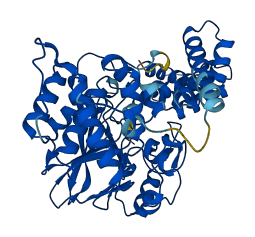
Descriptions
The autoinhibited protein was predicted that may have potential autoinhibitory elements via cis-regPred.
Autoinhibitory domains (AIDs)
Target domain |
156-495 (Phosphatase domain) |
Relief mechanism |
Partner binding |
Assay |
Structural analysis |
Accessory elements
No accessory elements
References
- Haslbeck V et al. (2015) "The activity of protein phosphatase 5 towards native clients is modulated by the middle- and C-terminal domains of Hsp90", Scientific reports, 5, 17058
- Chen MX et al. (1997) "Activation of protein phosphatase 5 by limited proteolysis or the binding of polyunsaturated fatty acids to the TPR domain", FEBS letters, 400, 136-40
Autoinhibited structure

Activated structure
1 structures for Q9NES8
| Entry ID | Method | Resolution | Chain | Position | Source |
|---|---|---|---|---|---|
| AF-Q9NES8-F1 | Predicted | AlphaFoldDB |
No variants for Q9NES8
| Variant ID(s) | Position | Change | Description | Diseaes Association | Provenance |
|---|---|---|---|---|---|
| No variants for Q9NES8 | |||||
2 associated diseases with Q9NES8
[MIM: 619638]: Spondylometaphyseal dysplasia, Pagnamenta type (SMDP)
A form of spondylometaphyseal dysplasia, a group of short stature disorders distinguished by abnormalities in the vertebrae and the metaphyses of the tubular bones. SMDP is an autosomal recessive form characterized by short stature and mild platyspondyly with no disproportion between the limbs. Mild metaphyseal changes are present. {ECO:0000269|PubMed:34782440}. Note=The disease is caused by variants affecting the gene represented in this entry.
[MIM: 619636]: Acromesomelic dysplasia 4 (AMD4)
A form of acromesomelic dysplasia, a skeletal disorder characterized by short stature, very short limbs and hand/foot malformations. The severity of limb abnormalities increases from proximal to distal with profoundly affected hands and feet showing brachydactyly and/or rudimentary fingers (knob-like fingers). AMD4 radiographic hallmarks include mild to moderate platyspondyly, moderate brachydactyly, iliac flaring, and metaphyseal alterations of the long bones that progressively increase with age. AMD4 inheritance is autosomal recessive. {ECO:0000269|PubMed:33106379, ECO:0000269|PubMed:34782440}. Note=The disease is caused by variants affecting the gene represented in this entry.
Without disease ID
- A form of spondylometaphyseal dysplasia, a group of short stature disorders distinguished by abnormalities in the vertebrae and the metaphyses of the tubular bones. SMDP is an autosomal recessive form characterized by short stature and mild platyspondyly with no disproportion between the limbs. Mild metaphyseal changes are present. {ECO:0000269|PubMed:34782440}. Note=The disease is caused by variants affecting the gene represented in this entry.
- A form of acromesomelic dysplasia, a skeletal disorder characterized by short stature, very short limbs and hand/foot malformations. The severity of limb abnormalities increases from proximal to distal with profoundly affected hands and feet showing brachydactyly and/or rudimentary fingers (knob-like fingers). AMD4 radiographic hallmarks include mild to moderate platyspondyly, moderate brachydactyly, iliac flaring, and metaphyseal alterations of the long bones that progressively increase with age. AMD4 inheritance is autosomal recessive. {ECO:0000269|PubMed:33106379, ECO:0000269|PubMed:34782440}. Note=The disease is caused by variants affecting the gene represented in this entry.
7 regional properties for Q9NES8
| Type | Name | Position | InterPro Accession |
|---|---|---|---|
| domain | EF-hand domain | 199 - 230 | IPR002048 |
| domain | FAD-binding 8 | 556 - 683 | IPR013112 |
| domain | Ferric reductase, NAD binding domain | 690 - 869 | IPR013121 |
| domain | Ferric reductase transmembrane component-like domain | 356 - 512 | IPR013130 |
| domain | NADPH oxidase Respiratory burst | 96 - 197 | IPR013623 |
| domain | FAD-binding domain, ferredoxin reductase-type | 552 - 686 | IPR017927 |
| binding_site | EF-Hand 1, calcium-binding site | 208 - 220 | IPR018247 |
Functions
| Description | ||
|---|---|---|
| EC Number | 2.7.11.12 | Protein-serine/threonine kinases |
| Subcellular Localization |
|
|
| PANTHER Family | ||
| PANTHER Subfamily | ||
| PANTHER Protein Class | ||
| PANTHER Pathway Category | No pathway information available | |
5 GO annotations of cellular component
| Name | Definition |
|---|---|
| cytoplasm | The contents of a cell excluding the plasma membrane and nucleus, but including other subcellular structures. |
| cytosol | The part of the cytoplasm that does not contain organelles but which does contain other particulate matter, such as protein complexes. |
| mitotic spindle | A spindle that forms as part of mitosis. Mitotic and meiotic spindles contain distinctive complements of proteins associated with microtubules. |
| nucleus | A membrane-bounded organelle of eukaryotic cells in which chromosomes are housed and replicated. In most cells, the nucleus contains all of the cell's chromosomes except the organellar chromosomes, and is the site of RNA synthesis and processing. In some species, or in specialized cell types, RNA metabolism or DNA replication may be absent. |
| protein-containing complex | A stable assembly of two or more macromolecules, i.e. proteins, nucleic acids, carbohydrates or lipids, in which at least one component is a protein and the constituent parts function together. |
4 GO annotations of molecular function
| Name | Definition |
|---|---|
| Hsp90 protein binding | Binding to Hsp90 proteins, any of a group of heat shock proteins around 90kDa in size. |
| metal ion binding | Binding to a metal ion. |
| phosphoprotein phosphatase activity | Catalysis of the reaction: a phosphoprotein + H2O = a protein + phosphate. Together with protein kinases, these enzymes control the state of phosphorylation of cellular proteins and thereby provide an important mechanism for regulating cellular activity. |
| protein serine/threonine phosphatase activity | Catalysis of the reaction: protein serine phosphate + H2O = protein serine + phosphate, and protein threonine phosphate + H2O = protein threonine + phosphate. |
2 GO annotations of biological process
| Name | Definition |
|---|---|
| negative regulation of exocytosis | Any process that stops, prevents, or reduces the frequency, rate or extent of exocytosis. |
| protein localization to organelle | A process in which a protein is transported to, or maintained in, a location within an organelle. |
6 homologous proteins in AiPD
| UniProt AC | Gene Name | Protein Name | Species | Evidence Code |
|---|---|---|---|---|
| P53043 | PPT1 | Serine/threonine-protein phosphatase T | Saccharomyces cerevisiae (strain ATCC 204508 / S288c) (Baker's yeast) | SS |
| P53041 | PPP5C | Serine/threonine-protein phosphatase 5 | Homo sapiens (Human) | EV |
| Q60676 | Ppp5c | Serine/threonine-protein phosphatase 5 | Mus musculus (Mouse) | SS |
| P53042 | Ppp5c | Serine/threonine-protein phosphatase 5 | Rattus norvegicus (Rat) | EV |
| Q84XU2 | PAPP5 | Serine/threonine-protein phosphatase 5 | Arabidopsis thaliana (Mouse-ear cress) | SS |
| Q84K11 | PP5 | Serine/threonine-protein phosphatase 5 | Solanum lycopersicum (Tomato) (Lycopersicon esculentum) | PR |
| 10 | 20 | 30 | 40 | 50 | 60 |
| MGNGSVKPKH | SKHPDGHSGN | LTTDALRNKV | TELERELRRK | DAEIQEREYH | LKELREQLSK |
| 70 | 80 | 90 | 100 | 110 | 120 |
| QTVAIAELTE | ELQNKCIQLN | KLQDVVHMQG | GSPLQASPDK | VPLEVHRKTS | GLVSLHSRRG |
| 130 | 140 | 150 | 160 | 170 | 180 |
| AKAGVSAEPT | TRTYDLNKPP | EFSFEKARVR | KDSSEKKLIT | DALNKNQFLK | RLDPQQIKDM |
| 190 | 200 | 210 | 220 | 230 | 240 |
| VECMYGRNYQ | QGSYIIKQGE | PGNHIFVLAE | GRLEVFQGEK | LLSSIPMWTT | FGELAILYNC |
| 250 | 260 | 270 | 280 | 290 | 300 |
| TRTASVKAIT | NVKTWALDRE | VFQNIMRRTA | QARDEQYRNF | LRSVSLLKNL | PEDKLTKIID |
| 310 | 320 | 330 | 340 | 350 | 360 |
| CLEVEYYDKG | DYIIREGEEG | STFFILAKGK | VKVTQSTEGH | DQPQLIKTLQ | KGEYFGEKAL |
| 370 | 380 | 390 | 400 | 410 | 420 |
| ISDDVRSANI | IAEENDVACL | VIDRETFNQT | VGTFEELQKY | LEGYVANLNR | DDEKRHAKRS |
| 430 | 440 | 450 | 460 | 470 | 480 |
| MSNWKLSKAL | SLEMIQLKEK | VARFSSSSPF | QNLEIIATLG | VGGFGRVELV | KVKNENVAFA |
| 490 | 500 | 510 | 520 | 530 | 540 |
| MKCIRKKHIV | DTKQQEHVYS | EKRILEELCS | PFIVKLYRTF | KDNKYVYMLL | EACLGGELWS |
| 550 | 560 | 570 | 580 | 590 | 600 |
| ILRDRGSFDE | PTSKFCVACV | TEAFDYLHRL | GIIYRDLKPE | NLILDAEGYL | KLVDFGFAKK |
| 610 | 620 | 630 | 640 | 650 | 660 |
| IGSGQKTWTF | CGTPEYVAPE | VILNKGHDFS | VDFWSLGILV | YELLTGNPPF | SGVDQMMTYN |
| 670 | 680 | 690 | 700 | 710 | 720 |
| LILKGIEKMD | FPRKITRRPE | DLIRRLCRQN | PTERLGNLKN | GINDIKKHRW | LNGFNWEGLK |
| 730 | 740 | 750 | 760 | ||
| ARSLPSPLQR | ELKGPIDHSY | FDKYPPEKGM | PPDELSGWDK | DF |